Review Eversolo Z10
Eversolo made a significant impact on the hi-fi streaming market with the launch of its DMP-A6, challenging established brands with strong value for money. Since then, the company has continued to develop and refine its line-up, strengthening its position in the high-end market. At High End Vienna, we saw just how much Eversolo’s portfolio had grown, reaching well beyond streaming. There’s even a C10 master clock on its way.
The T10 left a strong impression in our recent review and set high expectations for the DAC-Z10. The Z8 was already an impressive DAC built around ESS’s ES9038PRO. With the Z10, Eversolo takes a different approach using a dual-mono AKM design and a fully balanced analogue preamp.
The Z10 arrived with our curiosity and expectations already high. Let’s get started and explore what Eversolo’s latest DAC has to offer.
Design and build quality
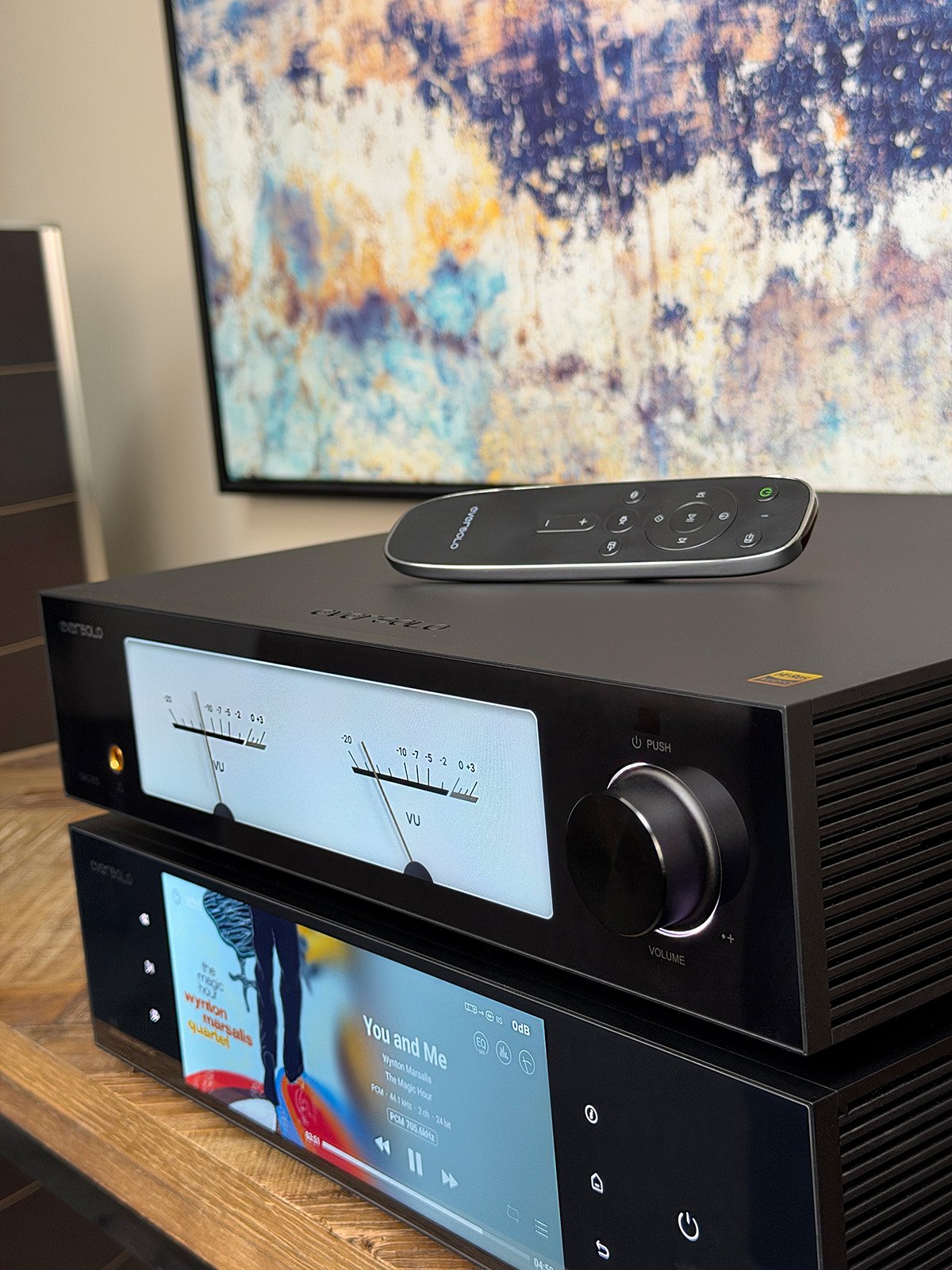
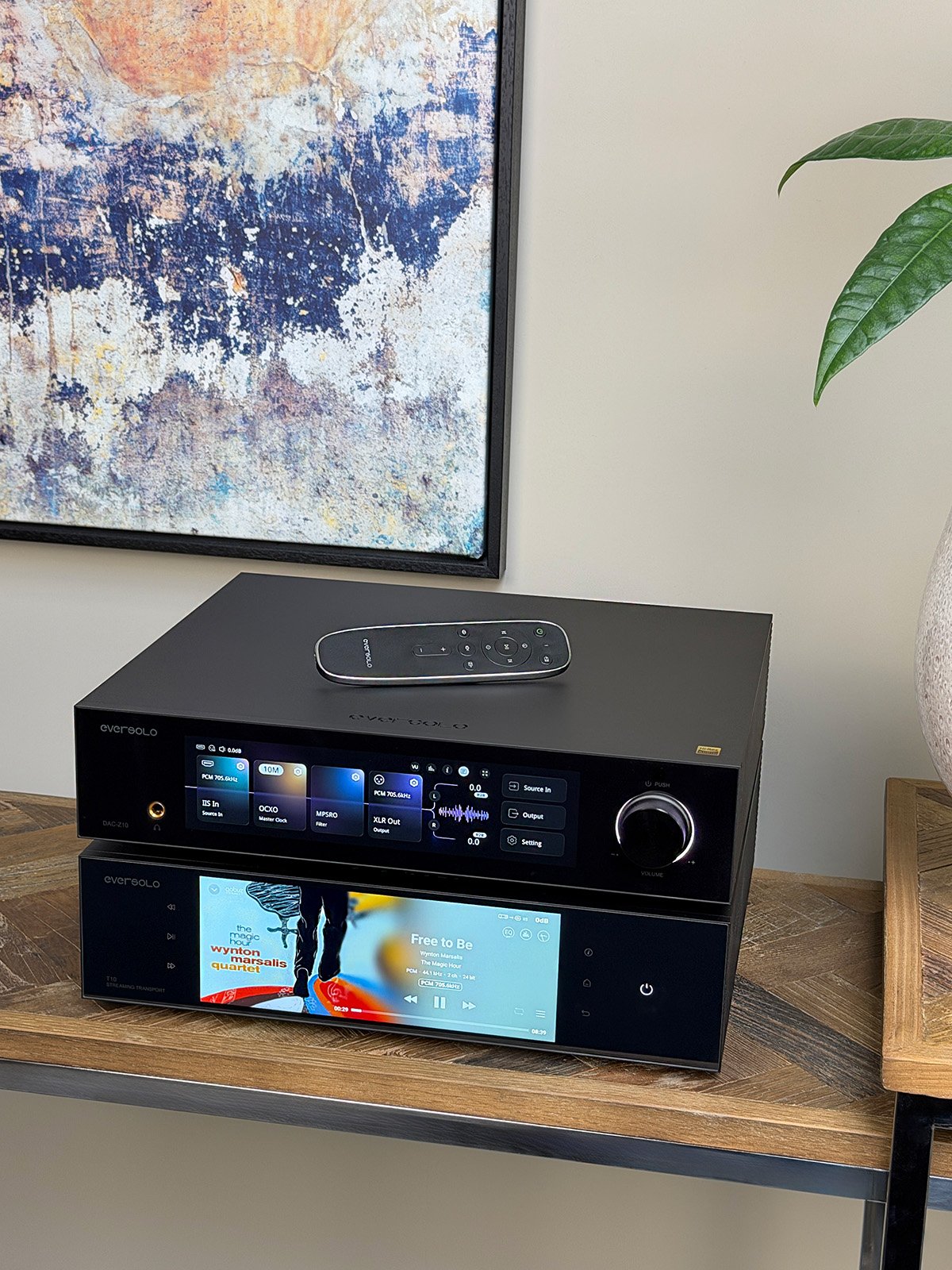
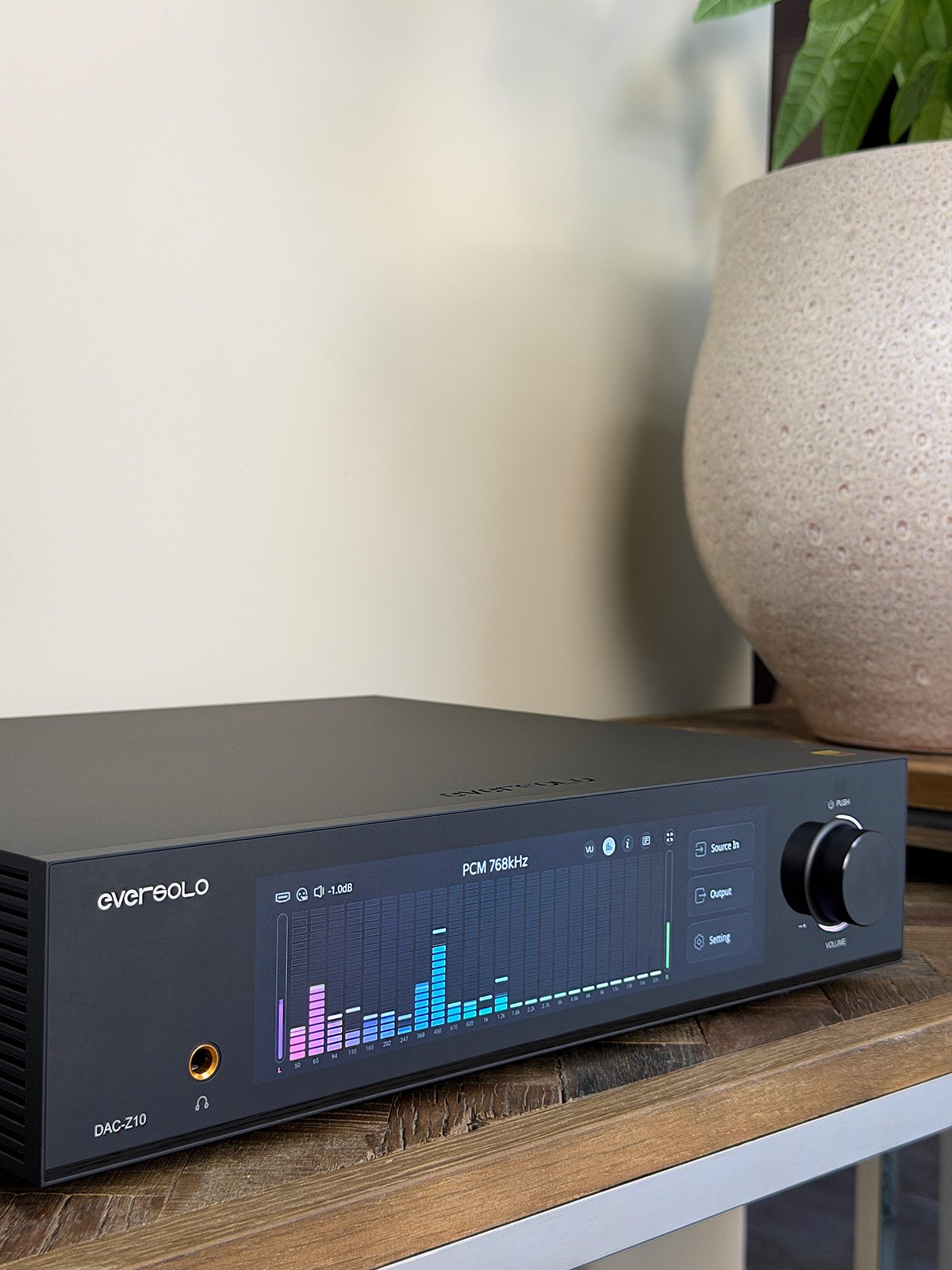
The Z10 looks great with its black aluminium chassis, large touchscreen and illuminated volume control. It also looks right at home next to the T10, as both share the same design. Build quality is excellent, with a solid chassis, quality materials and a volume knob that feels firm and precise. The supplied remote is the same as that included with the T8 and T10. It is a more premium version of the standard remote, with metal detailing and a more refined finish.
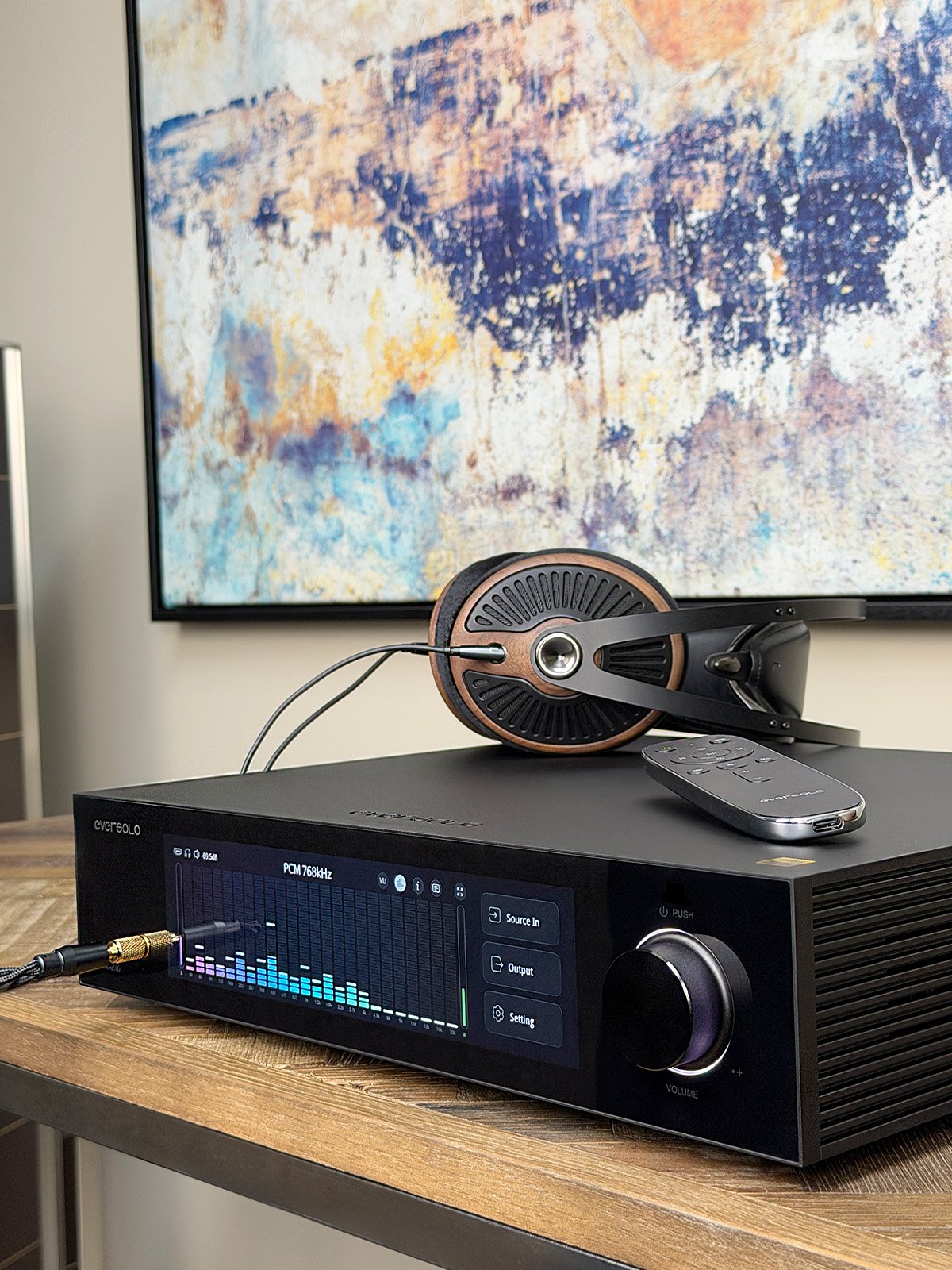
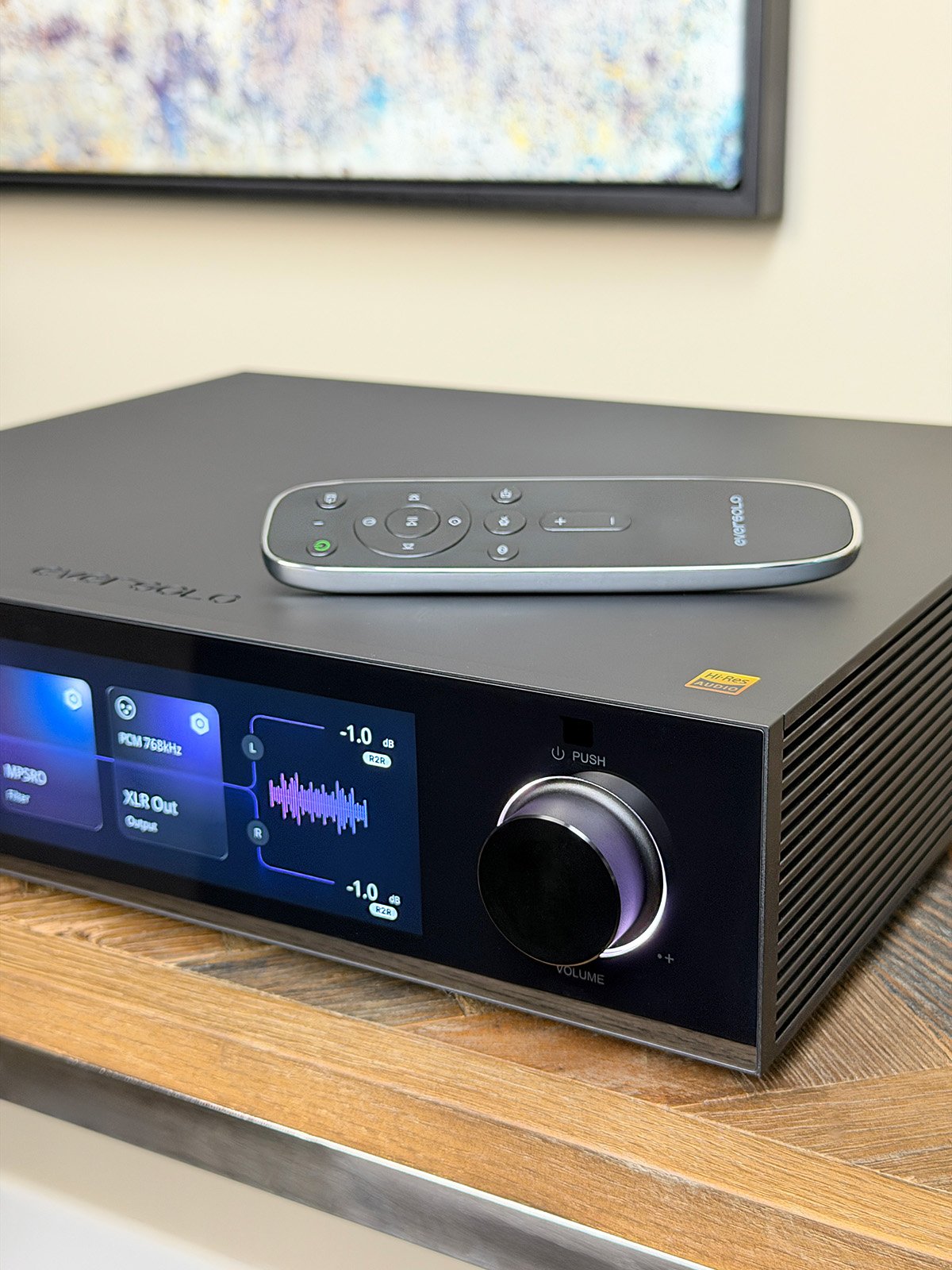
The 8.8-inch touchscreen occupies most of the front panel, with the volume control to its right. The choice of VU meters and spectrum analysers makes good use of that generous display. You can even adjust the colour and brightness of the illuminated ring around the volume knob to suit your preference. A 6.35mm headphone socket completes the front panel.
The routing display is also very useful. It brings the selected input, clock, filter and output settings together in one view, making it easy to check the configuration when trying different options.
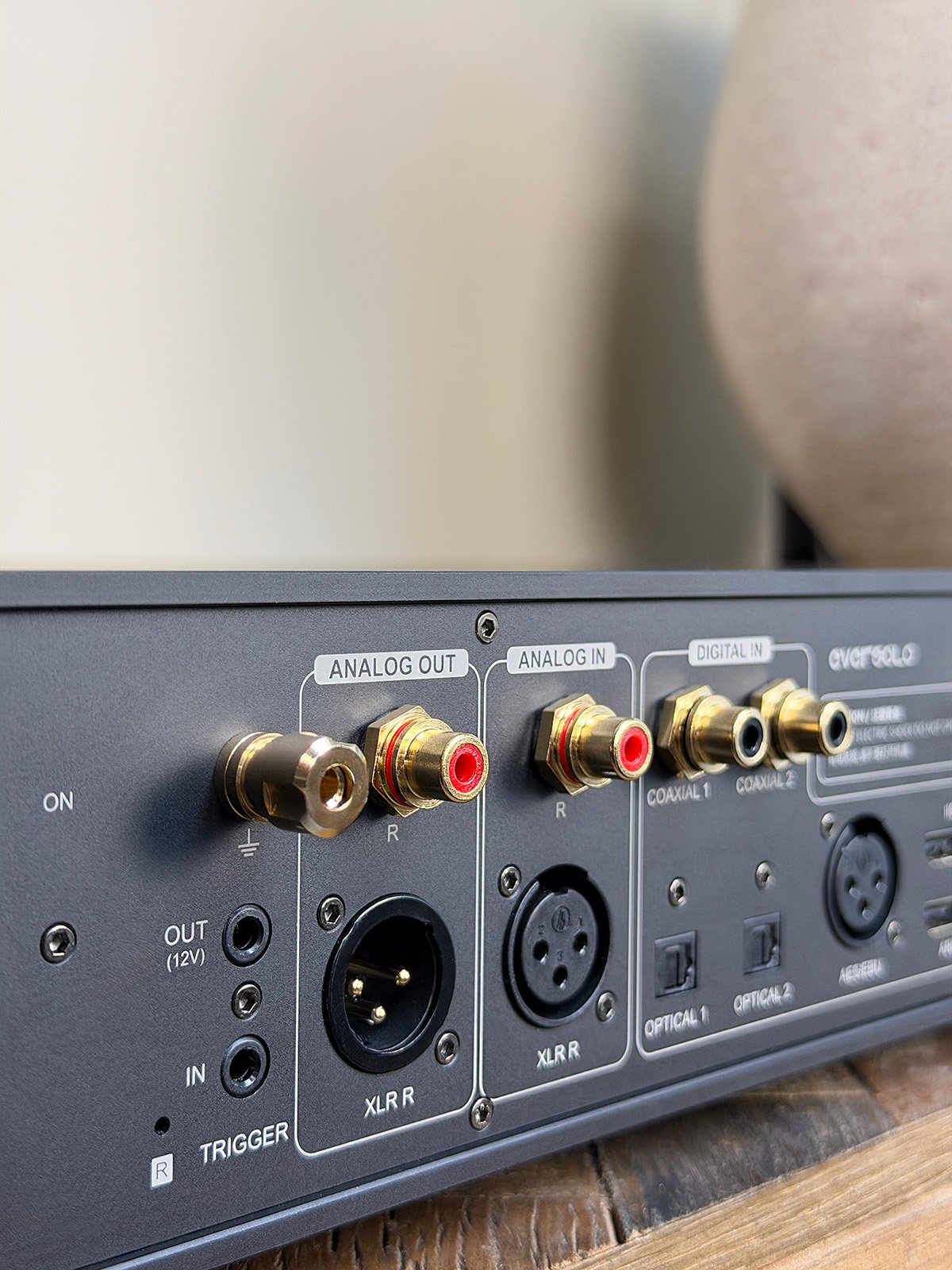
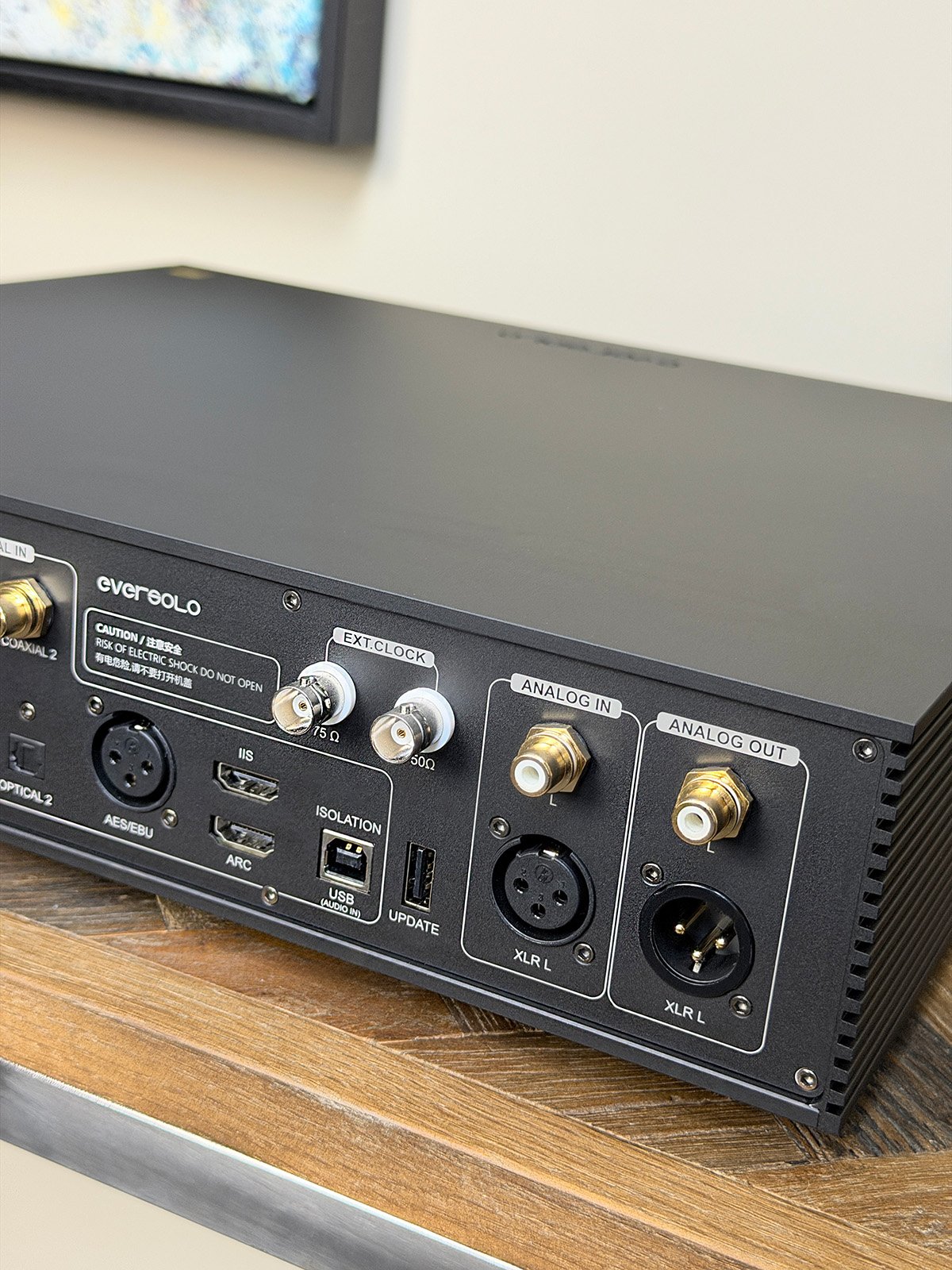
There is an equally good selection of connections around the back. USB-B and AES/EBU sit alongside two optical and two coaxial inputs, while HDMI ARC accommodates a television. The dedicated I²S input is a valuable addition for anyone using a compatible digital transport such as the T10. Eversolo provides eight selectable pin configurations. That is a thoughtful inclusion, making it easier to use the connection with transports from different manufacturers.
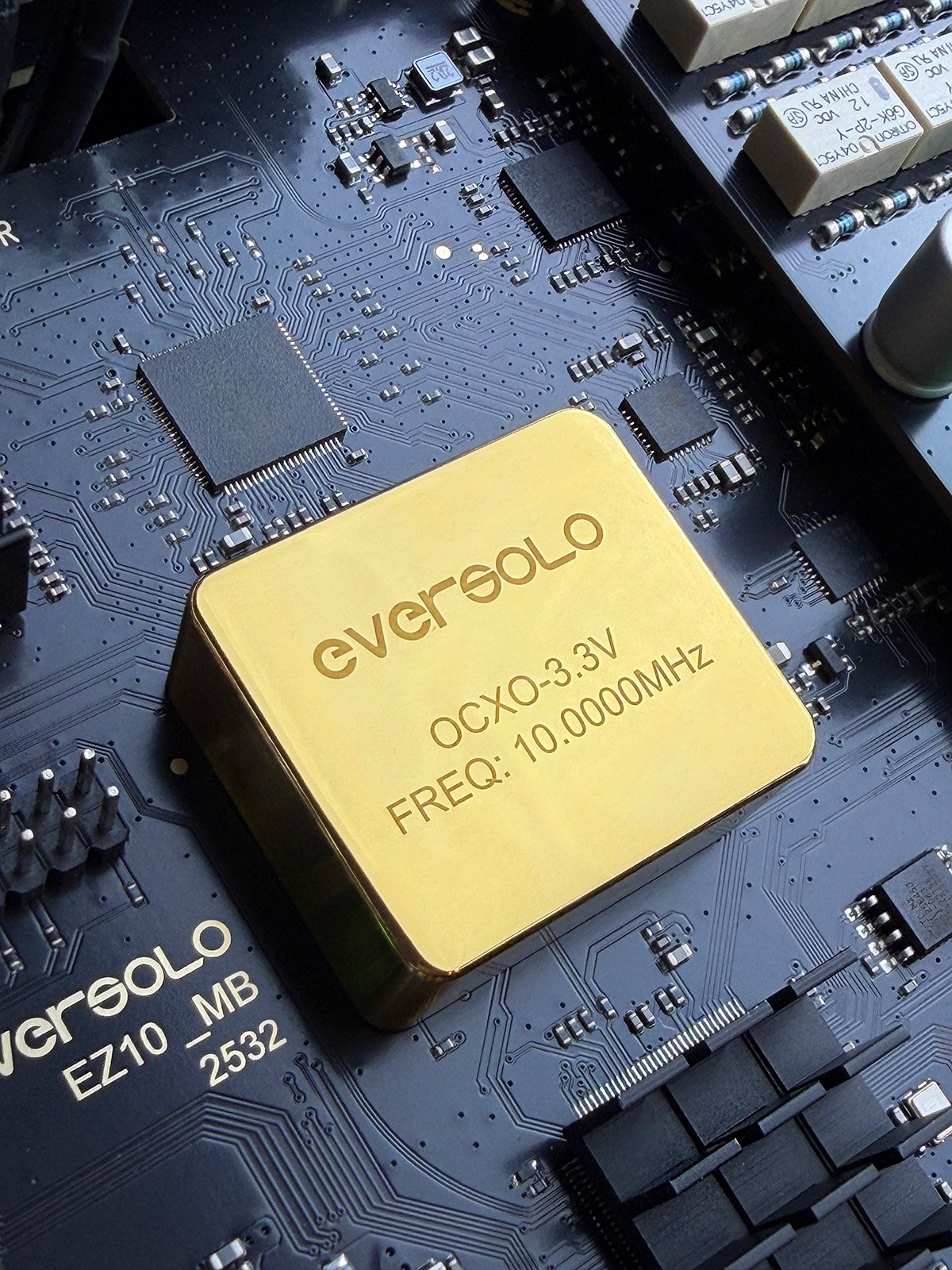
The external clock inputs add another interesting possibility, particularly with Eversolo’s C10 master clock on the way. The Z10 accepts 10MHz or 25MHz reference signals with 50Ω or 75Ω impedance options, allowing it to work with clocks from other manufacturers too. There is already a high-quality OCXO-based clock on board, but the C10 gives us a good reason to return to this feature when it arrives.
Both XLR and RCA analogue inputs and outputs are provided. A particular strength of the Z10 is that incoming analogue signals remain analogue throughout the preamp and volume-control stages. Where some DAC/preamps digitise their analogue inputs, the Z10 avoids that additional conversion altogether. This is a significant advantage for those who want to preserve an entirely analogue signal path while using the same preamplifier for digital sources. The Z10 can also connect directly to a power amplifier or active speakers.
Technology and architecture
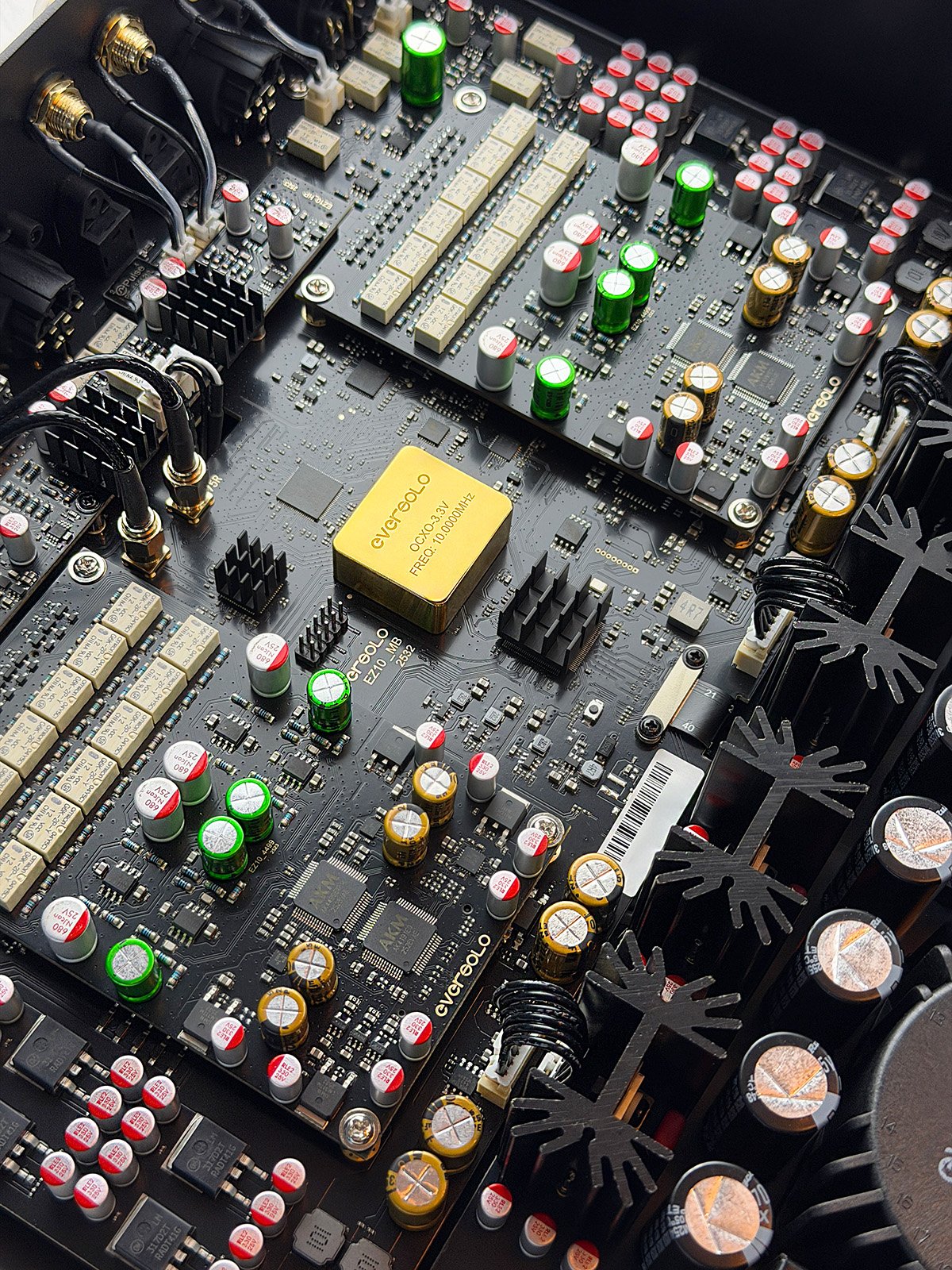
Inside the Z10, Eversolo uses three independent linear power supplies, each built around its own toroidal transformer, to separately power the left channel, right channel and system circuitry. This arrangement is intended to reduce interference between these sections and forms part of the company’s Fully Isolated Architecture (FIA), which also isolates the digital and analogue domains.
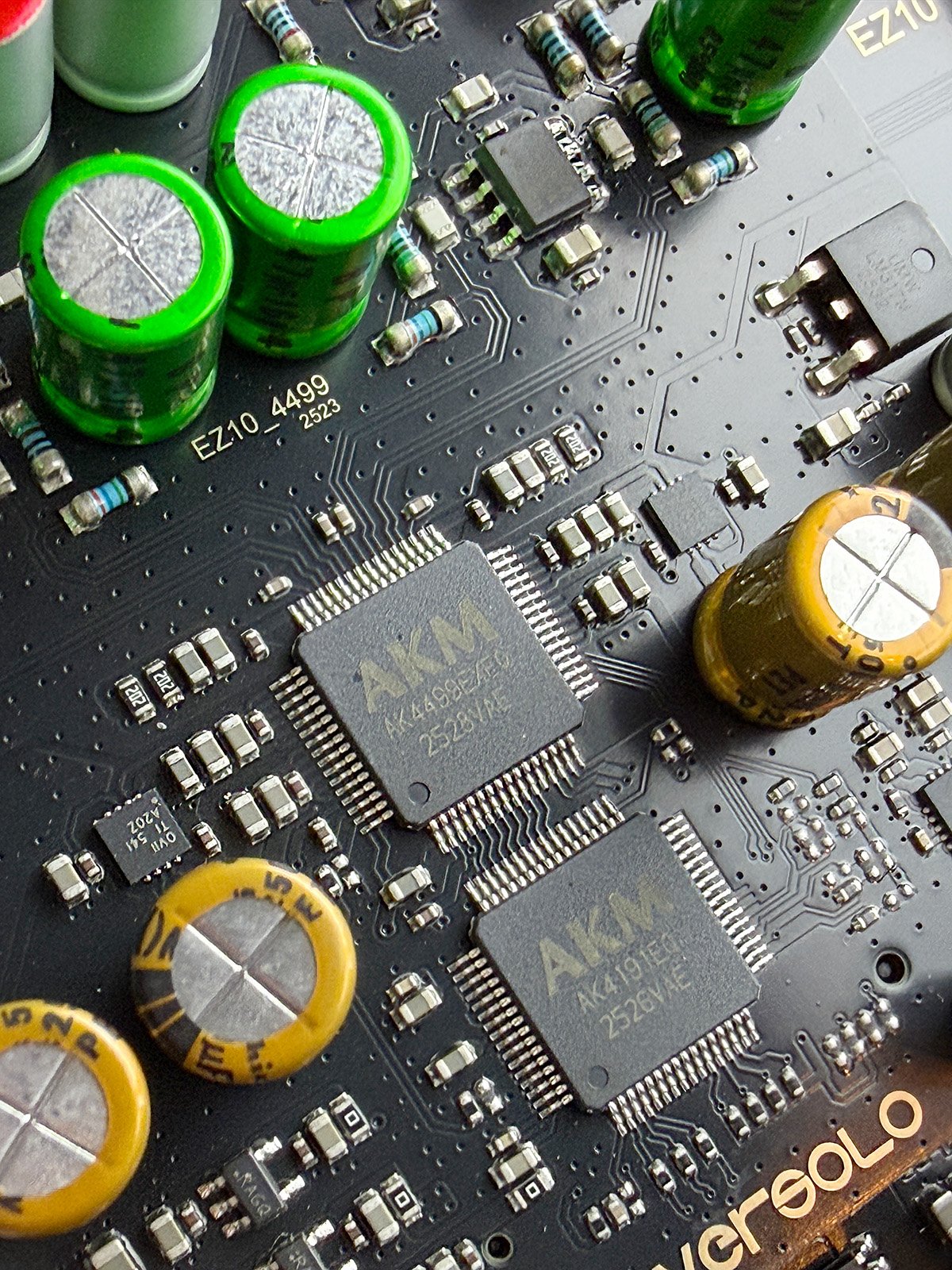
The same approach extends to the DAC section, where each channel has its own dedicated conversion stage built around an AK4191EQ and AK4499EX. Together with the separate channel supplies, this forms a dual-mono design.
The analogue signal path is fully balanced, including the preamplifier stage. For volume control, Eversolo uses an analogue R2R resistor network with an independent module for each channel, adjusting the level after D/A conversion.
To reduce interference from connected sources, the USB, I²S, coaxial and AES/EBU inputs feature electrical isolation. The I²S implementation separates both signal and ground between devices, while the USB input is designed to limit electrical noise and ground-loop interference.
The Z10 features Eversolo’s Precision Core clock system, built around an OCXO (Oven-Controlled Crystal Oscillator). Unlike conventional crystal oscillators, an OCXO maintains a stable operating temperature to minimise frequency drift. Combined with PLL technology and FPGA-based clock processing, the system is designed to provide a stable timing reference and reduce jitter. The Z10 also supports external 10MHz and 25MHz master clocks.
Taken together, these design choices show Eversolo’s careful attention to channel separation, power supply isolation and noise control throughout the Z10.
Interface and software
The Z10 can be controlled through its touchscreen, supplied remote or Eversolo Control app. Unlike Eversolo’s streamers, the Z10 uses Bluetooth rather than a network connection for app control. The app lets you select inputs, adjust the volume and change settings, but does not support switching the unit on or off.
There is plenty of flexibility in the settings, including channel balance, XLR polarity, digital filters and volume behaviour. The volume limit and default startup level settings provide useful safeguards when using the Z10 as a preamplifier.
The analogue volume control produces audible relay clicks when adjusting the level. This is normal for this type of resistor-based volume control, although some listeners may find it a little distracting.
Firmware updates are downloaded from Eversolo’s website and installed using a USB stick through the dedicated update port.
Specs
-
Architecture: Fully balanced design with Eversolo Fully Isolated Architecture (FIA)
-
DAC configuration: Dual-mono AKM design with a dedicated AK4191EQ + AK4499EX pair for each channel
-
Power supplies: Three independent linear supplies with separate toroidal transformers for the left channel, right channel and system circuitry
-
USB and I²S support: PCM up to 32-bit/768kHz and native DSD512
-
AES/EBU, coaxial and optical support: PCM up to 24-bit/192kHz and DSD64 via DoP
-
Digital inputs: USB-B, I²S via HDMI, AES/EBU, 2 × coaxial, 2 × optical and HDMI ARC/eARC
-
I²S compatibility: Eight selectable pin configurations
-
Bluetooth: Qualcomm QCC5125; Bluetooth 5.0 with SBC and AAC
-
Analogue inputs/outputs: Stereo balanced XLR and unbalanced RCA
-
Volume control: Fully balanced analogue R2R
-
Internal clock: Eversolo OCXO, PLL and FPGA clock processing
-
External clock support: 10MHz and 25MHz references with 50Ω or 75Ω impedance options
-
Headphone output: 6.35mm
-
Headphone power: Up to 1W into 32Ω
-
Headphone gain: Low, medium and high, with automatic impedance detection
-
Line output level: 5Vrms XLR / 2.5Vrms RCA at 0dBFS
-
THD+N at 1kHz: 0.00008% XLR / 0.000097% RCA, unweighted
-
Signal-to-noise ratio: 130dB XLR / 128dB RCA, A-weighted
-
Frequency response: 20Hz–20kHz, ±0.1dB
-
Display: 8.8-inch IPS touchscreen
-
Control: Touchscreen, rotary control, supplied remote and Eversolo Control app
-
Firmware updates: Through a dedicated USB update port
-
Dimensions: 365 × 310 × 78mm, excluding feet
-
Rated power consumption: 32W
Reference equipment for this review
- Speakers: Sonus Faber Olympica Nova III
- Class A amplifier: Accuphase E-800S
- Headphone amplifier: Burson Audio Soloist Voyager & Soloist Prime
- Headphones: Hifiman Arya Unveiled / Sendy Audio Egret
- Streamer: Eversolo T10
Sound quality
One of the first things we noticed about the Z10 was how clearly it revealed the different elements within a recording. Instruments had their own place and voices were clearly defined. Even quieter passages and subtle details were easy to distinguish. Yet despite this level of clarity, the music never felt pulled apart or overly analytical. The Z10 allowed us to follow individual instruments without losing the connection between them, preserving the musical coherence of the performance.
The Z10 uses AKM’s flagship AK4191EQ and AK4499EX chips. While AKM DACs are often associated with a warm and relaxed sound, Eversolo has taken a slightly different approach here. The Z10 sounds open and direct, with excellent detail and control. It retains a subtle warmth and smoothness that gives the presentation a more natural character.
The Z10’s detailed and transparent presentation also means that flaws in less-than-perfect recordings are easier to hear. It doesn’t add brightness or harshness of its own, but it won’t necessarily hide what’s already there. This is worth considering when pairing it with particularly revealing equipment.
Treble sounds open and well defined, revealing fine details of percussion, strings and acoustic instruments. Notes have a crisp attack without sounding sharp. What we particularly liked was how naturally the upper frequencies were presented. There was no shortage of detail or sense of roll-off, yet the Z10 avoided the sharpness and fatigue that can sometimes accompany such a revealing treble presentation.
The midrange sounds clean and expressive, especially with vocals. Subtle changes in phrasing and the texture of a singer’s voice come through naturally. The Z10 doesn’t add unnecessary warmth or push voices forward to create a false sense of intimacy. Instead, it preserves the character of each voice, with a convincing balance between detail and body.
The Z10 also impresses in the bass department. There’s a satisfying sense of depth and weight, but it’s the control and texture that really make a difference. With acoustic bass, you can hear the resonance of the wooden body and the subtle changes in tone as each note is played. Even during faster passages, the bass remains tight and well defined without losing its natural fullness.
Soundstage presentation is equally impressive, with excellent width, depth and precise instrument placement. With the right recordings, instruments extend well beyond the speakers. Vocals remain firmly positioned in the centre. What impressed us was how easily we could distinguish the space around individual instruments without losing the sense of a unified performance. Quieter details and subtle transients were also clearly audible, even during complex classical or jazz passages.
Another quality we appreciated was how naturally the Z10 reproduced the finer nuances of a musical performance. Subtle changes in rhythm and the way instruments complemented one another were easy to follow. There was a convincing sense of realism, allowing us to become absorbed in the music.
Digital filters
Like many modern delta-sigma DACs, the Z10 offers a choice of six digital filters. These affect how the DAC processes the digital signal, particularly around the upper frequency range and the timing of the filter response. It’s a familiar feature. The audible differences between the settings are generally very subtle.
The linear-phase fast roll-off filter is a good starting point, offering a conventional frequency response with strong suppression of unwanted frequencies above the audible range. The slow roll-off filters behave a little differently, with a more gradual reduction of high frequencies near the upper limit of the digital signal.
In practice, we found the differences small enough that switching between filters didn’t dramatically change the listening experience. It’s worth experimenting to see if one setting works better with your system or personal taste, but we wouldn’t consider the choice of filter a major factor in the Z10’s sound quality.
Headphone performance
Besides its role as a DAC and preamplifier, the Z10 also includes a dedicated headphone amplifier. It offers three gain settings (Low, Mid and High), along with an Auto Detect function that detects the headphone’s impedance and selects the appropriate gain. With up to 1W of output power into 32 ohms, the Z10 has sufficient power to drive a wide range of headphones with ease.
For headphone listening, the Z10 uses a standard 6.35mm output rather than a balanced connection. Plugging in headphones automatically mutes the RCA and XLR outputs, making it easy to switch between speaker and headphone listening.
The headphone output is a welcome addition, especially for those who enjoy listening through both speakers and headphones. More importantly, it feels like a serious part of the Z10 rather than a feature added simply for convenience. It delivers excellent clarity and control, with a natural and engaging sound.
Dedicated headphone amplifiers offer additional refinement, particularly in bass control, dynamics and overall authority. However, for listeners who primarily use the Z10 as a DAC or preamplifier and only occasionally listen through headphones, its built-in amplifier is an excellent option that removes the need for a separate headphone amplifier.

Reference tracks
For our listening tests, we used both headphones and a full speaker setup, with particular attention to how the Z10 performed through the Sonus Faber Olympica Nova III speakers. Listening through speakers gave us a clearer sense of the soundstage, depth and instrument placement.
Weavers – Aukai (Apricity)
Aukai’s Weavers unfolded with a wonderful sense of calm, its delicate string arrangements and soft vocals creating an almost dreamlike atmosphere. The plucked notes of the charango and acoustic guitar had an organic texture through the Z10, with enough definition to distinguish individual strings without making them sound sharp or overly pronounced. A gentle warmth was present in the lower strings, while the finer details remained clearly audible.
The airy vocals floated naturally among the instruments, retaining their delicate, intimate character. The Z10 reproduced the space around each instrument convincingly, while the subtle reverberation added a pleasing sense of depth. Everything remained connected, preserving the quiet atmosphere of the recording.
You and Me – Wynton Marsalis (The Magic Hour)
On Wynton Marsalis’ You and Me, his trumpet had an expressive quality, moving from softer, rounded phrases to more pronounced notes with bite and brass texture. The Z10 preserved that lively character without giving the upper registers an unnecessarily hard edge. With a convincing sense of body and tonal richness, the trumpet sounded lifelike rather than simply bright or detailed.
The piano contributed a rich harmonic character, its notes remaining clearly defined alongside the gentle movement of the double bass and drums. Quieter details in the arrangement were easy to distinguish, even when the trumpet became more prominent. The instruments maintained a convincing balance, allowing the performance to unfold naturally.
Too Rich for My Blood – Patricia Barber (Café Blue)
Too Rich for My Blood brought a darker, more intimate atmosphere. Patricia Barber’s voice was reproduced with excellent clarity, revealing its slightly husky undertones and subtle changes in delivery. Her voice had a tangible presence, yet the Z10 avoided adding excessive warmth. Even during the quieter passages, where her phrasing became almost conversational, the character of her voice remained beautifully intact.
The percussion had a crisp attack and natural decay, while the deeper drum passages carried real weight without losing control. Barber’s piano added richness, with resonant lower notes and delicate upper registers. As the music grew more intense, the Z10 maintained excellent separation between her voice, piano and rhythm section without losing the recording’s dark, slightly mysterious atmosphere.
Experience – Ludovico Einaudi (Cinema)
Few composers build emotion quite like Ludovico Einaudi. The opening piano notes established a gentle, repetitive melody, and the Z10 gave each note a pleasing combination of weight, clarity and lingering resonance. The instrument sounded well balanced, with a solid foundation in the lower registers and a delicate, almost shimmering quality to the higher notes.
As Daniel Hope’s violin entered, the music took on a more emotional character. The Z10 captured its warm, expressive tone and the natural texture of the strings without introducing harshness in the upper registers. As the orchestra built towards its climax, the cellos and lower strings brought warmth and body, while the violins rose above them with excellent clarity. The Z10 reproduced the increasing scale of the arrangement while keeping the different string sections clearly defined, preserving both the power and emotion of the performance.
Mind Over Matter – Waylon (Time Jumper)
Waylon’s Mind Over Matter featured a relaxed country arrangement and expressive vocals. The Z10 gave his voice a warm, natural presence, allowing its slightly rough edges and deeper tones to come through. His delivery felt personal and intimate without being pushed unnaturally forward.
The guitars had a crisp, lively character, retaining their distinctive twang. The pedal steel added a smooth, almost singing quality that contrasted nicely with the brighter guitar notes. The Z10 kept these instruments clearly distinguishable without allowing them to overshadow Waylon’s voice. Underneath, the bass provided a solid foundation with satisfying weight and control, bringing the arrangement together without drawing unnecessary attention to itself.
Au Coin du Monde – Stacey Kent (Raconte-moi)
There was something wonderfully intimate about Stacey Kent’s Au Coin du Monde. Her soft, delicate voice sat naturally at the heart of the arrangement. The Z10 revealed the finer nuances of her French phrasing and the gentle breathiness that makes her singing so recognisable. The presentation was clear and articulate, with a natural smoothness that kept her lighter vocal tones from becoming thin or overly forward.
Conclusion
Eversolo has done an excellent job with the Z10. It’s a beautifully designed and well-built DAC with extensive connectivity, a sophisticated internal architecture and a genuinely useful preamplifier section. Whether paired with the T10 or another digital source, the Z10 offers an impressive combination of performance and versatility.
The Z10 delivers exceptional clarity and detail with excellent separation between instruments. The soundstage is spacious with convincing depth and precise instrument placement. Even with this level of detail, the presentation remains natural and engaging. Its subtle warmth and smoothness make listening a real pleasure.
We’ve thoroughly enjoyed reviewing the Z10 here at JJAZZIFI. Eversolo has clearly put a great deal of thought into the Z10, delivering a DAC that offers exceptional value for money. For anyone looking for a great-sounding and versatile DAC, the Z10 is an excellent choice and one we’re happy to recommend.
Pros
-
Excellent build quality
-
Large 8.8-inch touchscreen
-
Extensive connectivity
-
Fully balanced analogue R2R volume control
-
Excellent imaging and separation
-
Three dedicated linear power supplies (LPS)
-
HDMI ARC/eARC support
-
Configurable I²S input
-
Built-in OCXO clock
-
External clock support
-
Capable headphone amplifier
Cons
-
Reflective front panel
-
No balanced headphone output
-
Audible volume relay clicks