Shanling has been building audio equipment since 1988 and is well known for its DAPs, DACs and headphone amplifiers. The UA series is part of Shanling’s portable DAC lineup, with models ranging from the UA1 Plus to the higher-end UA6 and tube-equipped UA7.
The new UA6 II replaces the original UA6 and is considerably smaller than its predecessor. Shanling has doubled the number of Cirrus Logic CS43131 DAC chips from four to eight. The UA6 II also uses the physical volume wheel we already saw on the UA7.
Eight DAC chips in a device this small is quite remarkable. According to Shanling, the UA6 II is the first portable USB dongle DAC to use an eight-DAC architecture. We are curious to hear what these changes bring compared to the original UA6. Time to find out.

What’s in the box
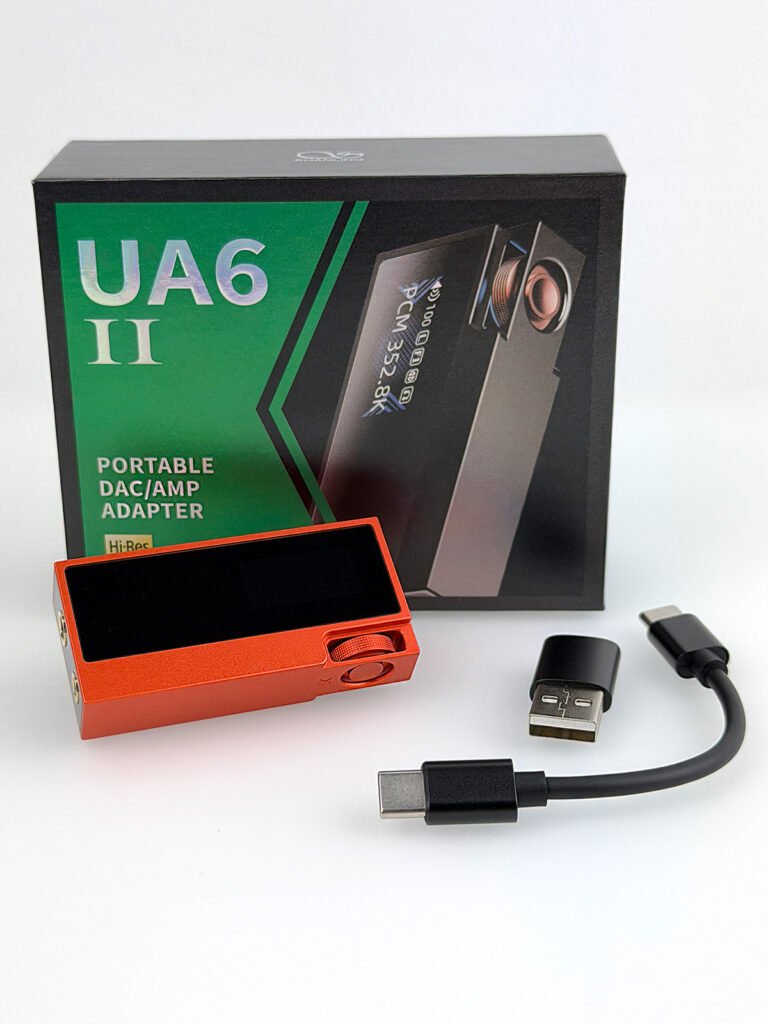
The UA6 II includes everything to get you started. Inside the box are a short USB-C to USB-C cable, a USB-A adapter, quick-start guide and the usual warranty documentation.
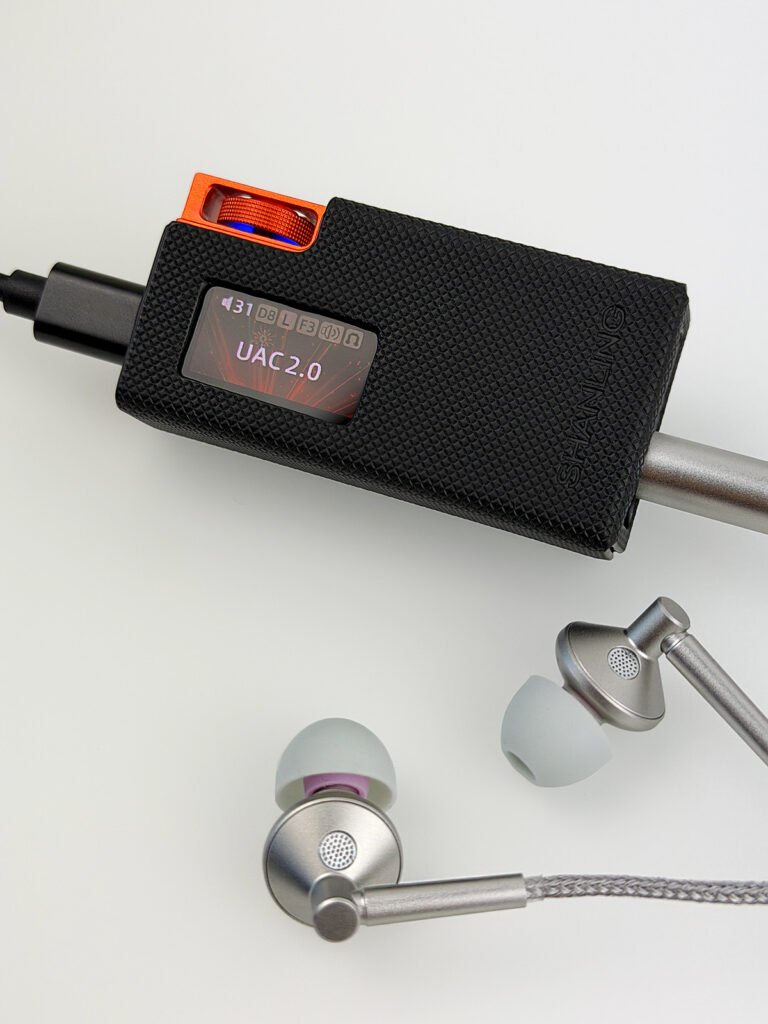
A leather case is available separately. The case also includes a small magnetic mount that can be attached to the back of a phone.
Design
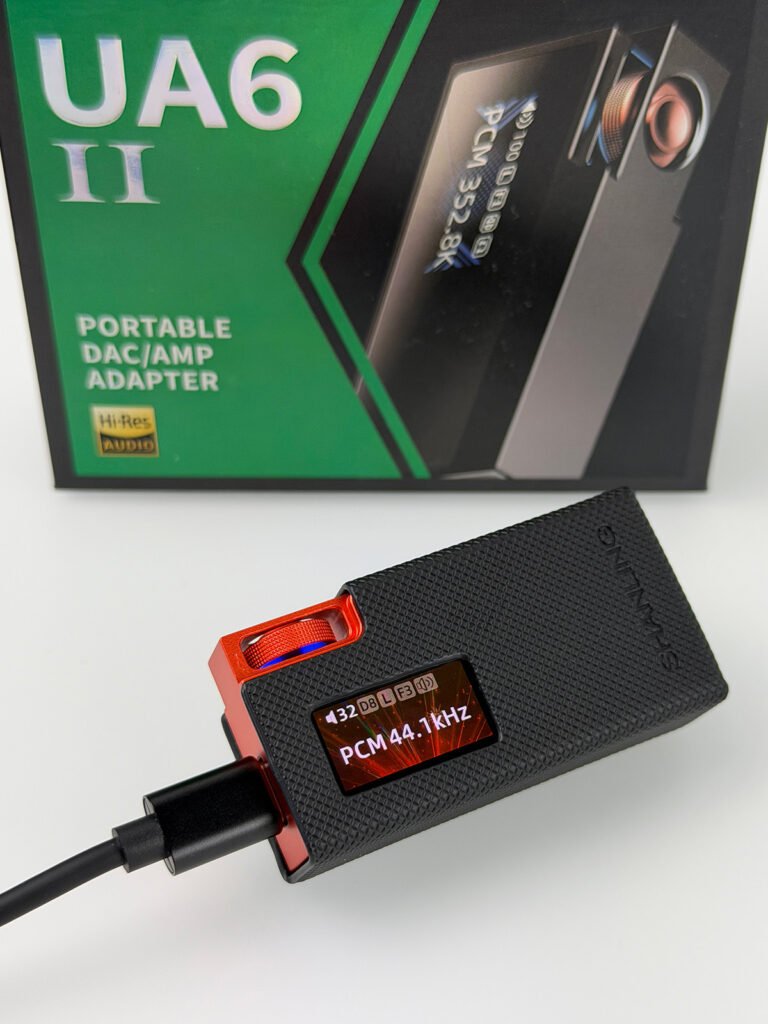
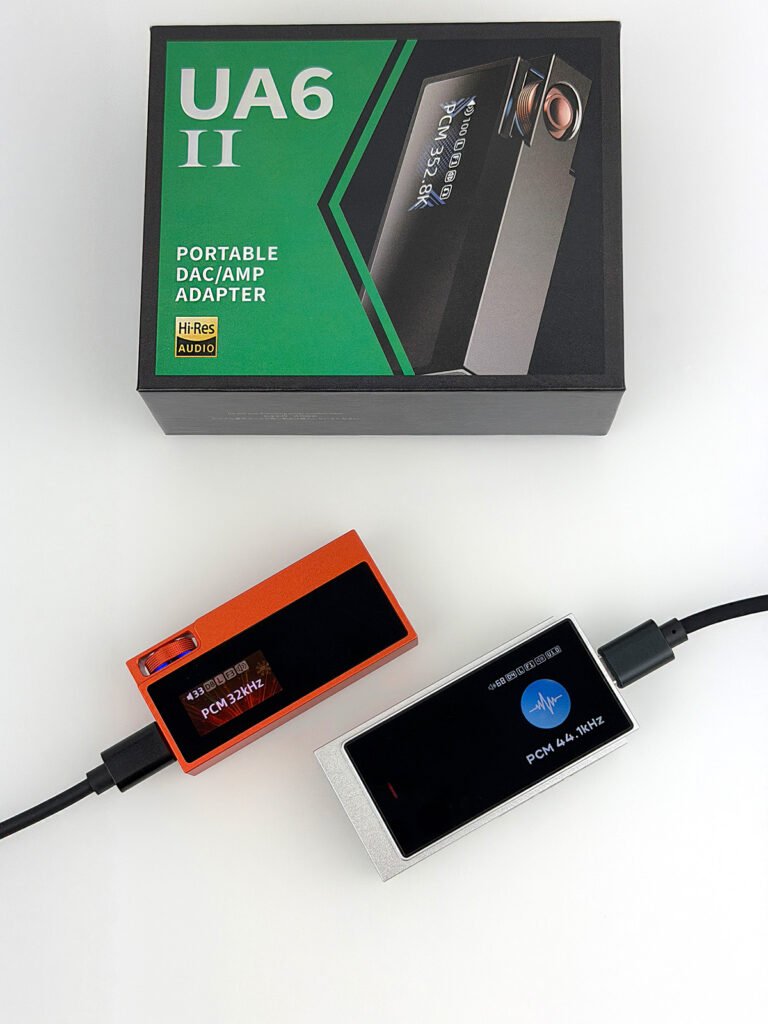
The UA6 II is considerably smaller than the original UA6 and follows the design introduced with the UA7. The aluminum chassis is combined with glossy glass panels on the front and rear. A subtle image on the back shows the eight DAC chips inside.
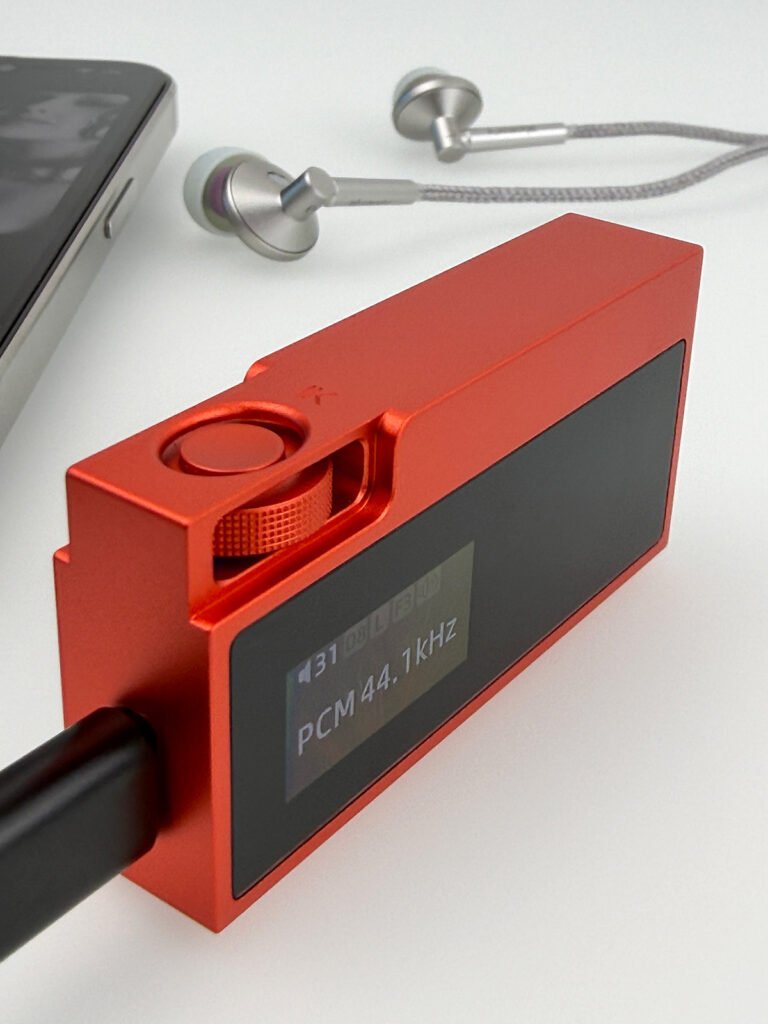
Build quality is excellent. The aluminum chassis feels solid and the controls are neatly integrated into the design. A LED ring surrounds the volume wheel and can be switched off through the settings menu. The aluminum chassis measures only 62 × 30 × 13.5 mm and weighs just over 30 grams.
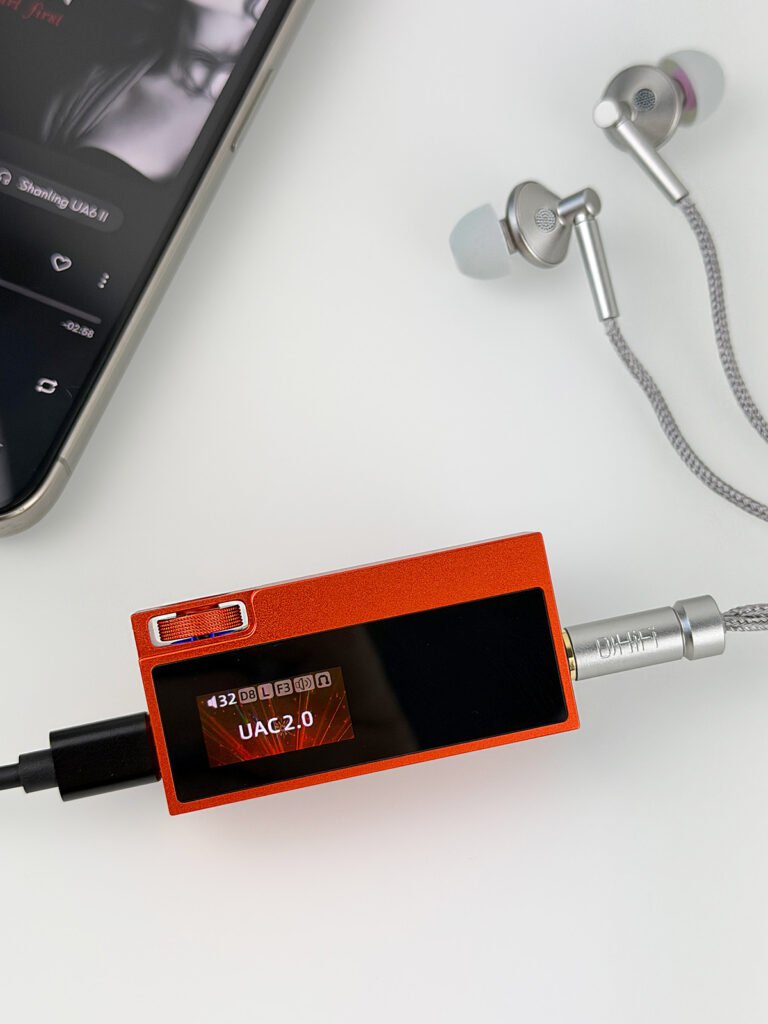
The front also houses a small 0.95-inch AMOLED display. The screen provides information about the selected input mode, sample rate, volume level, gain and other settings.
One of the useful changes is the physical volume wheel, following the layout Shanling introduced with the UA7. We already enjoyed using it on the UA7, so it is great to see it return on the UA6 II. Adjusting the volume is easier than with small individual buttons. The 0.95-inch display and multifunction button provide access to most settings directly on the device, including gain, DAC mode, digital filters, channel balance and UAC mode.
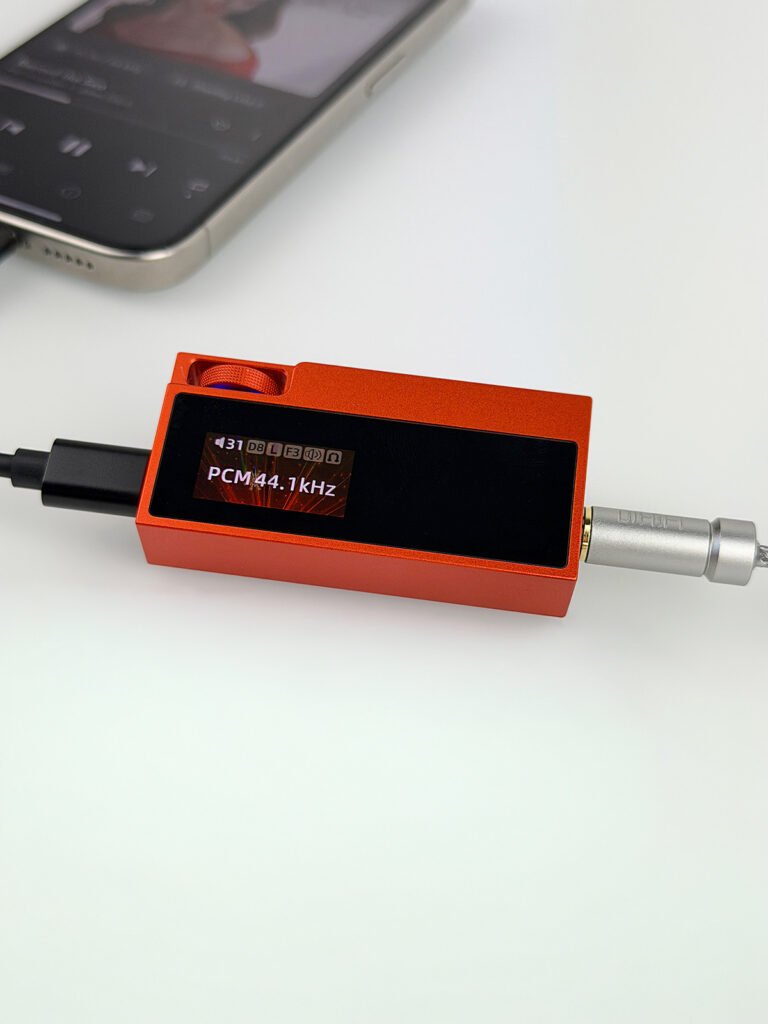
The UA6 II provides both a 3.5 mm single-ended and 4.4 mm balanced headphone output, with USB-C used for connecting it to a source device.
The UA6 II is available in black, silver and orange.
Technical specs
The UA6 II uses eight Cirrus Logic CS43131 DAC chips, twice the number found in the original UA6. It can operate in two DAC modes. Quad mode uses four DAC chips and Octuple activates all eight. You can switch between the two depending on listening preference and power consumption.
The UA6 II no longer uses an internal battery and draws its power directly from the connected USB device. This helps keep the UA6 II considerably smaller and removes a component that can degrade over time.
The UA6 II delivers 365mW into 32 ohms from its 4.4 mm balanced output and 107mW from the 3.5 mm output. Signal-to-noise ratio reaches 133dB balanced and 128dB single-ended. In terms of output power and noise performance, the UA6 II remains very close to the original UA6.
Output impedance has been lowered. The original UA6 is rated below 1.2 ohm balanced and 0.6 ohm single-ended, compared to less than 0.5 ohm for both outputs on the UA6 II. This makes the UA6 II better suited to sensitive, low-impedance IEMs, with less chance of affecting their frequency response.
PCM playback is supported up to 768kHz/32-bit, with native DSD support up to DSD512.
Five digital filters are available:
- Fast Roll-Off
- Slow Roll-Off
- Low-Latency Fast
- Low-Latency Slow
- NOS
The UA6 II offers low and high gain modes and supports both UAC 1.0 and UAC 2.0.
Settings can be adjusted directly on the device. Android users can also access additional controls through Shanling’s Eddict Player app.
Specs
- DAC: 8 × Cirrus Logic CS43131
- DAC modes: Quad / Octuple
- Headphone outputs: 3.5 mm single-ended / 4.4 mm balanced
- USB: USB-C
- PCM: Up to 32-bit-768kHz / DSD: Native-DSD512
- Output power 3.5 mm: 107mW @ 32Ω / 4.4 mm: 365mW @ 32Ω
- SNR 3.5 mm: 128dB / 4.4 mm: 133dB
- DNR 3.5 mm: 128dB / 4.4 mm: 133dB
- THD+N 3.5 mm: 0.0002% / 4.4 mm: 0.0006%
- Output impedance: <0.5Ω
- Frequency response: 20Hz – 40kHz
- Channel separation 3.5 mm: 76dB / 4.4 mm: 108dB
- Gain: Low / High
- Digital filters: 5
- USB Audio: UAC 1.0 / UAC 2.0
- Display: 0.95-inch AMOLED
- Dimensions: 62 × 30 × 13.5mm
- Weight: Approx. 33g
Test equipment
Sound Quality
The UA6 II has a clean and open sound with excellent detail retrieval. Its tuning stays close to neutral, with a slight touch of warmth and enough weight to avoid sounding lean. It is transparent enough to let the character of the connected IEM or headphone come through.
Treble is clear and well extended, with some extra energy higher in the frequency range. High-frequency details are well defined and decay naturally. This contributes to the open character and high level of detail of the UA6 II. The additional treble energy makes matching worth considering. With an already bright IEM or headphone, the upper frequencies can become more prominent. This is mainly relevant for listeners who are particularly sensitive to treble. With neutral or slightly warmer IEMs, the balance is excellent.
The midrange is clean and neutral, with vocals placed naturally within the recording. Male voices have enough weight in the lower registers and female vocals are clear and well defined. Instruments have plenty of texture and notes have a precise attack.
Bass extends deep into the sub-bass, with plenty of weight and impact. Mid-bass has less emphasis than the sub-bass. Definition, texture and layering are all very good, making subtle differences in the lower frequencies noticeable.
The soundstage has good width, although depth is its stronger point. Instruments have plenty of space around them and their position within the soundstage is well defined. Imaging is precise and reverberation extends naturally into the background.
Quad and Octuple mode have slightly different characteristics. Quad is a tad warmer and smoother. Octuple sounds more open, with better layering and finer detail. The difference is subtle, but clearly audible. Octuple mode provides the highest level of detail, while Quad reduces power consumption, which can be useful when the UA6 II is connected to a smartphone.
UA6 II vs UA6 & UA7
Although the UA6 II uses the same CS43131 DAC as the original UA6, Shanling has doubled the number of DAC chips from four to eight. Output power has barely changed, so the additional DACs are clearly not there to provide extra power. Instead, the UA6 II improves on the original in detail, depth and layering.
The original UA6 has a slightly warmer character. The UA6 II sounds cleaner and more open. Bass is tighter and has slightly more impact. Individual bass notes also have better definition. In comparison, bass on the original UA6 has a softer and slightly fuller character.
There are also differences in the soundstage. The UA6 II creates a deeper soundstage, with instruments more distinctly separated from each other. It is easier to hear which instruments are positioned closer or further back in the recording. Reverberation and decay are also better defined.
The UA6 II has a little more energy in the upper treble, giving it a more open sound. The original UA6 is slightly smoother in comparison, but the familiar tuning of the UA6 is still present.
The UA7 has greater bass weight and more body in the lower midrange. Vocals sound fuller, with the tube stage adding extra warmth. The UA6 II is more neutral in comparison, with a cleaner and slightly leaner midrange. The UA6 II sounds lighter and more open, with stronger contrast between soft and loud passages.
The UA6 II sits between the original UA6 and the UA7. It improves on the UA6 with tighter bass, more depth and a more open sound, while the UA7 goes further in warmth and body. If you prefer a more neutral solid-state sound, the UA6 II may be the better choice. The UA7 is the better match for those who prefer a warmer and fuller sound.
Which one should you choose?
Choosing between the UA6, UA6 II and UA7 ultimately depends on the kind of sound you prefer. If you already own the original UA6 and enjoy its slightly warmer and smoother character, there is no immediate need to replace it. Output power is almost identical and the UA6 also retains its SPDIF output and internal battery, two features that have disappeared from the UA6 II.
The UA6 II becomes interesting if you want tighter bass, better depth and a more open presentation. It is also smaller, has the new volume wheel and offers the choice between Quad and Octuple DAC modes. For someone buying a UA6 today, these improvements would make the UA6 II our choice unless the battery-powered design or SPDIF output of the original is important.
The UA7 is the one to choose if you prefer additional warmth, body and weight. Its tube stage gives it a fuller character, especially through the bass and lower midrange. The UA6 II stays closer to neutral and sounds cleaner in comparison, making the choice between them about sound preference.
For existing UA6 owners, the UA6 II is therefore an evolution rather than an essential upgrade. For a new buyer, however, the smaller design, improved controls and changes in sound make the UA6 II the more complete choice of the two.
Conclusion
The Shanling UA6 II is a clear evolution of the original UA6. Doubling the number of CS43131 DAC chips from four to eight is the most obvious technical change, but the differences go beyond the DAC configuration. It is considerably smaller than its predecessor. The physical volume wheel also makes it easier to use.
Sound quality is where the UA6 II makes its strongest case. It has a clean and open sound with excellent detail retrieval, while retaining enough warmth and weight to keep music sounding natural.
The improvements over the original UA6 are easy to notice, but its familiar character remains. The Shanling UA6 II is a worthy successor that improves on what was already a very good DAC. It is one we would happily reach for time and again. An easy recommendation from JJAZZIFI.
Pros:
-
Excellent resolution and detail retrieval
-
Clean and spacious sound
-
Quad and Octuple DAC modes
-
Compact and lightweight design
-
Excellent build quality
-
Physical volume wheel
Cons:
- Leather case is sold separately
- SPDIF output of the original UA6 has been removed