Sendy Audio is known for its headphones. With the Kylin, the company enters the desktop audio market with its first integrated DAC/headphone amplifier. According to Sendy Audio, the Kylin follows a no-compromise design, combining a fully balanced Class A amplifier with a carefully engineered ESS ES9038Q2M DAC stage.
Designing a headphone amplifier requires a very different skill set from designing a headphone. With the Kylin, Sendy Audio takes that step for the first time, entering a highly competitive desktop DAC/headphone amplifier market populated by well-established brands.
The Kylin certainly makes a strong impression. Its elegant design, carefully selected components and impressive specifications leave little doubt that Sendy Audio was determined to get its first amplifier right. We are looking forward to seeing how it performs.

Introduction
Before taking a closer look at how the Kylin performs, it is worth examining what Sendy Audio has put together. The specifications certainly look promising. A balanced Class A amplifier, carefully selected components and generous power output suggest that Sendy Audio has approached its first desktop DAC/headphone amplifier with great care.
Specs:
- ESS ES9038Q2M DAC
- XMOS XU316 USB Interface
- Up to 10 W @ 30 Ω (Balanced), 1 W @ 300 Ω, 500 mW @ 600 Ω
- PCM Support: Up to 32-bit / 768 kHz
- Native DSD512 Support
- Dual Burr-Brown OPA604 Operational Amplifiers
- Hitachi Power Transistors – 2SB649/2SD669
- WIMA & Nichicon Capacitors
- 4-pin XLR, 4.4 mm Balanced & 6.35 mm Outputs
- USB, Optical & Coaxial Digital Inputs
- Three RCA Analogue Inputs
- RCA Pre-Out
- ALPS RK27 Volume Potentiometer
- Frequency Response: 20 Hz – 20 kHz (±0.2 dB)
- THD+N: < 0.0004%
- Signal-to-Noise Ratio: 122 dB
- Dynamic Range: 126 dB
- Dimensions: 270 × 200 × 70 mm
- Weight: 3.1 kg
What’s in the Box?
The presentation is somewhat understated for a product in this price category. Given the excellent presentation of Sendy Audio’s headphones, a slightly more premium unboxing experience would have suited the Kylin well.
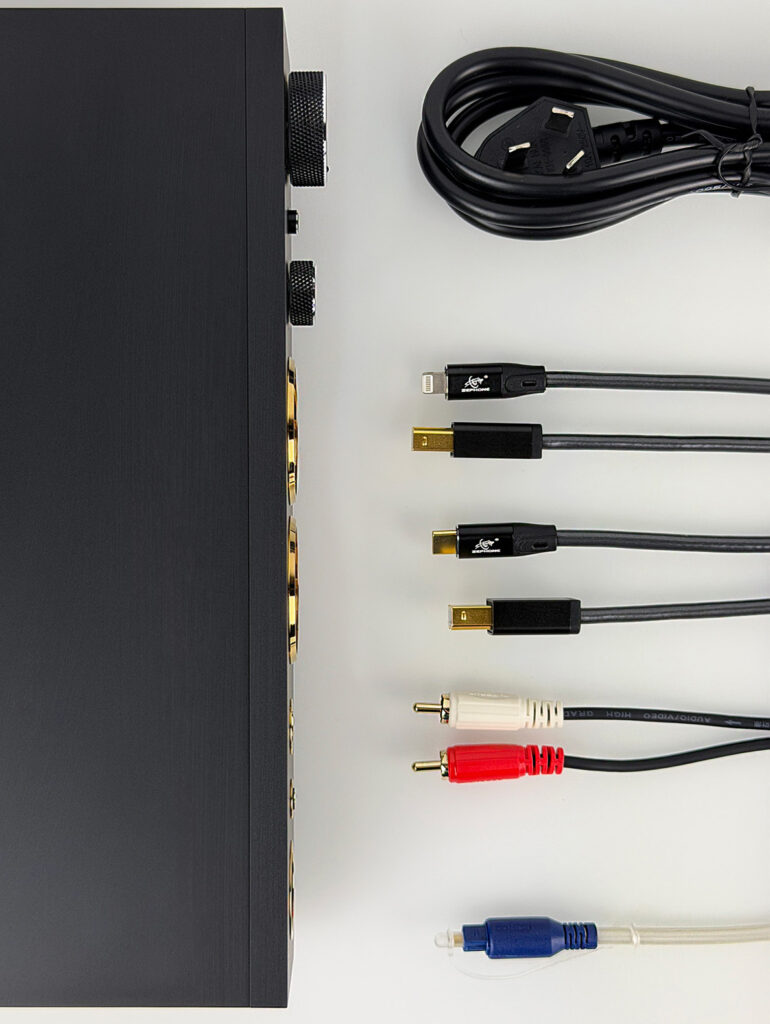
The included accessories cover everything needed to get started. Sendy Audio provides documentation, a power cable and a selection of USB, USB-C, Lightning, optical and RCA cables, making the Kylin ready to use straight out of the box. The only item that feels somewhat basic is the supplied RCA interconnect, although it performs its intended role perfectly well.
Some of the supplied cables appear to be sourced from Zephone, a Chinese cable manufacturer known for producing well-made audio cables. While this is not something Sendy Audio explicitly mentions, it is a welcome detail that reflects the attention given to the overall package.
The accessory package is more comprehensive than what is typically supplied with competing products. It is a thoughtful inclusion that allows users to get started immediately without the need to purchase additional cables.
Build quality:
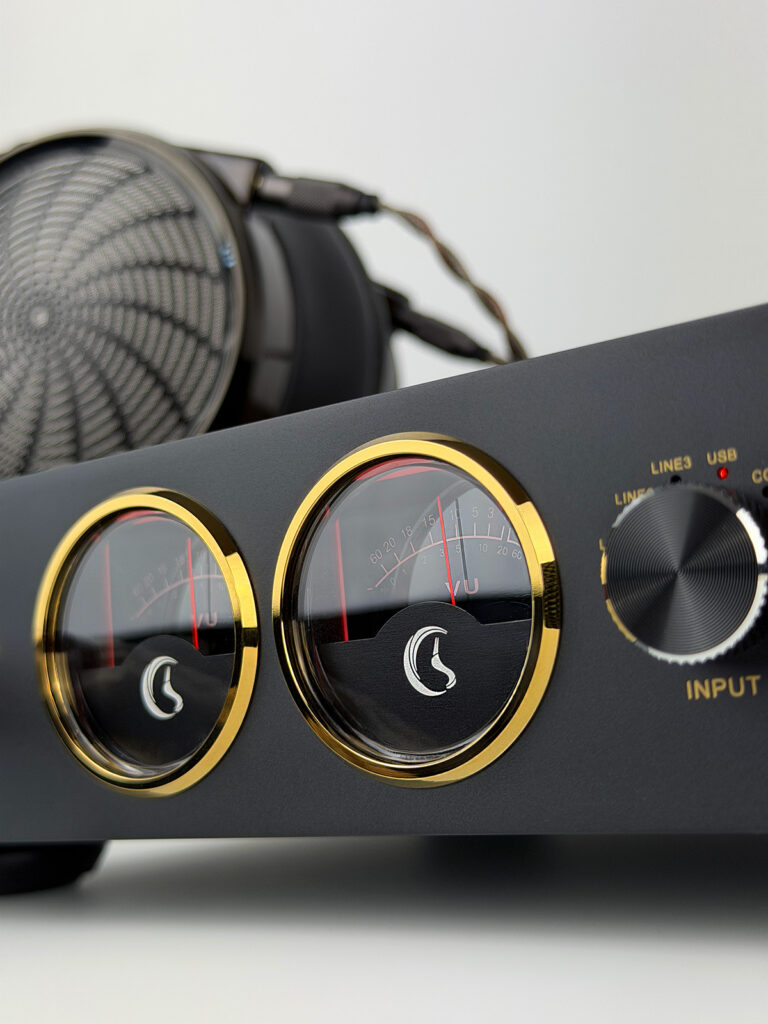
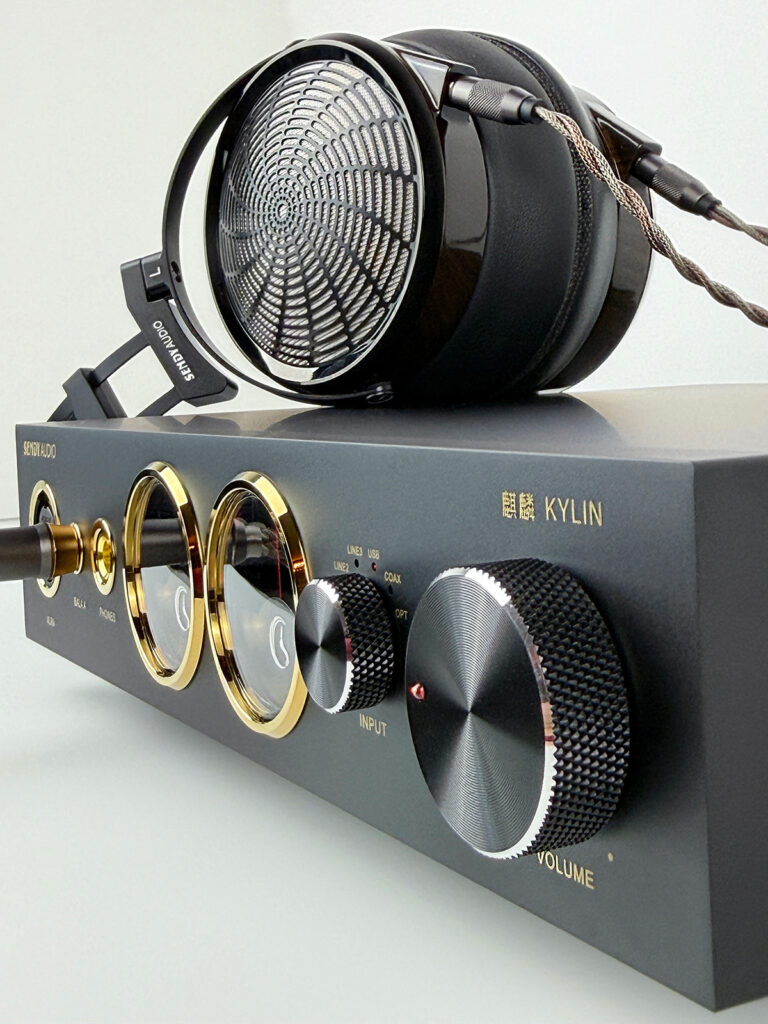
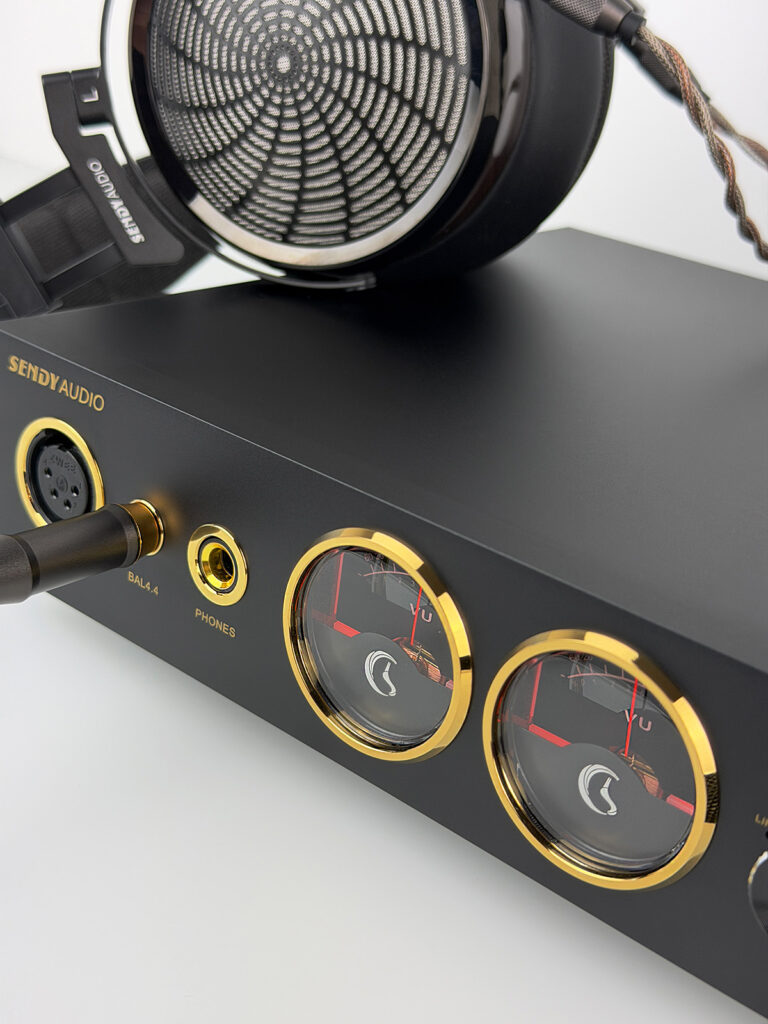
The Kylin is a modern desktop amplifier with a distinctly retro-inspired appearance. Instead of following the trend of large displays and touch interfaces, Sendy Audio has chosen a more traditional approach. The analogue VU meters give the Kylin much of its classic hi-fi appeal. The chassis is exceptionally well finished. At just over 3 kg, the Kylin has a reassuring heft.
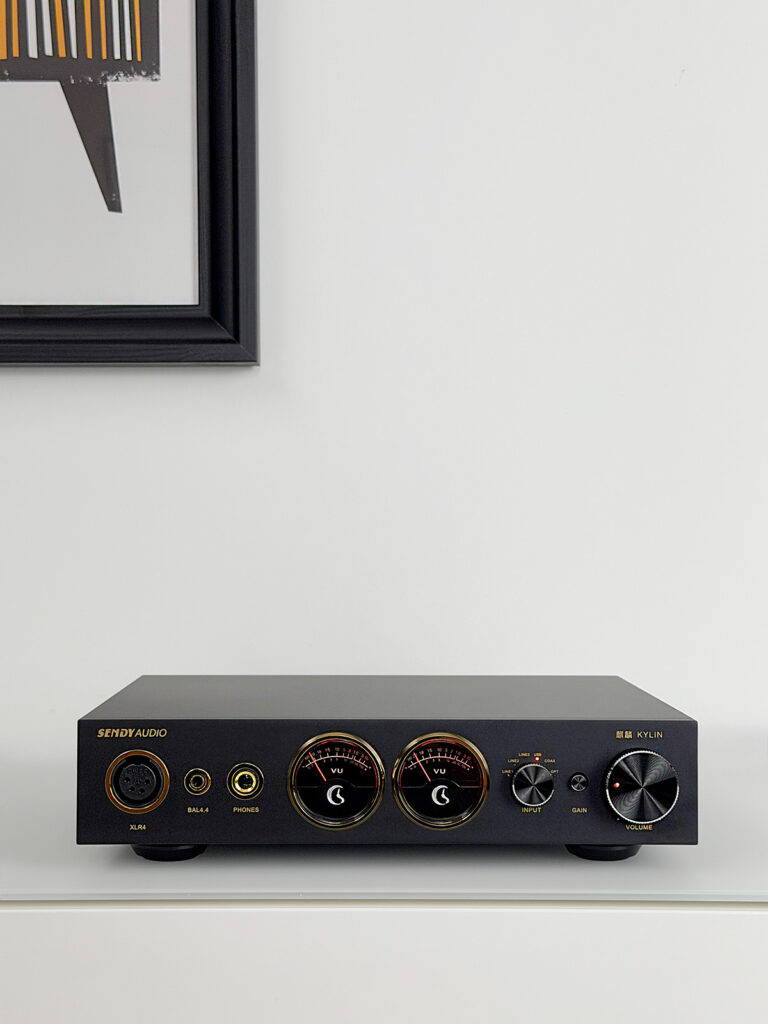
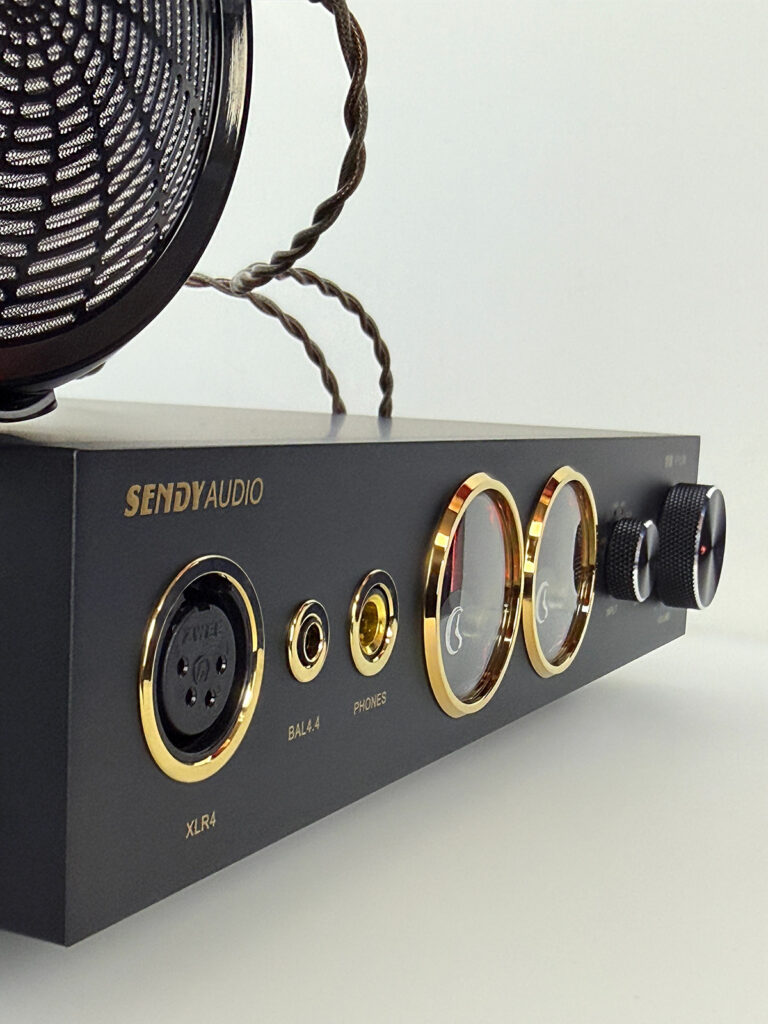
The analogue VU meters are the visual centrepiece of the front panel. The subtle amber backlighting enhances the retro-inspired aesthetic beautifully. Gold accents surrounding the headphone outputs and VU meters complement the black finish well.
The front panel houses 4-pin XLR, 4.4 mm balanced and 6.35 mm headphone outputs, alongside the input selector, gain switch and volume control.
The Japanese ALPS potentiometer provides smooth and consistent volume adjustment. Every button, switch and rotary control feels well made, while the relay-switched input selector reflects the same attention to detail.
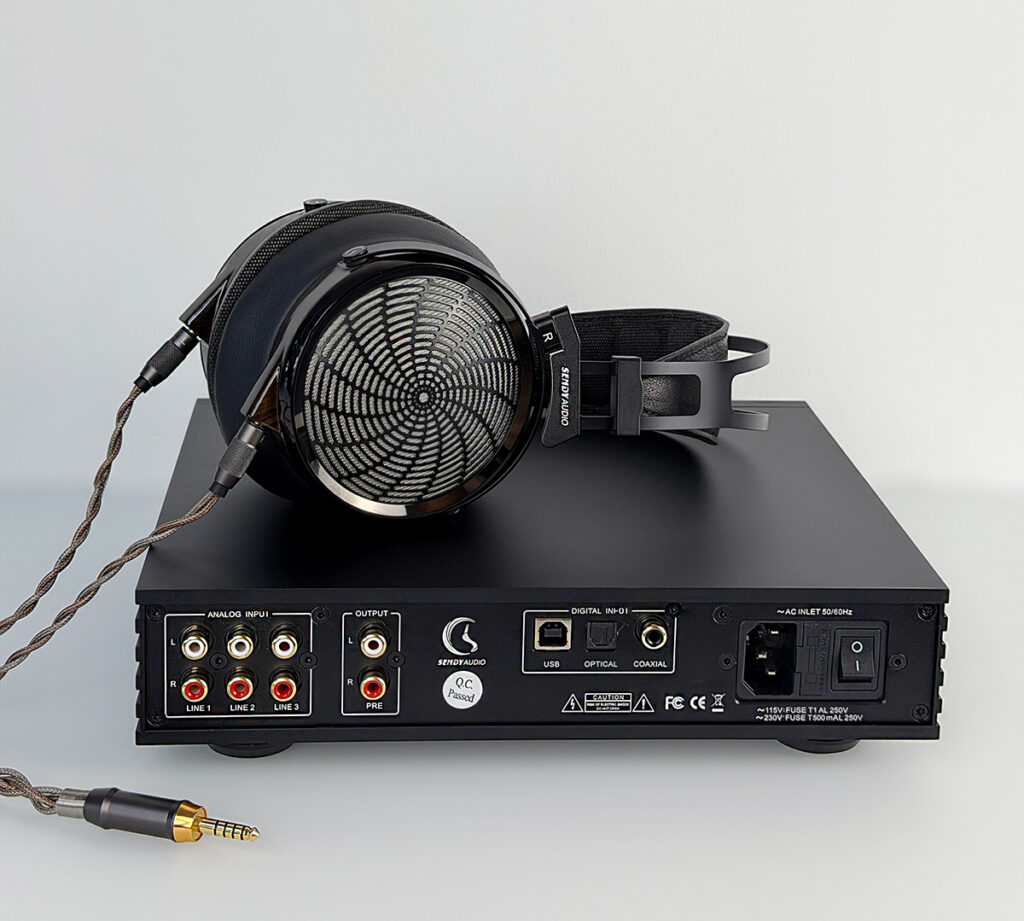
The rear panel offers USB, optical and coaxial digital inputs, together with three RCA analogue inputs, making it easy to connect multiple source components. A pair of RCA pre-outs also allows it to function as a preamplifier. Considering the amplifier’s fully balanced internal design, balanced XLR inputs and outputs would have been a welcome addition.
Internal design
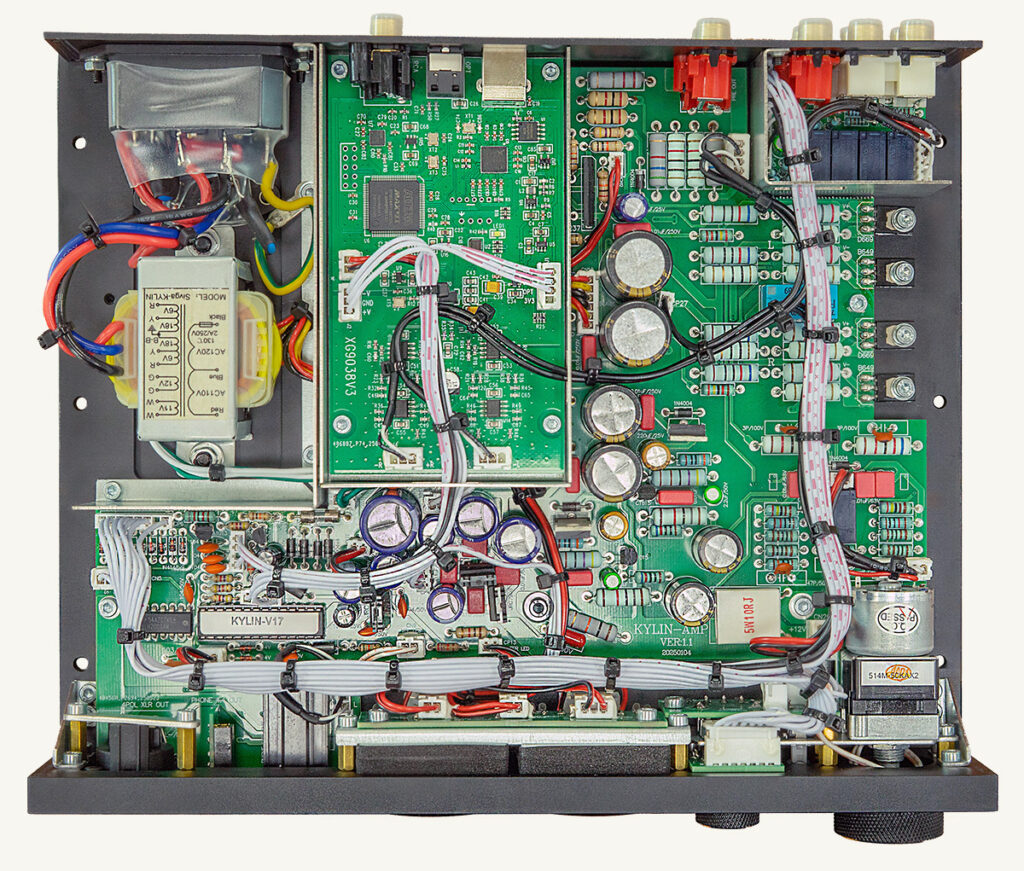
Digital conversion is handled by a ESS ES9038Q2M DAC. While ESS has since introduced the newer ES9039 series, the DAC chip itself is only one element of the equation. In practice, the quality of the analogue stage, power supply and overall implementation often has a far greater influence on the final result than the DAC chip alone.
The analogue stage operates in Class A. Sendy Audio has chosen dual Burr-Brown OPA604 operational amplifiers, Hitachi output transistors 2SB649/2SD669 and a combination of WIMA and Nichicon capacitors.
One of the key advantages of a Class A amplifier is that the output stage remains active throughout the entire signal cycle. This avoids crossover distortion found in Class AB designs. In practice, this contributes to a smooth and highly linear presentation, while preserving excellent detail and control.
Class A amplifiers are often associated with significant heat output, making the Kylin’s relatively cool operation all the more impressive. After our listening sessions, the chassis remained only moderately warm, indicating an efficient internal layout and well-designed passive cooling.
The available output power is impressive. Rated at up to 10 W into 30 ohms, the Kylin has current reserves for virtually any headphone, from demanding planar magnetics to high-impedance dynamic drivers.
Test Equipment:
General sound signature
The Kylin leans slightly towards warmth, but not to the extent that it changes the overall character of the music. Rather than adding extra bass or thickness, it introduces a subtle sense of body through the lower midrange and mid-bass, giving instruments and vocals a natural weight. Some of this character may well be related to the Class A output stage.
The Kylin never sounds clinical, yet equally avoids becoming overly smooth or rich. That slight warmth is most noticeable through the midrange. Vocals and acoustic instruments gain a touch of body, but never enough to mask the finer details.
There is no artificial bass boost, yet the amplifier provides excellent authority and control when the recording calls for it. Combined with its generous power reserves even demanding passages retain their impact without sounding compressed.
The outputs differ slightly in their presentation of the upper frequencies. Through the balanced outputs, the treble has a touch more energy and sparkle, whereas the single-ended output sounds slightly smoother and more laid-back. The difference is subtle, but clearly audible when switching between the outputs.


Treble
The Kylin leaves the upper frequencies largely untouched. Headphones with an energetic treble remain energetic, while smoother headphones retain that same character. At no point did the amplifier add extra sharpness or soften the top end.
Cymbals retain their metallic shimmer, string overtones remain intact and room ambience is reproduced naturally. Small details are presented as part of the recording rather than being pushed to the foreground. Reverberation, note decay and subtle ambient cues remain clearly audible, but always within the context of the music.
Switching between the balanced and single-ended outputs revealed a subtle difference. The balanced outputs sound slightly more open, while the single-ended output softens the leading edge of notes just enough to pair well with headphones that already have a more energetic upper register.
Midrange
The midrange is well balanced across a wide variety of recordings. Vocals never appear (too) forward or (too) recessed. Voices retain their individual character without unnecessary emphasis on either the lower or upper midrange.
Acoustic instruments are reproduced with a convincing timbre. String instruments preserve the natural resonance, while piano notes carry both weight of the initial strike and the decay that follows. Brass instruments maintain their bite without becoming aggressive.
The midrange remains consistent regardless of the connected headphone. Switching between headphones revealed far greater differences between the headphones themselves than those introduced by the amplifier.
Bass
The Kylin never sounds short of current, even when driving a demanding headphone like the HEDDphone TWO GT. Bass remains controlled throughout, including during complex passages where less capable amplifiers can begin to lose their grip.
Sub-bass reaches deep when present in the recording, but never overwhelms the rest of the frequency range. Individual bass notes are easy to distinguish. Fast bass lines sound clean and well defined. Double bass preserves the natural resonance of the instrument without becoming overly warm, while kick drums deliver convincing impact without masking surrounding instruments.
Whether switching to current-hungry headphones or playing densely layered recordings, the Kylin continues to keep the low end controlled and free from congestion.
Soundstage & Imaging
The Kylin does not make the soundstage appear artificially larger. Intimate recordings remain focused, while larger productions retain their natural sense of space. Instruments occupy clearly defined positions, with vocals remaining firmly centred.
This remains true as recordings become more complex. Even during dense orchestral passages, individual instruments remain easy to follow without blending together. Large dynamic swings are reproduced cleanly, allowing the recording to remain clear and composed throughout.
The gain switch has little influence beyond output level. Tonal balance, imaging and overall presentation remain unchanged, making it easy to select the appropriate gain setting for different headphones.

Headphone pairing
To get a good impression of Kylin’s capabilities, we paired it with headphones that differ considerably in design, efficiency and power requirements. Each headphone retained its own character, whether that meant a warmer tonality, a more intimate presentation or a wider soundstage. The amplifier simply provided the control and current needed to drive them properly.
Its substantial power reserves are far better suited to demanding over-ear headphones than to highly sensitive IEMs. It performs well with IEMs and sounds excellent, but the amplifier’s high output leaves only a limited usable range on the volume control. With many sensitive IEMs, the volume is already approaching loud listening levels by around the 9 o’clock position.
Sendy Audio Apollo Pro
The Apollo Pro feels perfectly at ease on the Kylin. Its balanced presentation is preserved from top to bottom, while the amplifier provides the level of control expected from a well-implemented Class A design. Bass remains disciplined and well defined, vocals retain their natural position. The smooth treble continues to resolve fine detail without becoming more prominent. Nothing feels exaggerated, allowing the Apollo Pro’s smooth and balanced tuning to remain.
Sendy Audio Egret
The Egret approaches music differently, placing greater emphasis on openness and spaciousness. The generous sense of space remains fully intact, while the lower registers gain a slightly firmer foundation. It gives the presentation stability without affecting its openness. Even with complex orchestral arrangements, instruments remain clearly separated, allowing the Egret’s excellent sense of space to shine through naturally. The Egret is a great pairing with the Kylin.
HEDDphone TWO GT
The HEDDphone TWO GT was the most demanding headphone used during this review. The Kylin never gave the impression of running short of current, bass remained tight, dynamic passages retained their impact and densely layered recordings stayed well separated. The HEDDphone’s highly revealing nature also highlights Kylin’s balanced character, delivering plenty of detail without sounding analytical.
Hifiman Arya Unveiled
The Arya Unveiled demonstrates how little the Kylin influences the connected headphone. Its expansive soundstage remains unchanged, while the bass stays tight and well controlled. Even in complex recordings, individual instruments remain easy to distinguish without compromising the Arya Unveiled’s sense of space.
Listening impressions
Please allow me to walk you through a few music tracks to highlight Kylin’s strenghts and capabilities.

Sophie Milman – Be Cool (Take Love Easy)
Sophie Milman’s voice immediately demonstrates how naturally the Kylin handles midrange. Her vocals remain intimate and beautifully focused without sounding enlarged or pushed forward. The accompanying double bass sounds impressive, with each plucked note carrying a clear attack followed by the natural resonance of the instrument, while the piano and delicate cymbal work occupy their own space. The Kylin kept everything perfectly balanced and separated.
HAEVN – One Day (Wide Awake)
One Day gradually builds from a restrained opening into a much larger and more layered arrangement. Marijn van der Meer’s vocals remain firmly anchored at the centre while piano, strings, percussion and the surrounding ambient layers expanded naturally around him. Even as the arrangement reached its climax, the presentation never became congested. The amplifier preserved the separation between every layer perfectly.
Loreena McKennitt – The Dark Night of the Soul (The Mask and Mirror)
This recording is filled with subtle acoustic textures, from Brian Hughes’ intricate guitar work to Hugh Marsh’s expressive violin. The Kylin captured all fine details without making them sound exaggerated. Every instrument occupied a defined position. Loreena McKennitt’s voice remained beautifully centred, surrounded by the natural ambience of the recording. The amplifier’s slightly warm character complements the organic nature of this performance, giving instruments convincing body while preserving the openness and atmosphere that makes this recording so captivating to listen to.
Andrea Bocelli – Un Ballo in Maschera (Verdi)
Opera places very different demands on an amplifier than smaller acoustic recordings, requiring both dynamic headroom and precise control as orchestra, choir and soloists share the stage. The Kylin remained composed throughout. Bocelli’s powerful tenor voice rose effortlessly above the orchestra without becoming detached from it, while the different orchestral sections retained their own position within the soundstage. During the larger crescendos, the amplifier never loses its composure, allowing even the smallest details to remain clearly audible.
Albert King & Stevie Ray Vaughan – Call It Stormy Monday (In Session)
In Session captured two legendary blues guitarists exchanging phrases with remarkable spontaneity. The Kylin made it easy to follow that musical conversation, clearly separating Albert King’s unmistakable Gibson tone from Stevie Ray Vaughan’s brighter and more aggressive sound. The rhythm section provided a solid foundation, with the bass remaining tight and the snare carrying satisfying impact without overpowering the guitars. Equally impressive is the sense of space, preserving the live atmosphere of the performance and making it easy to appreciate the interaction between both artists.
Myriam Alter – Come With Me (Where Is There)
Come With Me is built around a a richly layered arrangement in which every instrument contributes to the atmosphere of this recording. The Kylin keeps those individual layers clearly separated, making it easy to follow the interplay between the different instruments. Around the five-minute mark, the large drums introduce deep, beautifully textured low frequencies. Rather than reproducing them as a single low-frequency thump, the Kylin reveals the character of each strike, from the initial impact to the resonance of the drum itself. The bass has excellent texture and control, adding weight and scale to the recording without overshadowing the delicate acoustic instrumentation.
Amplifier comparisons
The Kylin enters a market populated by well-established competitors such as Burson Audio and Violectric. Rather than developing a distinctive house sound of its own, Sendy Audio has focused on building an amplifier that remains controlled, composed and largely transparent to the connected headphone.
Compared to the Burson Conductor Stellar, the differences are subtle rather than dramatic. The Burson presents music with a slightly more open character. The Kylin, by comparison, gives notes a little more body, producing a presentation that feels slightly more laid-back without sacrificing control or resolution. Neither approach is inherently better; they simply offer different interpretations of the same recording. If I had to compare the Kylin with another brand, Accuphase with their class A is the name that comes to mind.
The comparison with the Violectric DHA V226 follows a similar pattern. Both amplifiers remain composed across the frequency range and avoid imposing an obvious character on the connected headphone. The V226 leans towards a slightly more linear presentation, while the Kylin introduces a little more substance to instruments and vocals. The difference is subtle. The Kylin presents notes with a little more body, while the Violectric sounds slightly leaner and more direct.
What ultimately separates the Kylin from many of its competitors is not a particular sonic signature, but the absence of one. Rather than encouraging different headphones to conform to the amplifier, it allows each to retain its own identity. Whether connected to a dynamic or planar magnetic design, the Kylin consistently steps into the background, leaving the headphone and the recording to take centre stage.
Conclusion
The Sendy Audio Kylin comes across as a mature and well-developed amplifier. Every aspect, from its construction and component selection to its overall presentation, reflects the considerable care that has gone into its development.
Even alongside considerably more expensive amplifiers, the Kylin proves itself to be a worthy competitor. Its retro-inspired design and high standard of finish are matched by an equally impressive overall performance. Even considered purely as a headphone amplifier, it stands comfortably on its own. The quality of the integrated DAC further strengthens the overall package.
Throughout our listening sessions, one characteristic remained constant. The Kylin never imposed its own character on the connected headphone. It simply delivered the control and power needed to allow each headphone to perform at its best. Rather than relying on exaggerated warmth or artificial detail, the Kylin delivers a balanced, controlled and highly natural presentation.
With the Kylin, Sendy Audio has made an impressive debut in the desktop amplifier market. It has earned our recommendation and deserves a place on the shortlist of anyone looking for a powerful, refined and highly musical Class A DAC/headphone amplifier.
Pros
- Class A amplifier
- Retro-inspired design
- Excellent build quality
- Balanced, neutral tuning
- Premium fit and finish
- Generous accessory package
- High-quality ALPS volume potentiometer
- Excellent separation and layering
- Well-implemented integrated DAC
Cons
- No remote control
- Rear-mounted power switch
- No balanced line inputs / outputs