When it comes to hi-fi, iBasso has been in the game for years. Good sound, clean designs and each release a bit more refined than the last. The roots of iBasso trace back to 2006, when the company was founded in Shenzhen, China. Since then, it has steadily grown into an established name in the portable audio scene.
Things really took off in 2013 with the iBasso DX50 and DX90, which helped put the brand on the map. This happened at a time when high-quality portable players were still a niche, the DX50 delivered excellent price-to-performance. Back then, for many enthusiasts, the DX50 was their first introduction to dedicated portable hi-fi.
While digital audio players have always been at the core of the brand, iBasso has expanded its lineup over the years. Today, it includes DAPs, portable DACs and amplifiers.
In this review, we will explore iBasso’s latest addition to their lineup, the iBasso DX270 Ultra. Following the success of the DX260 MK2, this new model takes a different direction. It moves away from the multi-chip Cirrus Logic DAC of its predecessor and introduces a Hybrid R2R architecture instead. This marks a clear change in design and likely in sound as well. Let’s see how it performs.
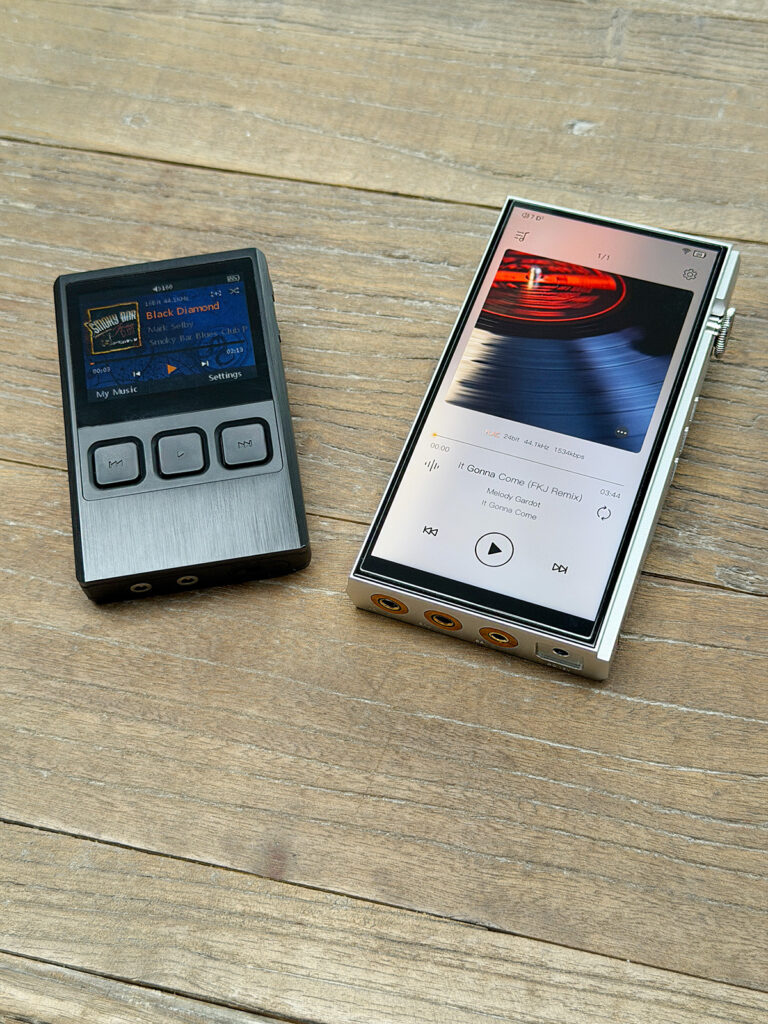
Left the DX90, right the DX270
iBasso DX270
The DX270 is not a typical R2R DAC. While R2R designs are known for their natural tone, they frequently fall short on a technical level, with softer detail retrieval, a higher noise floor and less precision compared to modern Delta-Sigma DACs. With the ‘DX270’ iBasso clearly set out to address these limitations. The DX270 performance is far ahead of what you would expect from a R2R device.
At its core is a 20-bit R2R combined with a 4-bit String DAC. It’s a hybrid setup. The string DAC handles the larger voltage steps, which improves linearity and lowers distortion. The result is a higher dynamic range of up to 130dB, allowing the DX270 to fully capture the dynamics of the music.
The DX270 uses a carefully structured, multi-layered architecture to get the most out of the R2R. The 8-channel differential design uses 344 high-precision resistors for the main ladder network. Additionally, iBasso implemented a separate hardware resistor compensation network with another 76 resistors. This separate network works as a correction layer. The FPGA monitors this and applies real-time compensation to keep performance consistent.
The FPGA-Master 3.0, is supported by two Accusilicon femtosecond oscillators for precise timing. As with other DX models and iBasso’s D-DACs, the FPGA controls the entire clocking system, syncing data from the SoC to the R2R ladders. As a result you still get that typical R2R character, but with a level of technical performance that pushes into flagship territory.
The DX270 is a modern Android DAP with a dual OS setup, You get Android 13 for apps and streaming and Mango OS as a stripped-down Linux mode focused purely on music playback. iBasso also sticks to its system-wide non-SRC design, so Android resampling is not an issue. Boot times are relatively quick and general navigation is smooth. Switching between Android and Mango OS is straightforward, making it easy to choose between convenience and pure playback
It runs on a Qualcomm Snapdragon 665, with 4 GB RAM and 128 GB storage. You can expand that with a microSD card up to 2 TB. The screen is a 5.5-inch 1080×2160 panel. Battery capacity is 4400 mAh, with a claimed playback time of up to 13.5 hours (in low gain mode) depending on use. In real-world use, battery life came very close to the claimed 13.5 hours. The 80% charge limiter is also an useful addition, helping to preserve long-term battery health.
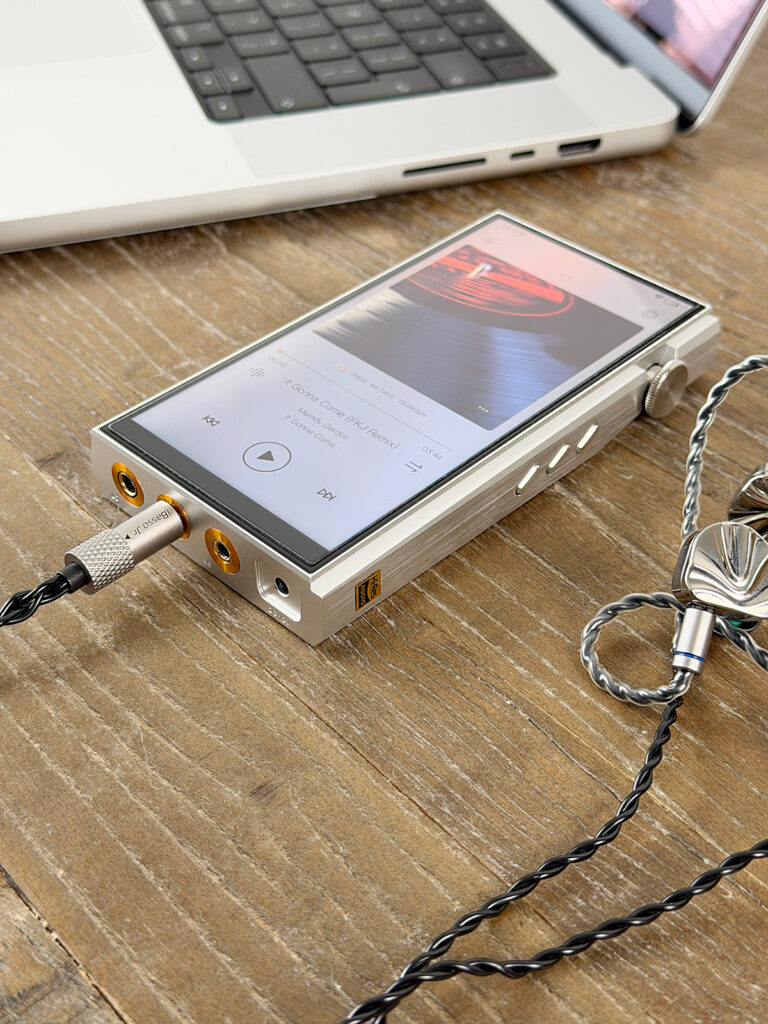
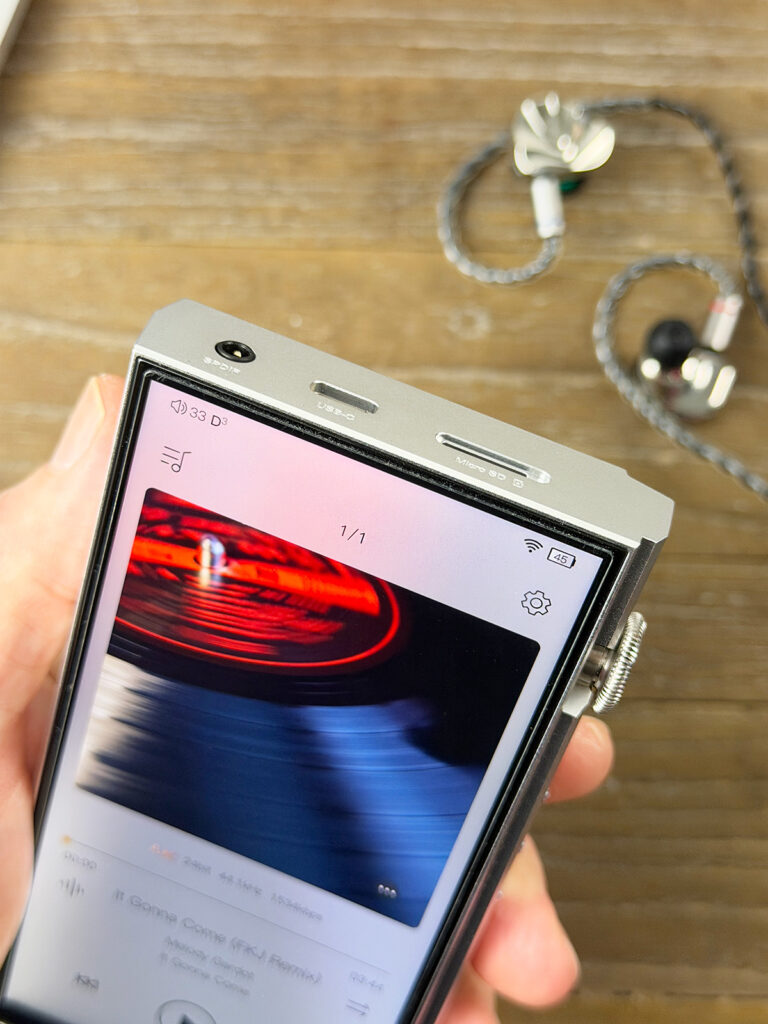
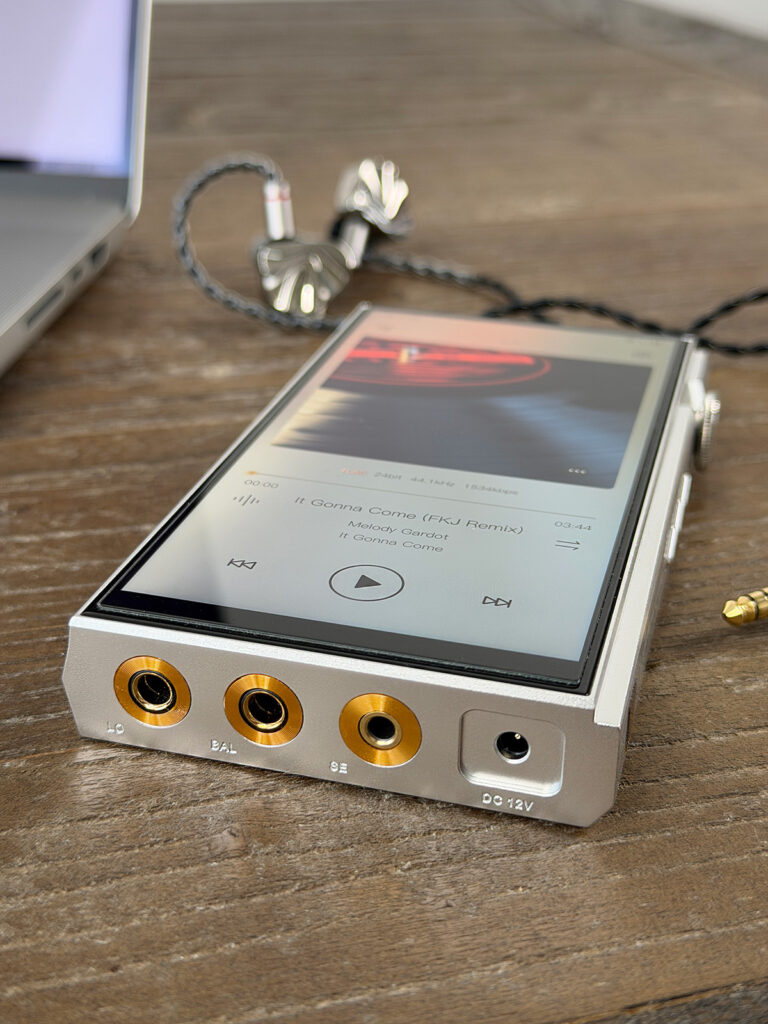
The DX270 offers a 4.4mm balanced headphone out, 4.4mm balanced line out, 3.5mm single-ended output and a 3.5mm coaxial output. It also supports USB DAC mode.
Super gain mode
The DX270 does not reuse the amp section of the DX260. It is a redesigned stage aimed at higher voltage swing and current output.
When using the included 12V adapter, the amplifier switches into what iBasso calls ‘Super Gain Mode’, raising the internal rails from 8V to 12V. Output increases from 1050mW to 1575mW per channel into 32Ω via the balanced output. This provides the DX270 with more than enough power for more demanding headphones. The higher voltage improves slew rate and dynamic headroom, allowing the amp stage to operate with more control and stability under load.
Connecting the 12V PSU made this immediately noticeable. Across the entire frequency range, everything stepped up a level, especially with planar headphones, where the added control and drive were clearly audible.
Amplification and DAC Settings
The DX270 offers several options for fine-tuning. Gain control includes both AMP Gain (Low/High) and DAC Gain (Low/High). This dual gain system allows for better matching with both sensitive IEMs and more demanding headphones. For digital filters, you can enable NOS (Non-Over-Sampling) mode or select from standard options such as fast and slow roll-off.
Design
In terms of aesthetics, the device comes close to the flagship DX340, while still clearly building on the design introduced with the DX260. The metallic finish sits somewhere between gunmetal and silver, giving it a refined look. It builds on what already worked well with the DX260 and pushing it slightly further in both design and usability.
Despite being taller than the DX260 it only weighs 265g, it remains comfortable in hand. The buttons and volume wheel feel solid and provide clear, tactile feedback.
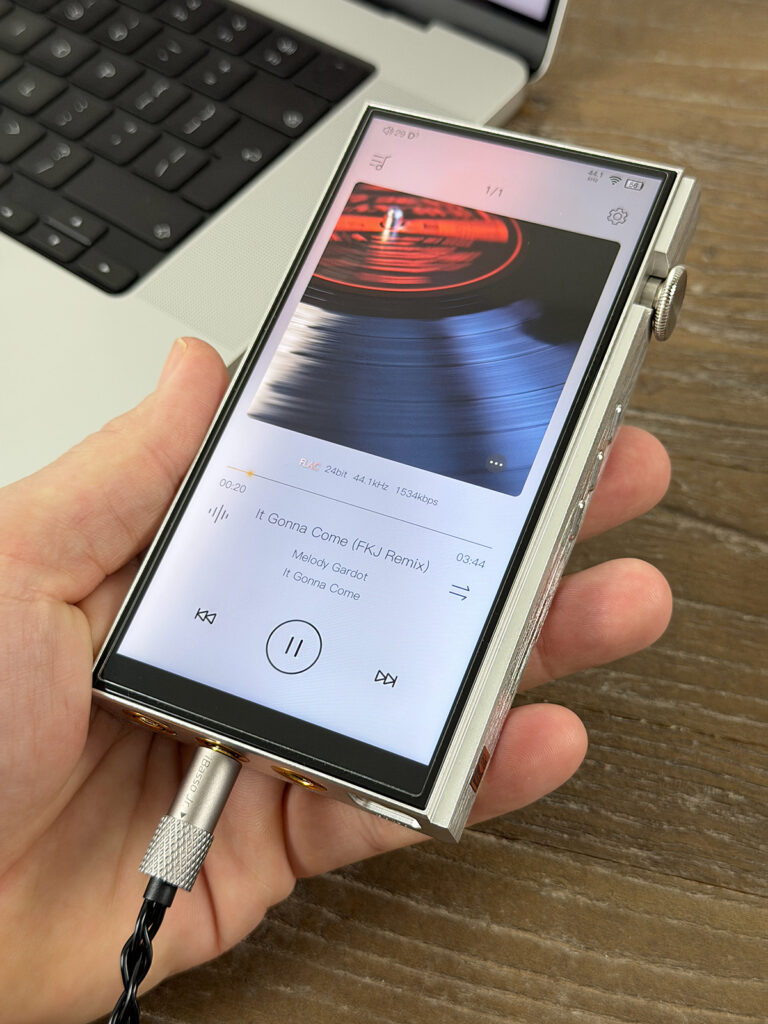
The display is slightly larger and offers a bit more contrast compared to the DX260. Viewing angles are excellent and color reproduction are natural.
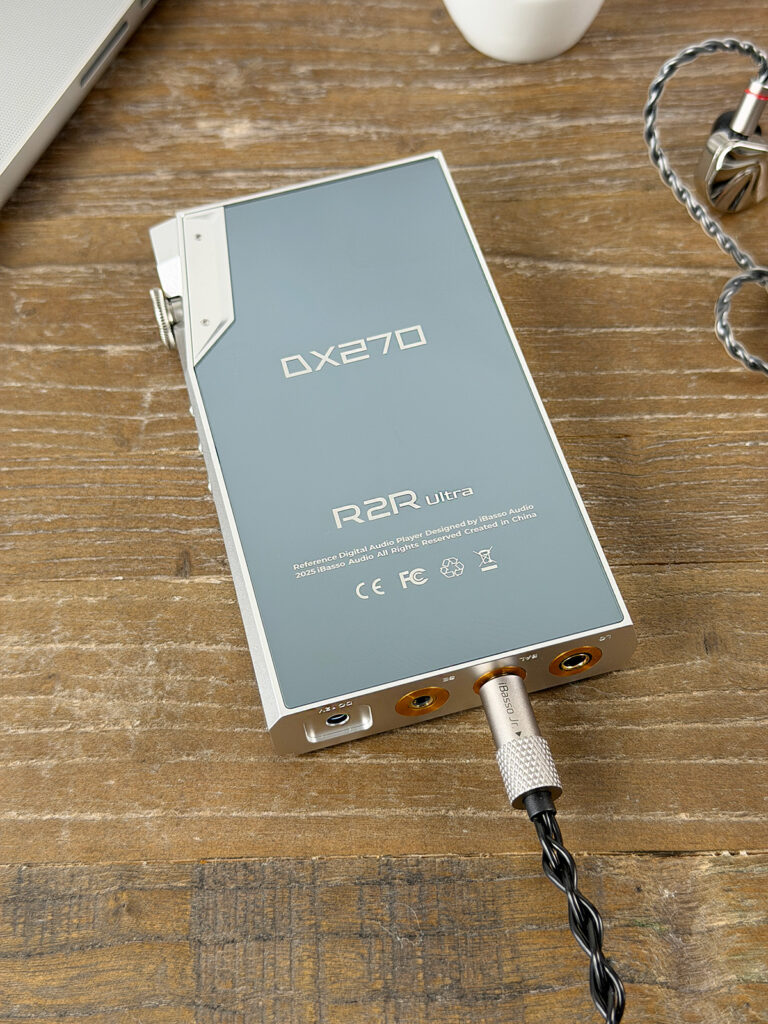
At the bottom, you’ll find a 4.4mm line out, 4.4mm balanced headphone out, a 3.5mm single-ended output, along with the dedicated 12V DC input.
User-Replaceable Battery
iBasso continues to deliver on its promise of user-replaceable batteries. The DX270, like most recent DX series models, features an easily replaceable battery, something that remains rare in this segment. By removing a few screws on the back, users can swap out the battery with minimal effort. This is a clear advantage for long-term use and ownership.
What is in the box
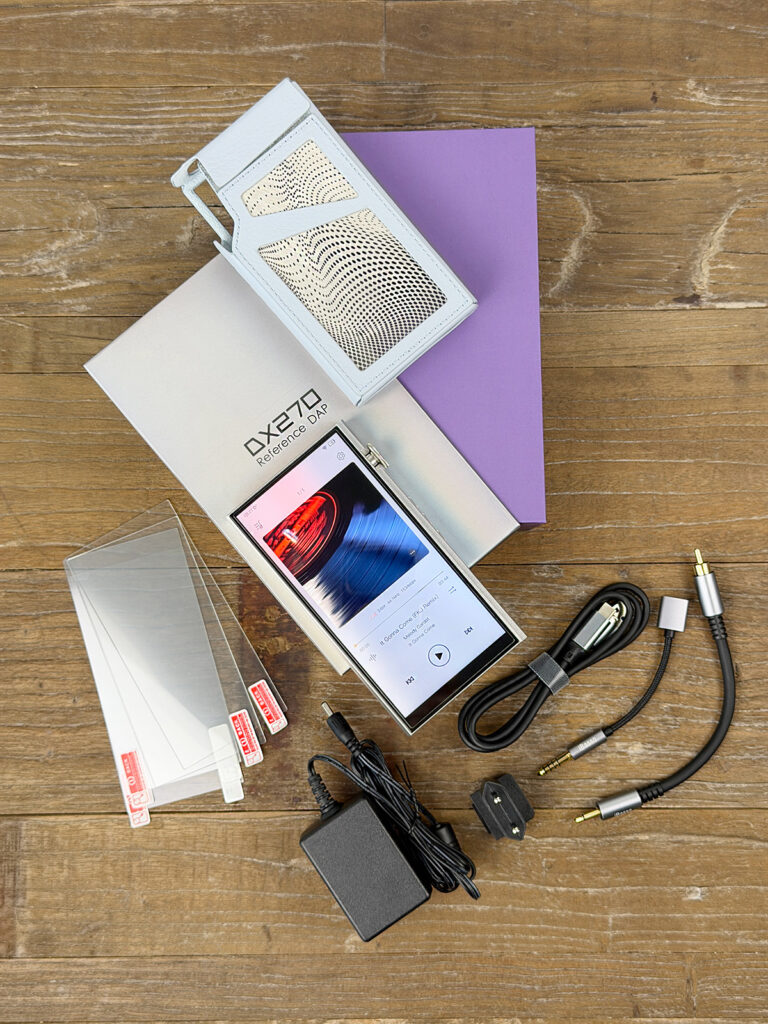
The DX270 comes in two-tone box with a silver sleeve and purple inner shell. Inside, the player rest in a velour cradle, with three small accessory boxes underneath.
A tempered glass screen protector is pre-installed. iBasso also includes four spare films and two extra glass protectors. In my opinion the glass screenprotectors are better in daily use. It is nice iBasso gives you the choice.
The included grey case is almost identical to the one from the DX340. It complements the player well. The cutouts are precise, the grip is great and the case fits the DX270 securely. Build quality leaves little to be desired. A nice detail is the perforated back, which allows the backplate to remain partially visible.
The box also includes a compact 12V DC adapter. In addition you get a long USB-A to USB-C cable, a short coaxial cable, an iBasso burn-in cable, a soft pouch and the usual paperwork. The accessory set is generous, altough an USB-C to USB-C cable would have been a welcome addition.
Specs
- DAC: 20-bit R2R + 4-bit String DAC
- Architecture: 8-channel fully differential
- FPGA: FPGA-Master 3.0
- CPU: Qualcomm Snapdragon 665
- OS: Android 13 + Mango OS
Display & Build
- Screen: 5.5-inch
- Resolution: 1080 × 2160
- Chassis: Aluminum alloy
- Dimensions: 136 × 73.5 × 19 mm
- Weight: 265 g
Memory & Storage
- RAM: 4 GB
- Internal storage: 128 GB
- Expandable: microSD up to 2 TB
Connectivity
- USB: USB-C (USB 3.1, data + charging)
- Wi-Fi: 802.11 a/b/g/n/ac (2.4 / 5 GHz)
- Bluetooth: 5.0
Outputs & Functions
- 4.4 mm balanced headphone out
- 4.4 mm balanced line out
- 3.5 mm single-ended headphone out
- 3.5 mm coaxial output
- USB DAC function
- 12V DC input (Super Gain Mode)
Audio Performance
- Max output (4.4mm): 1575 mW + 1575 mW @ 32Ω (12V)
- Output voltage: up to 7.3 Vrms
- Frequency response: 10 Hz – 40 kHz
- SNR: up to ~130 dB
- THD+N: up to ~ -97 dB
- Output impedance: ~0.7Ω (balanced)
Battery
- Capacity: 4400 mAh (Li-polymer)
- Playback time: up to 13.5 hours (in low gain mode)
- Charging time: ~2.3 hours
Test equipment
– Campfire Audio Alien Brain
– Ibasso Cookie Ti
– Hifiman Arya Unveiled
– Sendy Audio Egret
Sound quality
Compared to the DX260 MK2, the DX270 sounds slightly fuller and smoother, while still maintaining a similar level of clarity and resolution. The overall signature remains well-balanced, with a noticeable R2R character.
The DX270 combines a clean, precise presentation with the characteristic traits of an R2R implementation. It does not lean into an exaggerated R2R character. It maintains a balanced approach, preserving detail and technical performance while introducing a more natural and fluid presentation. This comes through as a more natural, especially in the midrange, along with a sense of ease in the overall presentation. It differs from typical Delta-Sigma designs, which tend to sound more controlled and analytical.
There’s a wide soundstage with a solid holographic imaging. Separation is clear and definition is sharp. The presentation feels three-dimensional. It is easy to pick up positioning and detail.
Treble
The treble is one of the more surprising aspects of the DX270. While many R2R designs tend to show some degree of roll-off in the upper range, the DX270 maintains good extension. It combines the smoother character associated with R2R with a level of sparkle that keeps the presentation open. This balance helps avoid the typical trade-off where added warmth comes at the expense of top-end definition. The treble remains well controlled while still providing enough energy to keep the overall tuning from sounding closed-in. The sense of air and extension also contributes to spatial perception, supporting both height and openness in the presentation.
Midrange
The midrange is DX270’s key strength. It is presented in a smooth and natural way, with a sense of balance that keeps it well integrated within the overall tuning. There is a noticeable increase in body and density compared to the DX260 MK2, while actually maintaining a more natural presentation than the DX340. Note weight is well defined, avoiding both thinness and excessive thickness. Vocals and instruments have a convincing sense of presence without being pushed forward. The presentation remains clean and transparent. The mids sounds refined, yet can still deliver enough bite and contrast when the recording demands it.
Bass
The low-end is more elevated compared to the DX260 MK2. It sounds fuller and rounder, with a satisfying sense of punch that adds weight and physicality to the presentation. It avoids sounding slow or overly soft, while decay remains natural with good control and no noticeable smearing.
The mid-bass carries a bit more body than average, which supports instrument presence and contributes to a richer overall tone. In terms of impact, the DX270 sits nicely inbetween the DX260 MK2 and the flagship DX340.
Listening impressions
Please allow me to walk you through a few music tracks to highlight the DX270 classics strenghts and capabilities.
Joe Bonamassa – Breakthrough
This track sounds amazing on the DX270. All the detail is there, but it is not the kind that immediately grabs your attention. Instead, what stand out is how natural everything feels and sounds.
The opening guitar has a slightly rounded edge with real body behind each note, not only you hear the attack, but also the wood and resonance as well. Joe’s voice sounds full and present without being pushed forward, almost as if he is standing a bit closer.
The drums and bass sit together in a well-balanced flow, with the kick carrying weight and the bass line moving smoothly without drawing attention to itself. As the track builds into the solo the guitar keeps its raw character but never turns sharp or fatiguing, instead flowing in a way that lets you turn up the volume without strain. You stop focusing on sound and start following the music.
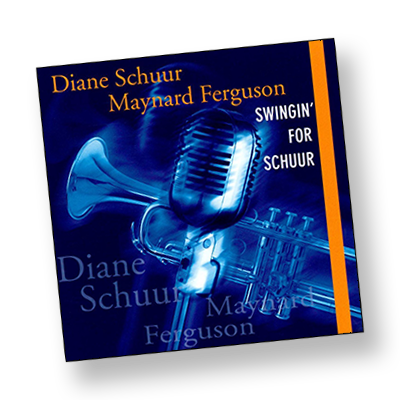
Diana Schuur & Maynard Ferguson – Besame Mucho
On the DX270 the first thing you notice is how effortlessly the rhythm section locks in, with the double bass carrying a warm, rounded tone. Schuur’s voice comes in rich and full, slightly forward but never forced. You can hear the subtle shifts in dynamics without them being pushed at you. The piano sits nicely in the mix with a soft edge, giving chords weight without sounding heavy. Details are present, but they are presented in a relaxed and organic way.
Andrea Bocelli – Di’Tu Se Fedele
Play Verdi’s “Di tu se fedele” by Andrea Bocelli from the album Verdi on the DX270 and what immediately comes through is the sense of space and control, with the orchestra laid out in a natural, believable stage. Strings have a smooth, slightly warm tone and never turn sharp. Bocelli’s voice has a strong weight and presence, not pushed forward but firmly anchored, allowing his timbre to sound full and human. The layering between voice and orchestra remains clear without becoming analytical. Even in the more powerful passages there is no glare or hardness, just a continuous, flowing presentation that keeps everything in balance. Everything is delivered in such a natural way that it feels less like listening to a recording and more like being present at the performance itself.
Harry Connick, JR. – Just the way you are
With ‘Just the way you are‘ by Harry Connick Jr. from the album Your Songs, the DX270 presents the track with a laid-back and intimate character. The piano carries a soft and rounded tone that gently fills the space without drawing attention to itself. Harry’s voice comes through with a natural warmth and a sense of ease. Nothing is pushed forward, yet nothing gets lost either. That balance keeps the focus on the mood of the song instead of individual elements, making it easy to just settle in and let the music do its thing. This is exactly what you expect from a source that is designed to play music. The iBasso DX270 delivers music in a highly organic way and at a very high level, combined with an amazing sense of refinement.