The story begins in 2014, when a group of engineers started Zidoo Technology, the parent company behind Eversolo.
Zidoo Technology specializes in high-end multimedia players and has built a solid reputation over the years. That technical foundation led to the groundwork for something ambitious, creating a division dedicated entirely to audio. This is when Eversolo was introduced as a brand, focused purely on high-end hi-fi.
With the launch of their first streamer; the DMP-A6 in may 2023, Eversolo captured global attention almost overnight. It set new expectations for what a reasonably priced streamer could deliver. The momentum continued with the more advanced A8, which moved the brand firmly into the realm of serious audiophiles. Other products followed, like the flagship A10, DAC-Z10 and AMP-F10 (all statement products that demonstrated how far the company’s engineering had come in such a short time). Eversolo continues to set a high standard has steadily built a strong worldwide following.
The combination of rapid innovation and sound quality defines Eversolo today. From that lineage, the T8 was created, representing not just another model but the next logical step in the company’s evolution into dedicated streamers.
In this review we will test and experience the Eversolo T8 and see how it fits within the brand’s existing portfolio in terms of sound quality and overall performance.

Design & Build Quality
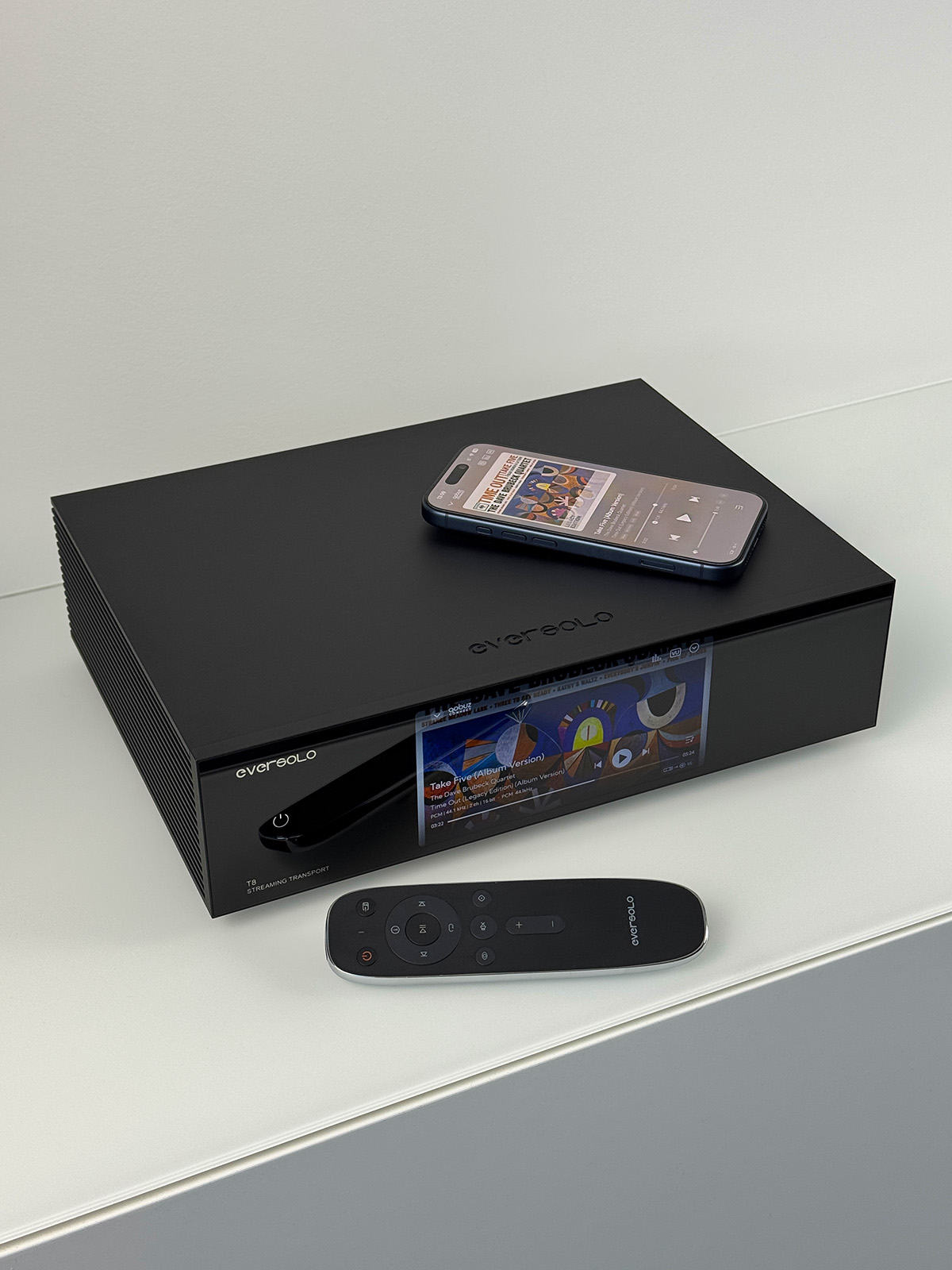
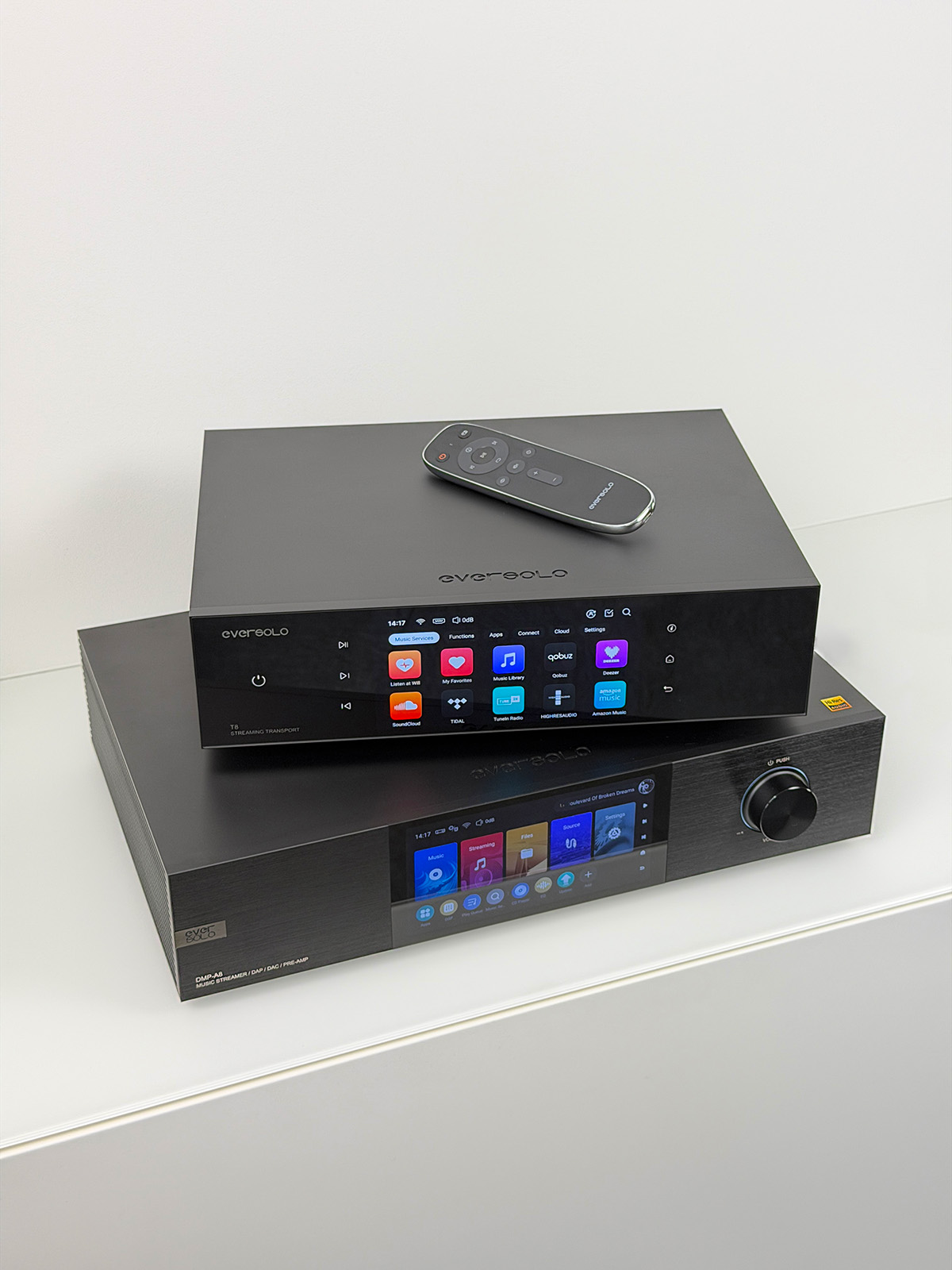
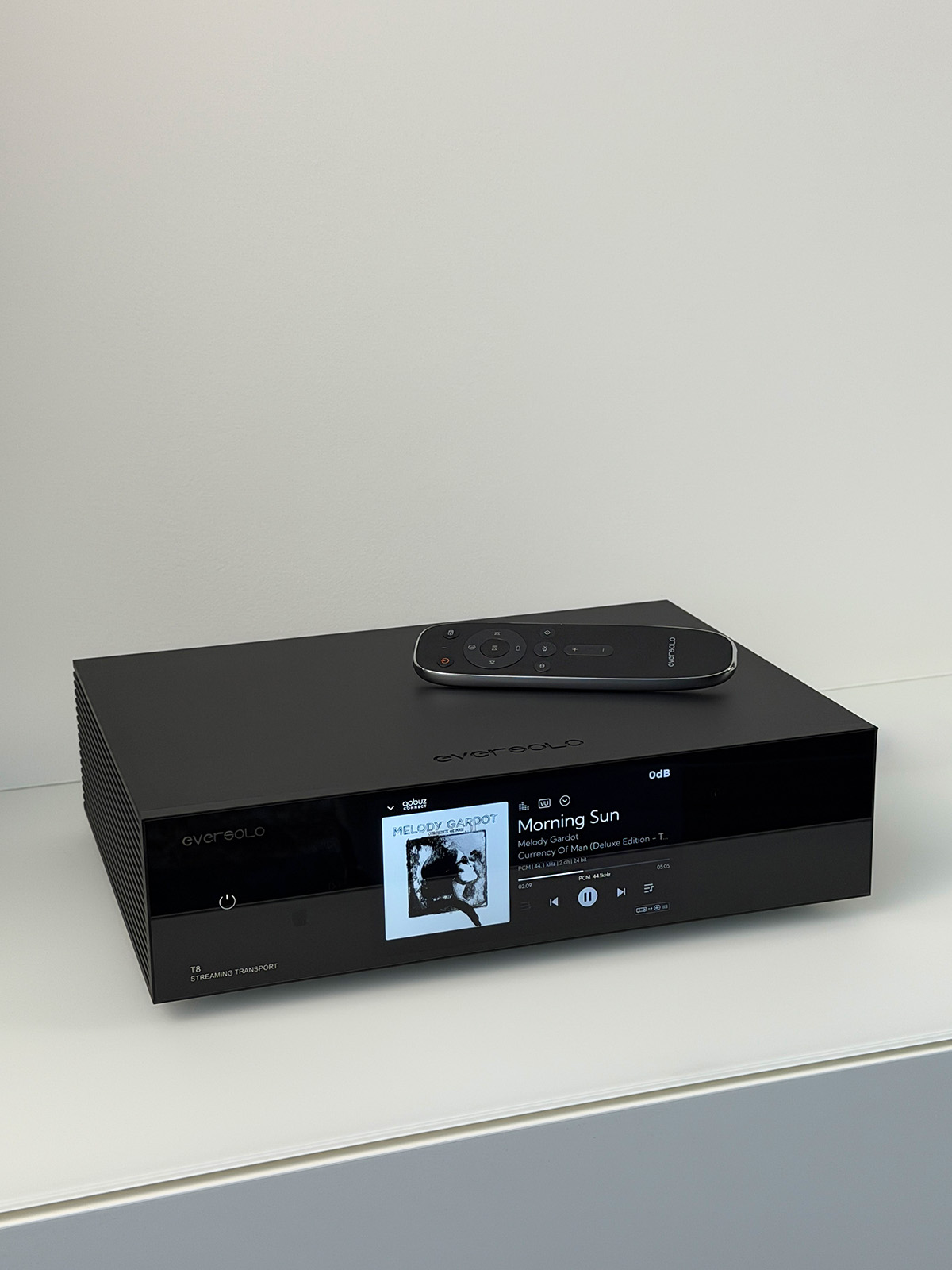
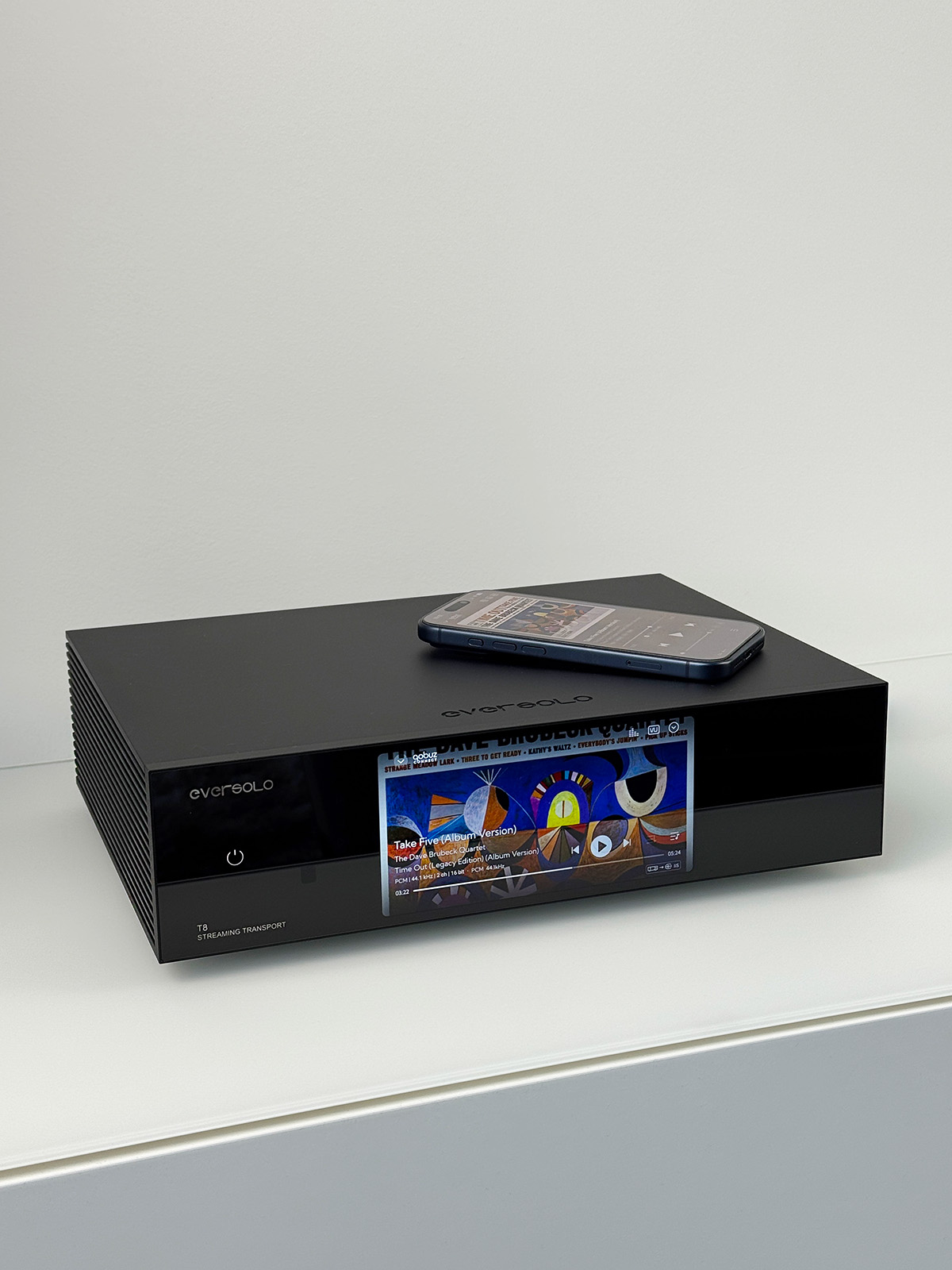
The T8 makes a great first impression with its clean, full glass front panel design. The footprint is smaller than its sibling, the dmp-A8. Although some might have prefered a full-size chassis. Behind the glass we find a sharp and responsive 6-inch LCD screen. Sight by sight compared to the dmp-a8, the new screen clearly represents a step forward. The antennas of the T8 are now integrated into the chassis, resulting in a much cleaner design. The introduced touch-sensitive buttons left and right from the screen, allow more efficient use of the display area. The included redesigned Eversolo remote (reacharable and with metal back) performs reliably and is pleasant to use.
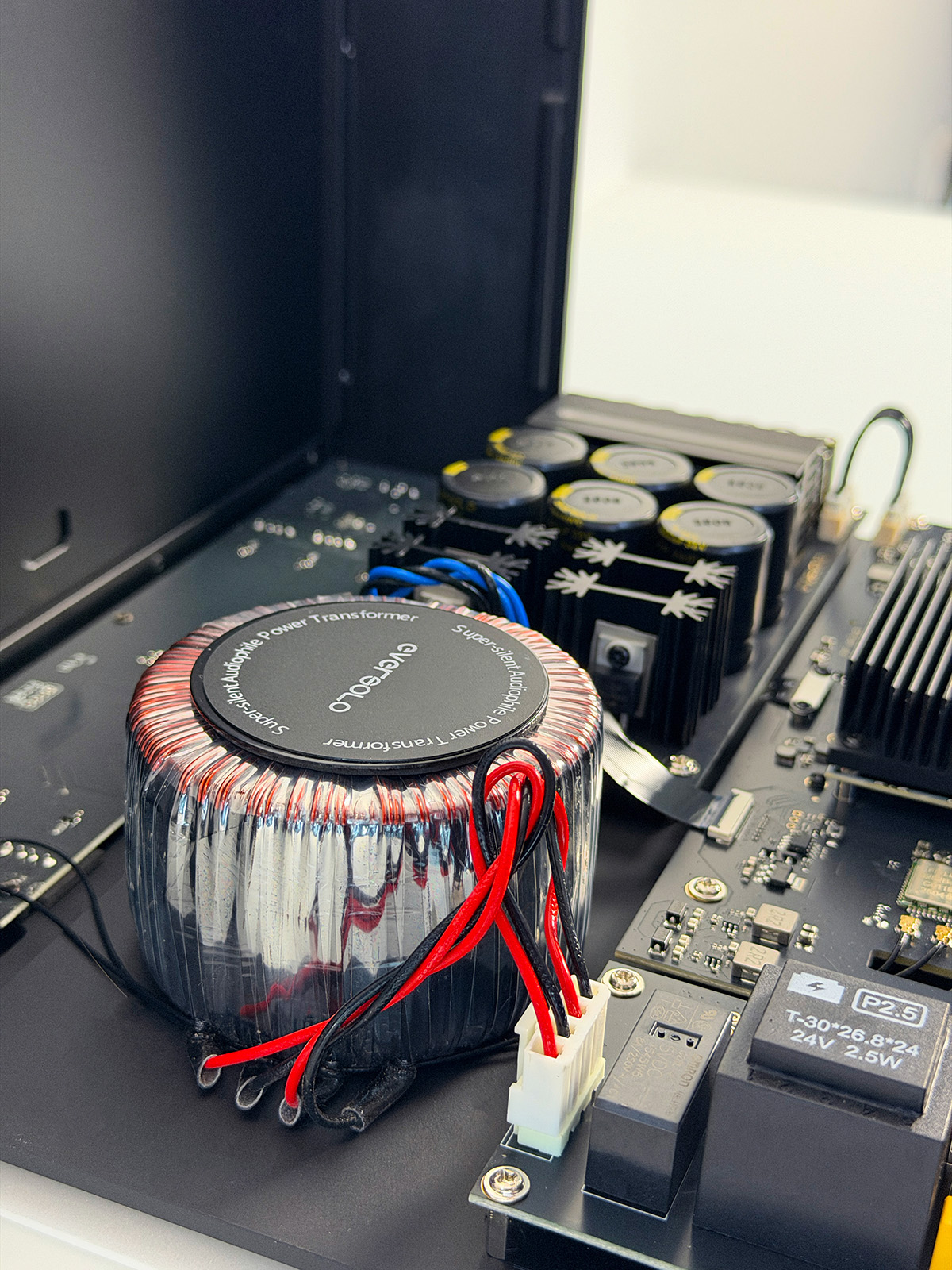
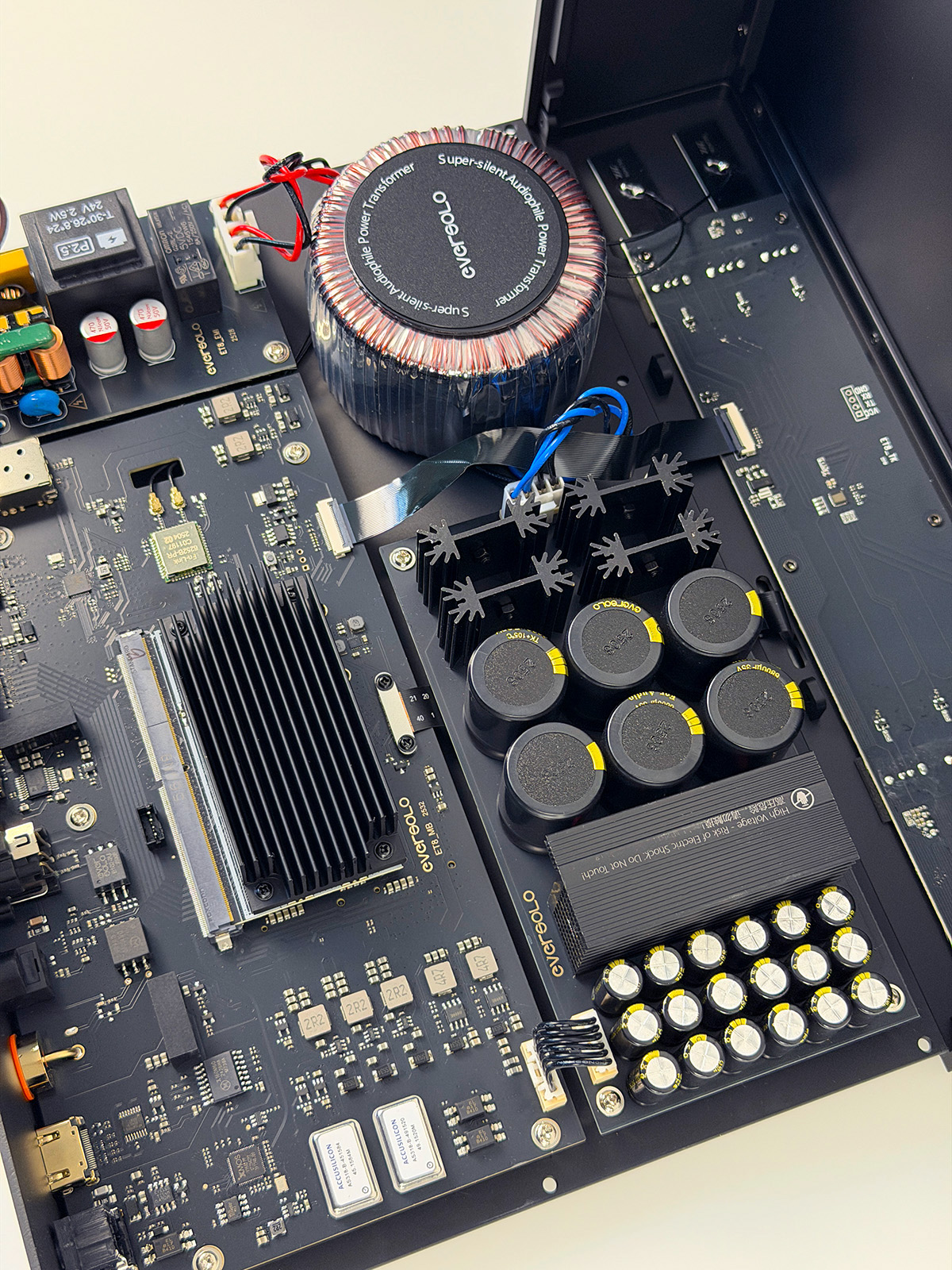
Beneath the refined exterior lies a carefully organized internal architecture. Precision and quality take center stage through the use of Accusilicon femtosecond clocks and a low-noise linear power supply built around a low-noise oxygen-free copper toroidal transformer. Everything is backed with a quad-core processor, 4 GB of RAM and 64 GB of storage ensuring fast and fluid operation. Dual internal SSD slots supporting up to 16 TB of local storage.
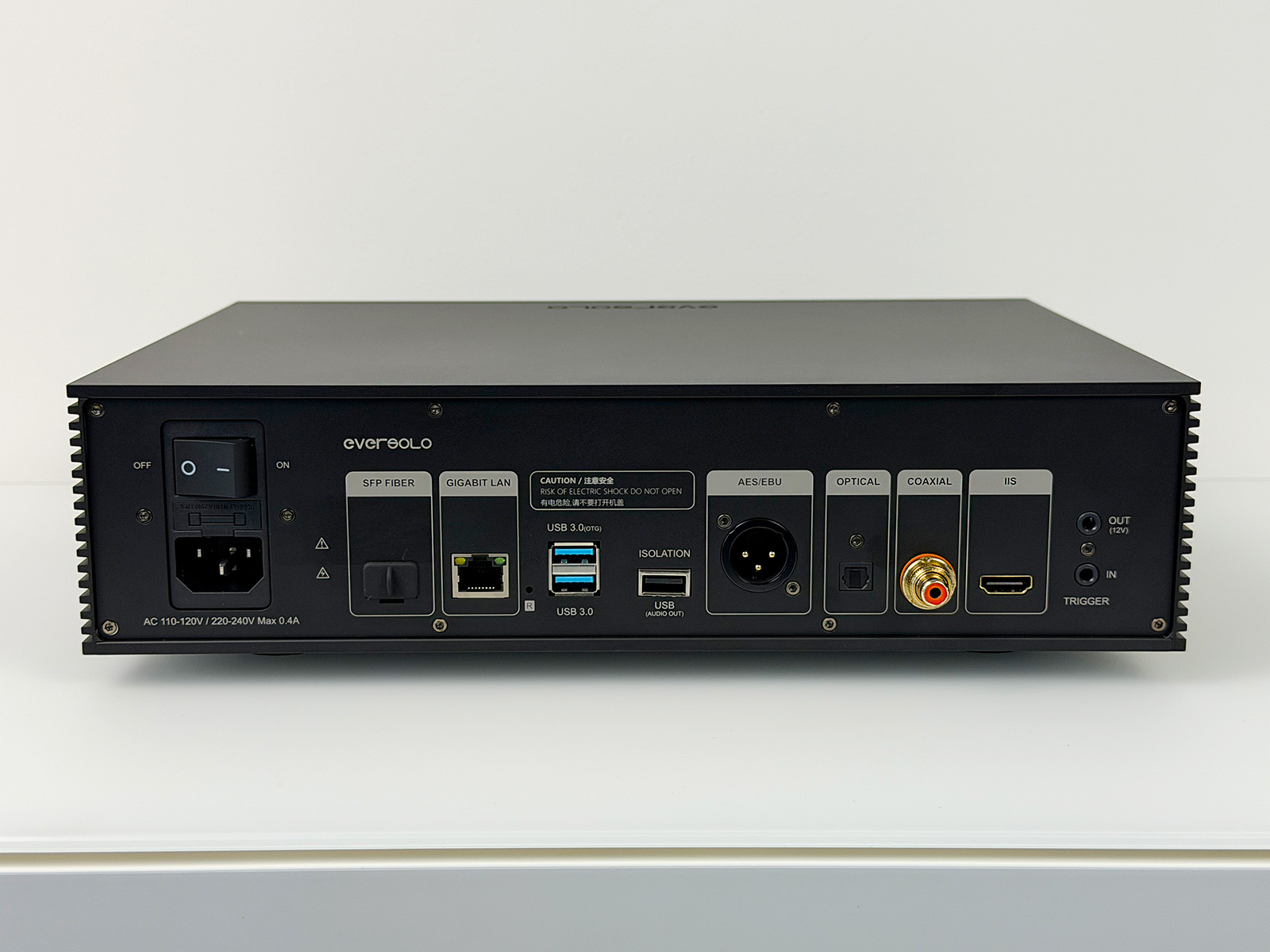
The T8 offers extensive and well-isolated connectivity like an isolated IIS output, usb and coax. In addition to standard network connectivity, it even includes a SFP fiber LAN connection. Eversolo’s Original Sampling Rate Audio Engine (EOS) ensures your music apps output the native sample rate by bypassing Androids SRC (sample rate conversion).
The T8 also features built-in room correction for PEQ, usable with a dedicated microphone, while a smartphone microphone can serve as a decent alternative. With its latest firmware update (v1.5.46), Eversolo even added NAA network support; a significant addition for HQPlayer enthusiasts.
Eversolo’s commitment is evident in regular updates, engagement on forums such as Head-Fi and the continuous introduction of new features and improvements driven by user feedback. Something other brands can learn from.
Compared to significantly pricier competitors, the T8 delivers similar solidity while offering an exceptionally comprehensive feature set at a much lower price tier. The Eversolo’s T8 is build for audiophiles who want high-end performance without breaking the bank.
Specs
- Supported Audio Formats : PCM up to 32bit / 768kHz, DSD up to DSD512, MQA passthrough
- Digital Outputs: USB Audio (Isolated), AES/EBU, Coaxial (Isolated), Toslink, IIS 8 modes (Isolated)
- Clocks: Dual Accusilicon femtosecond
- LPS Custom 4N oxygen-free copper toroidal transformer with noise levels as low as 30μV
- Streaming & Services: Roon Ready, JPlay, TIDAL, Qobuz, Spotify Connect, Apple AirPlay DLNA / UPnP, NAA network support, IDAGIO, Amazon Music, TuneIn Radio, Presto Music, KKBOX, Radio Paradise, Deezer
- PCM: Up to 32-bit – 768kHz / DSD: Up to DSD512 (Native)
- Supported Formats: DSD (DSF, DFF, SACD ISO w/ DST up to DSD512), MP3, APE, WAV, FLAC, AIF, AIFF, AAC, NRG, CUE
- Network: Gigabit Ethernet, WiFi, SFP network port
- Storage: Internal M.2 NVMe SSD slot, USB storage support
- Display: 6-inch full-color touchscreen
- Eversolo Control App (iOS & Android)
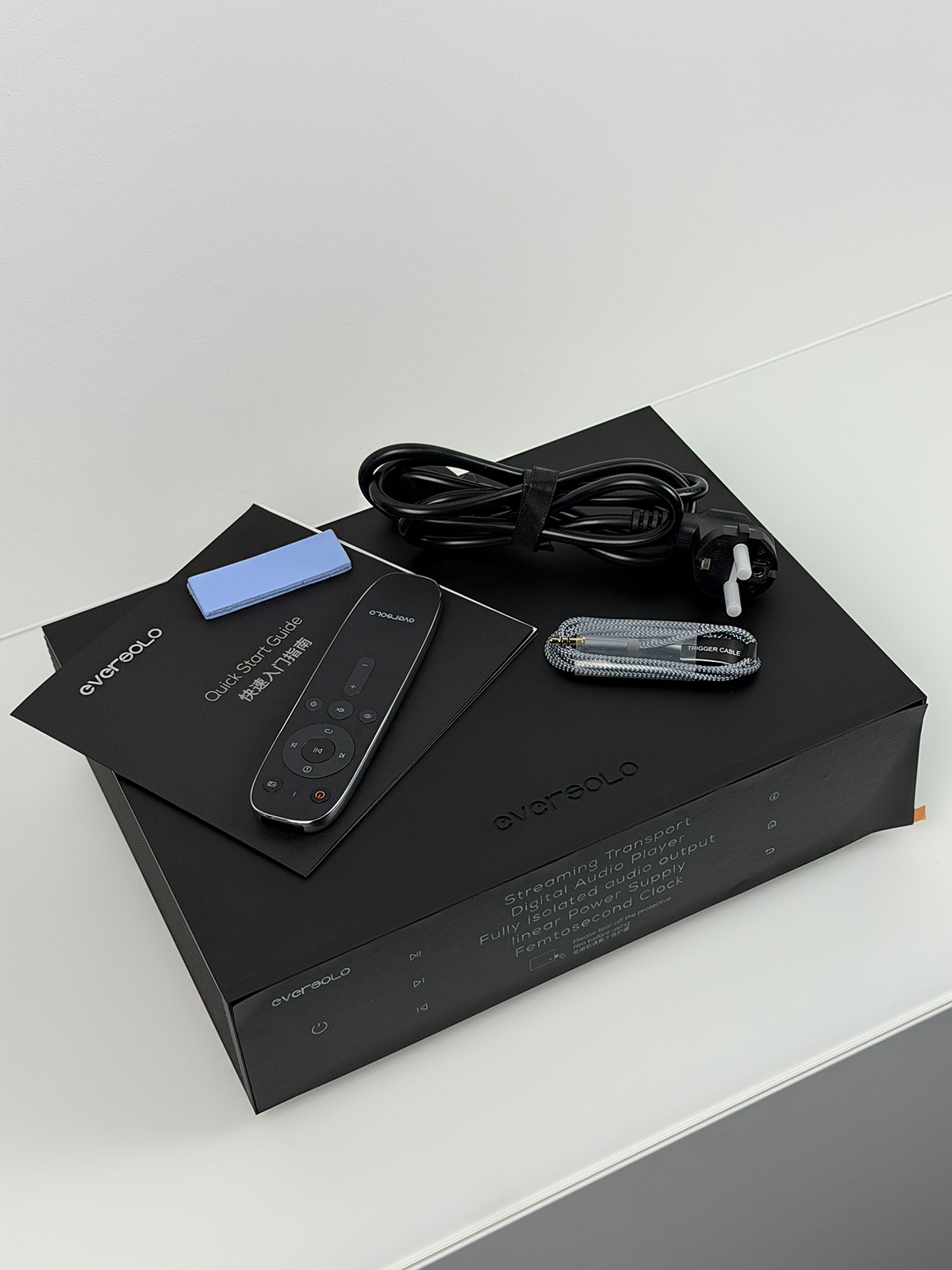
- Remote control (rechargable)
- Dimensions (W x D x H) 26.7 × 17.0 × 8.9 cm / 10.5 x 6.7 x 3.5 inches
- Weight: Approx. 3.5 kg
-
Package Contents: T8 unit, power cable, rechargable remote, 3.5 trigger cable, user manual, 2x thermal pads for nvm-e
All listening impressions for this review were conducted in both a full-sized hi-fi speaker system and a dedicated headphone setup. This approach allowed me to assess the Eversolo T8 and DMP-A8 across different listening scenarios, focusing on consistency, tonal balance and overall musical coherence. By switching between speakers and headphones, it becomes easier to identify subtle differences in presentation and control.
Test equipment for this review
- Sonus Faber Amati G5
- Accuphase C3900 + A48s
- Dac Chord TT2 + Mscaler
- Burson Voyager Soloist
- Arya Unveiled & Fosi i5
- Sendy Audio Aiva 2
- Eversolo T8 & A8(with & without LHY LPS upgrade)
- Media converters & sfp modules
- Media converter: TP-Link MC220L
- SFP: TP-LinkTL-SM311LSA-2KM
- SFP: 10Gtek ASF13-24-10
- LHY Audio SW-8

Interface and screen
The interface feels quick and responsive, switching settings, inputs and outputs is effortless. Although the remote is very pleasant to use, as mentioned above, the app and the touchscreen still remain the most intuitive way to navigate the system.
The interface and app have clearly evolved and matured over the years. As a result, the sheer number of settings and options never feels overwhelming. The T8 also brings an updated interface from Eversolo and adapting to the new T8’s interface, took only a brief adjustment period. If preferred, switching back to the classic layout is only a few taps away. In practice, the new interface quickly proved logical and efficient, leaving little reason to revert to the older design.
Sound quality
The T8 is a dedicated streaming transport and its performance depends on the quality of the connected DAC. When paired with the Chord TT2 and M Scaler, its quality becomes apparent from the first notes. The T8 allows this DAC to perform without any limitation. A pitch-black background with instruments precisely placed within the soundstage. The music has a strong sense of grip and stability. The background is also noticeably quieter than the DMP-A6 & A8 series. Subtle details surface more easily and in a more natural way, The system resolved the smallest vocal inflections, revealing even the faintest breaths and whispers like in Melody Gardot’s voice. This is even more apparent in quieter passages.
Rather than treating digital playback as an added function, you notice clearly the T8 is was engineered with digital output performance in mind. The result is a controlled and precise presentation, with a clear sense of calm and composure. Music is rendered effortlessly and flows naturally.
As a transport, the T8 presents music with a high degree of purity and openness. Imaging is stable and accurate, micro-details are easy to follow and the overall noise floor is noticeably lower then the a6 or a8. This does not result in a sterile sound though. The T8 manages to balance precision with ease, allowing music to breathe while remaining tightly controlled. Bass is well defined and articulate, midrange sound clean and smooth. High frequencies retain detail without any digital harshness or glare, compared to the A8’s digital out this step-up is very noticable.
Of course, the final result remains dependent on the quality of the connected DAC, but with a decent and capable DAC the T8 won’t be a limiting factor at all.
Sound difference between connections
With testing I focused my listening on the various digital outputs, comparing the different connections to assess their impact on sound quality. Each output was evaluated with the same downstream setup to keep variables to a minimum.
Digital-Out
Coaxial and Toslink outputs sound the smoothest, with very similar overall quality. The USB output delivers slightly more detail. With the T8, Eversolo has clearly focused on noise isolation, this is easy to hear, mostly through USB. I can not comment on IIS or AES, as I do not have a DAC that supports these interfaces.
Network connections
We also tested the different network connections, as there is often discussion about their influence on sound quality. While I expected some variation, the differences turned out to be more noticeable than anticipated.
SFP optical network connected
We used two different SFP modules to see if the outcome was general the same. With SFP the T8 sounds very detailed but leaning more towards (almost) analytical. The soundstage became a bit narrower and more centered. Stage and placement are very precise with SFP, but instruments felt almost surgically separated, as if each part of an orchestra was presented on its own. While impressive at first, this reduced the sense of overall harmony. Don’t get me wrong, it still sounds great, just be aware of this difference in sound signature.
Wi-Fi connected
In my opinion, this is the most musical option. Compared to SFP, the treble sounds less stressed and more relaxed. It also comes across as the smoothest and most harmonious of the three connections, without sacrificing detail. With Wi-Fi and UTP, the music feels more cohesive, preserving the natural balance and flow of the performance more effectively.
UTP connected
The sound is very similar to Wi-Fi. The difference between Wi-Fi and UTP is very small. In A/B testing, the results were not consistent enough to suggest a significant difference. This was totally different with SFP, which stood out clearly and was easy to identify every time.
This difference in network connection was an outcome we (JJAZZIFI) did not expect at all.
T8 Eversolo compared to dmp-a8
Many readers asked for a comparison between the T8 and the DMP-A8, focusing purely on their performance as streamers. The DMP-A8 is already a highly regarded and capable sounding streamer on it’s own. Moving to the T8 shows that there is still room for further refinement. With the T8 Instrument separation clearly gained more precision, the soundstage opened up further in width and depth and the background became noticeably darker and calmer. The overall delivery is more polished and composed. Don’t get me wrong by all means, the dmp-a8 is still a very good streamer with or without the LHY LPS upgrade!
Before testing we did not anticipate the performance gap between the dmp-a8 to be quite as noticeable. During quick A/B testing, the differences initially felt subtle, but extended listening sessions told a very different story. The T8 is unmistakable a step forward. This is no small achievement, given the A8’s already excellent streaming performance. With the T8, the entire presentation is gently lifted to a higher tier. Everything feels just a touch more composed, smooth and more mature. The T8 sounds more natural, presenting the music in a calmer and more controlled way.
On Diana Krall’s Boulevard of Broken Dreams, there is a section with a piano solo where the difference became clear. Through the DMP-A8, the piano carries a slightly sharper treble edge. When played back on the T8, the same passage sounded a touch smoother and more controlled, with less emphasis on the upper harmonics.
Some users have upgraded the DMP-A8 with an LHY dual LPS. I own that upgrade to, so I tested it against the new Eversolo T8. This upgrade brings the DMP-A8 much closer to the T8, but it still does not close the gap completely.
You will have to decide for yourself whether this improvement is enough to justify replacing your DMP-A8. For new buyers who are looking for a ‘streamer only’ and have no need for a DAC section, the Eversolo T8 is a clear and logical choice.
Listening Impressions
The following selection of tracks were chosen by me to explore a wide range of sonic attributes, from microdetail and imaging to rhythm and textures. I also made a direct comparison between the dmp-a8 (with Eversolo PSU build in). The Eversolo T8 was utp connected for this test.

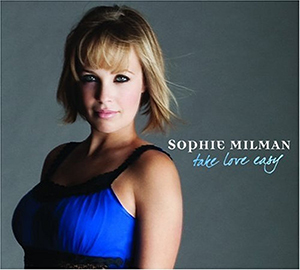
Sophie Milman – 50 ways to leave your lover
Sophie Milman’s voice sounded intimate and well focused, with a natural warmth and excellent control in the upper midrange. The rhythm section felt relaxed and precise, the background remained notably quiet, allowing small vocal inflections to come through easily.
Compared to the DMP-A8, the T8 sounded slightly calmer and smoother in the treble, with less edge on consonants and cymbal accents.

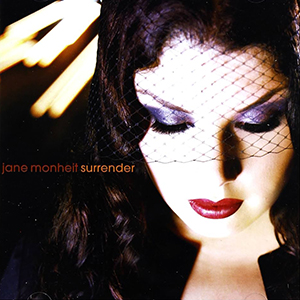
Jane Monheit – Rio de malo
The T8 presented this track with a refined sense and flow. Jane Monheit’s phrasing feels fluid and the interplay between the two vocals and instruments is well balanced. Voices are very clearly seperated in a very smooth way.
Compared to the DMP-A8, there is slightly better separation without pushing instruments forward, resulting in a more natural overall balance.
Willie Nelson – The Border
Willie Nelson’s voice came through with texture and realism, slightly rough around the edges but never thin or brittle. The acoustic guitar sounded natural and well proportioned, with a convincing sense of body and decay.
Compared to the DMP-A8, the T8 offered a calmer quieter background and a tad more relaxed treble, noticable in the guitar strings, Willie’s voice sounded just a tad more organic.
Whitney Houston – I will always love you (Live in Kings Park Stadium)
This live performance benefits from a darker background and better control during dynamic peaks. Whitney Houston’s voice remained powerful but composed, even at high intensity. The crowd and ambience stayed well layered. Separation was exquisite, holographic.
Compared to the DMP-A8, the T8 handled separation with more ease, sounding slightly less treble hot in the upper frequencies. Although, these differences are subtle.
Diana Krall – Boulevard of broken Dreams
The piano on the T8 sounded full and controlled, with a natural decay and no glare in the higher registers. Diana Krall’s voice sits comfortably in the mix, supported by a well-defined but relaxed rhythm section.
Compared to the DMP-A8, the T8 smooths out a slight sharpness in the piano’s treble, resulting in a more composed and balanced presentation.
Conclusion
Once again Eversolo clearly demonstrates how far the brand has matured in a remarkably short time. Zidoo has evolved into a serious high-end audio manufacturer with Eversolo. The T8 is not just another streamer in the lineup, but a carefully thought-out digital transport that reflects everything Eversolo is.
As a dedicated streamer, the T8 really impresses with its low noise floor and sound quality. It delivers music with extreme precision and calmness, without sounding clinical or sterile. When paired with a capable DAC it never becomes a bottleneck in the chain.
Eversolo’s commitment to software support, regular updates and active engagement with its user base further strengthens the overall package. A commitment that is quite rare in todays market. Add to that the refined design, excellent build quality and one of the most complete feature sets in its class and the T8 stands out as a compelling proposition.
Compared to the already excellent DMP-A8, the T8 brings subtle but meaningful refinements. The improvements reveal themselves most clearly during longer listening sessions, where the darker background, improved separation and a more natural presentation become increasingly apparent. This is not a dramatic leap, but definately a step forward. Whether the improvement justifies replacing a DMP-A8 is a personal decision. For new buyers seeking a streamer only, the Eversolo T8 is the clear and logical choice.
Yes, there are other streamers that might offer small incremental improvements. The real question is whether those small gains justify the extra cost, especially when choosing the T8 allows you to invest those savings in a truly high class DAC.
The Eversolo T8 is built for audiophiles who want a high-end streaming transport without breaking the bank. At JJAZZIFI we give a clear thumbs up and a full recommendation for a streamer that delivers this level of quality at such an accessible price point.
Pros
- Premium build quality with a sleek full glass front panel
-
Excellent 6-inch touchscreen that is intuitive and responsive
-
Flexible software platform with frequent and reliable updates
-
Active engagement with the audiophile community (Head-Fi)
-
Clean, refined and highly transparent sound
-
Very low noise floor
-
Extensive digital-out connectivity
- Broad streaming service integration
- Roon ready
-
Wi-Fi 6 support
- SFP fiber support (SFP has to be ordered separately)
-
Dual internal SSD support (16TB total)
- Built-in room correction software
Cons