Shanling‘s history in audio dates back to 1988, the year it introduced its first amplifier. Since then, the brand has steadily expanded and refined its expertise, growing into a manufacturer. They have a broad range of products that spans portable high-resolution players, headphone amplification and DAC solutions.
Based in Shenzhen, Shanling operates its own production facilities. This allows them close control over design and build quality. The company has built a strong reputation with both solid-state and vacuum tube technologies. They have a clear focus on maintaining a recognizable Shanling house sound and an intuitive user experience.
We recently reviewed Shanling’s tube based M8T flagship. In this review we will explore the UA7; their latest portable DAC, which also incorporates a pair of the JAN6418 vacuum tubes.
What’s in the box and design
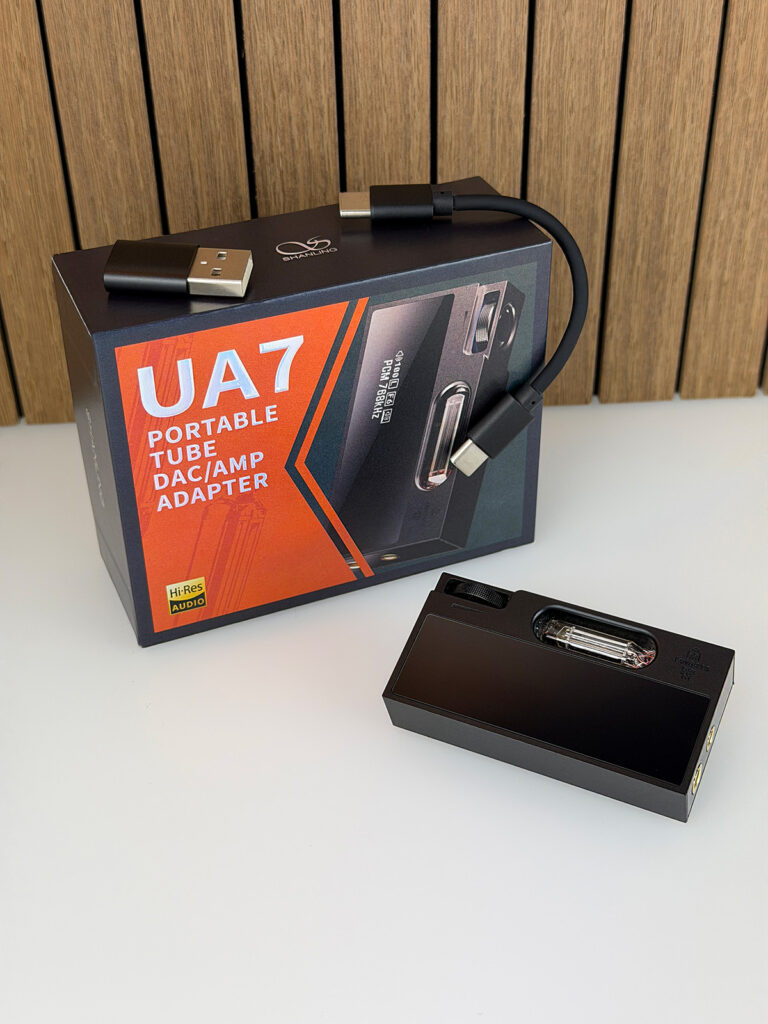
The UA7 is shipped in a compact box. Inside the box we find the UA7, secured in custom-cut foam. Beneath the foam we find a small compartment with the essentials: an USB-C cable, USB-A to USB-C adapter, along with the user manual and warranty documentation. The packaging is fitting for a DAC of this size. Everything you need to get started is organized in the box.
Build
The chassis is machined from high quality aluminum and finished with a nice powder coating. It is a premium looking device. The UA7 is offered in three great finishes: deep black, titanium gray and radiant orange. The orange variant certainly stands out most of course.
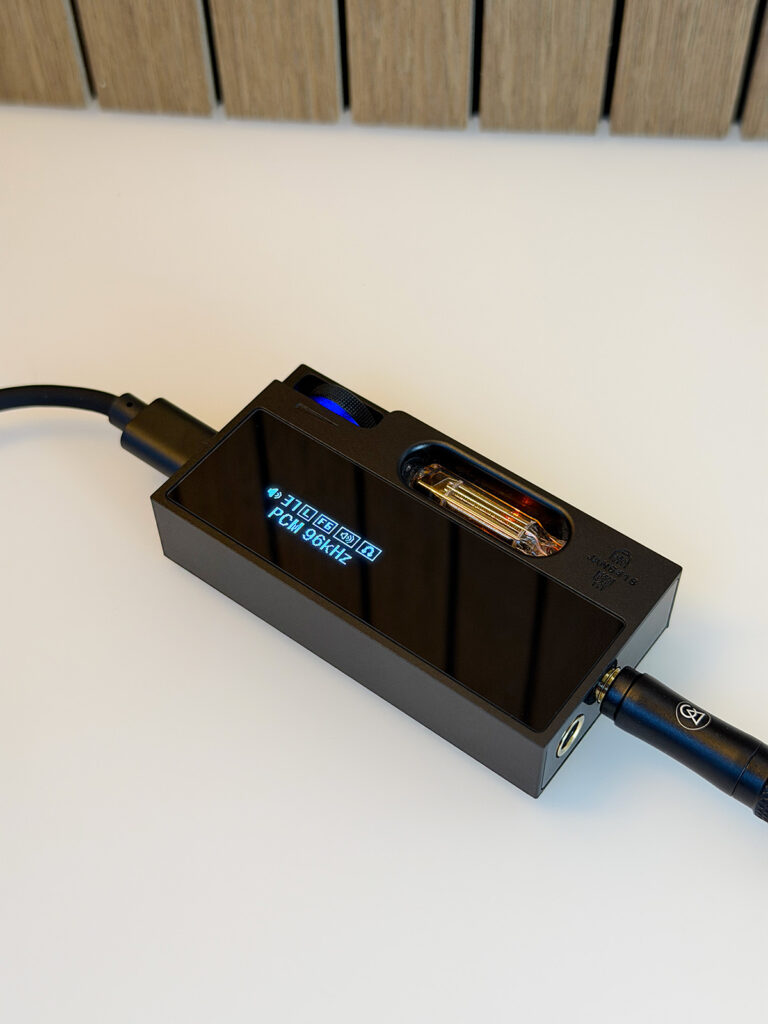
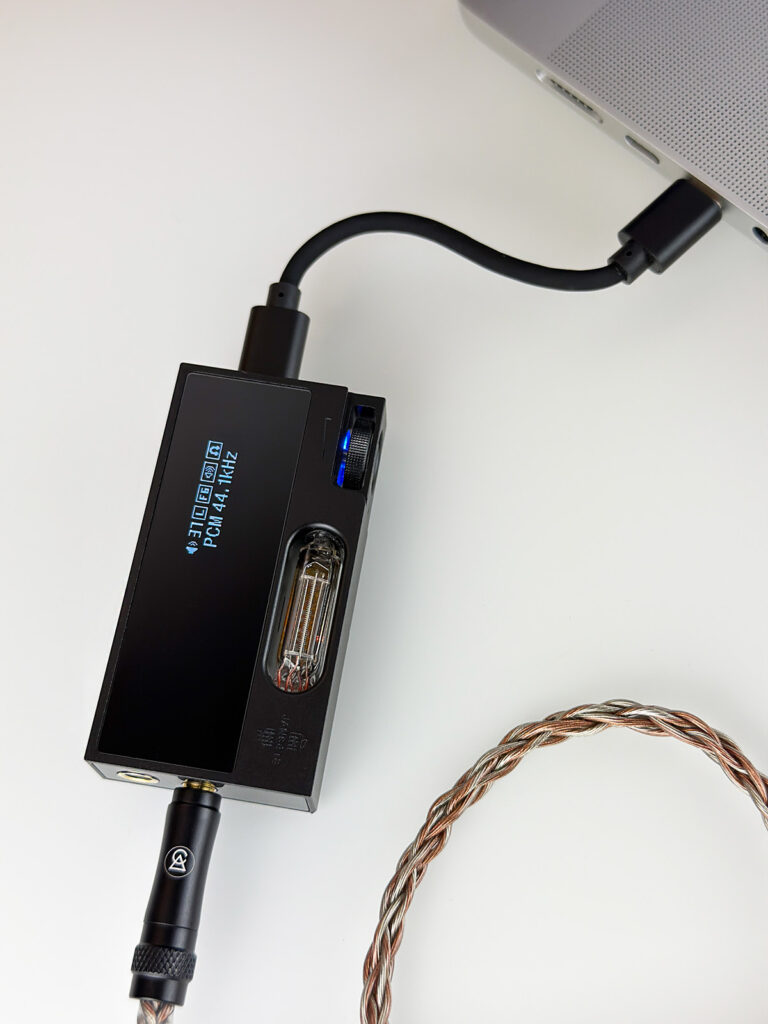
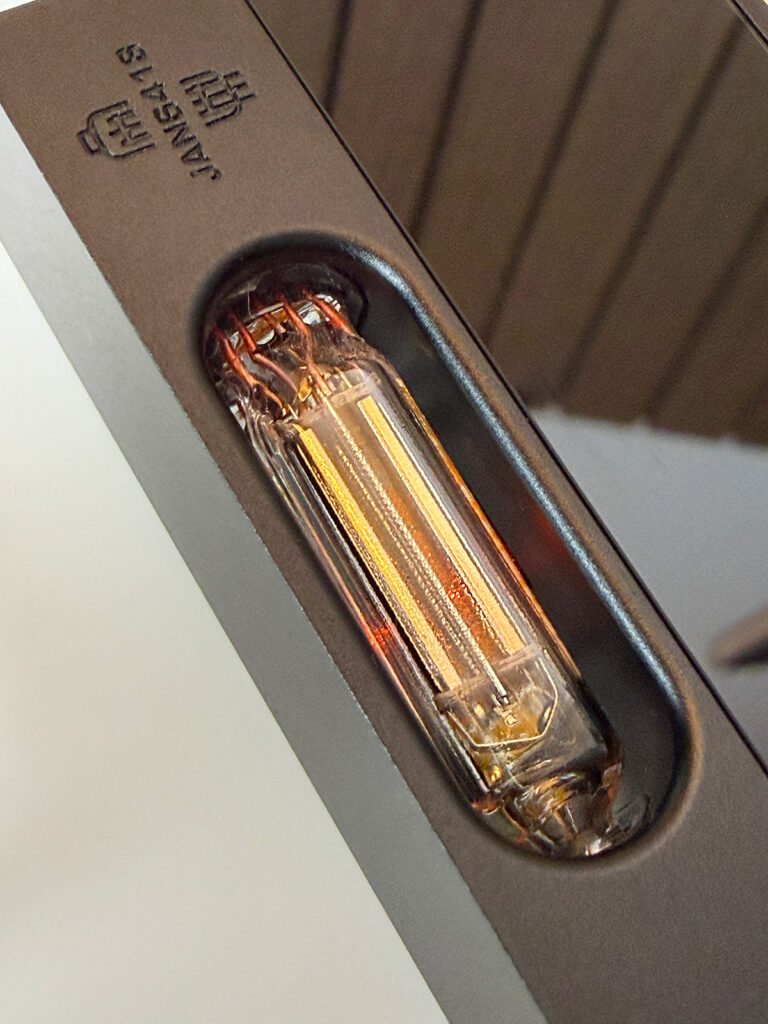
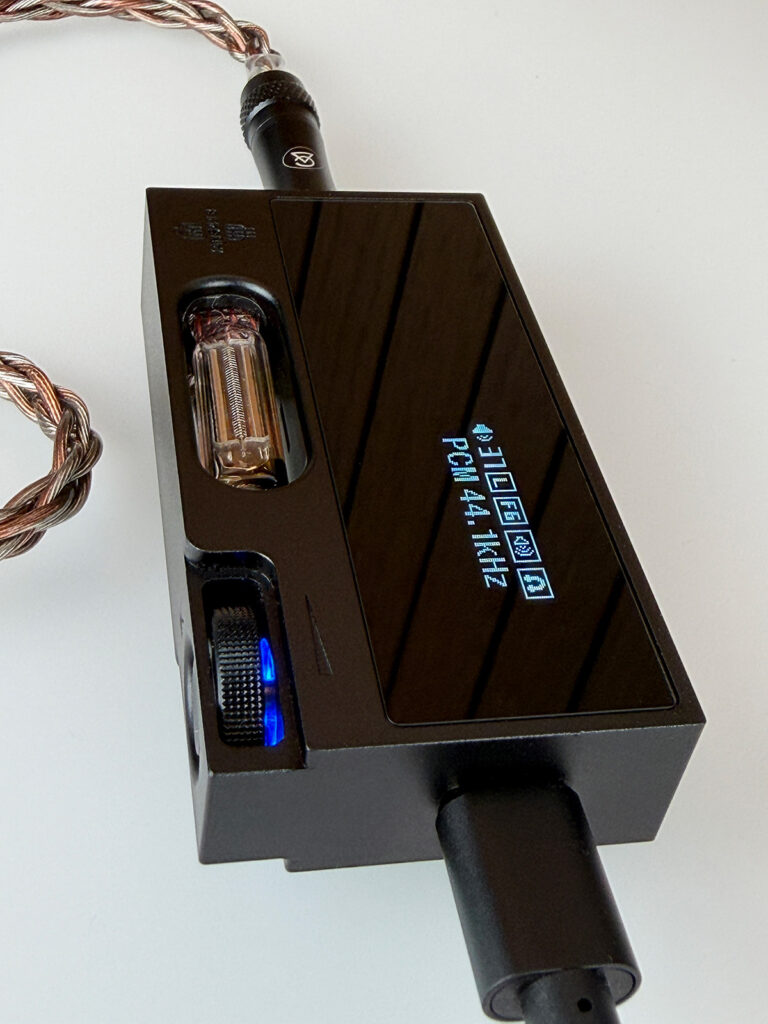
The UA7 features a great and functional 0.87 inch OLED display. The housing is compact and lightweight, especially given its solid construction. There is an internal shock absorbing structure designed to protect. Once connected, the dual JAN6418 vacuum tubes immediately emit a beautiful orange glow.
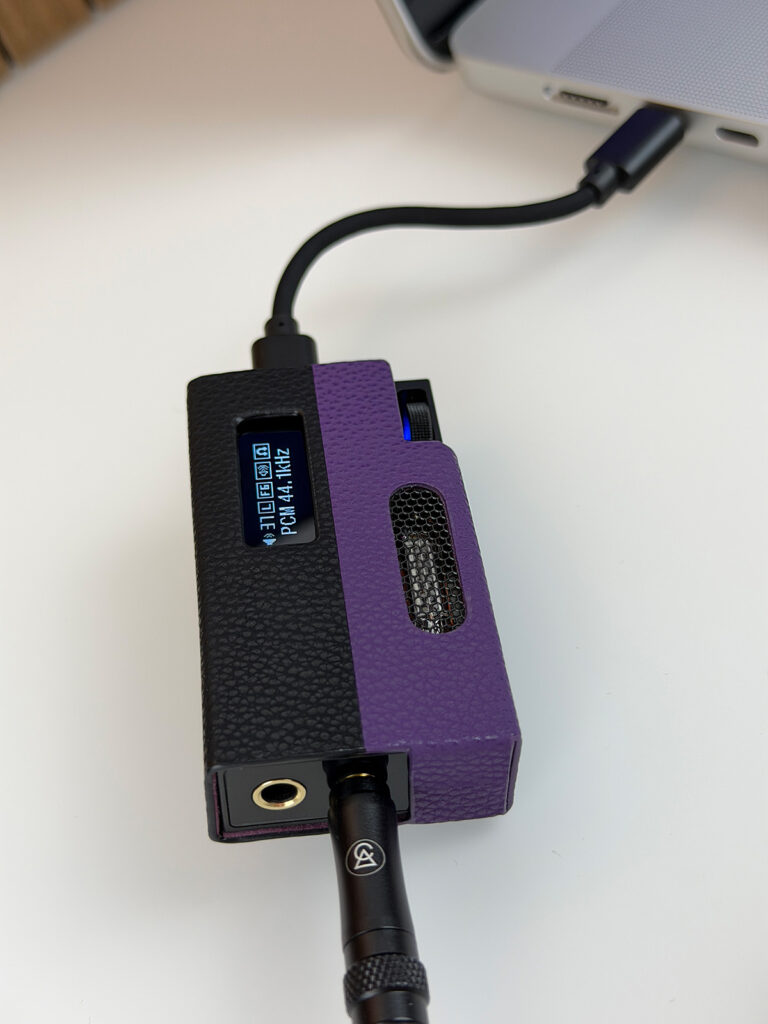
The tubes on the UA7 are fully exposed. A protective grille, as seen on the Shanling M8T, would have been a nice addition. Shanling does offer a (not included) orange or purple leather case, which protect the exposed tubes. For this review we did order and include the purple leather case.
Control is handled by a volume wheel that also functions as a multifunction button. Menu navigation is intuitive and reliable. A small status LED provides instant feedback on the active signal format, with different colors indicating PCM(Blue), DSD(Green) or UAC 1.0(Red) operation.
Menu settings
- Gain: low/high
- Tube: on/off, filter
- Volume wheel options: dac/system volume / track up/down
- Font
- Balance
- Display brightness
- Screensaver
- Rotate screen
- Uac 1 or 2
The JAN6418
The JAN6418 is a military-grade sub-miniature pentode tube originally developed for compact communication equipment in the 1950s. Its extremely small form factor, low power consumption and shock-resistant construction makes it well suited for modern portable audio devices where space and efficiency are critical. The JAN6418 is valued for its neutral character and its ability to introduce a controlled harmonic texture. A slightly smoother treble response, providing a subtle tube character without compromising resolution or overall technical performance.
A question many might wonder: “how long will those tubes last?” The JAN6418 is typically rated for around 10,000 hours. At two to three hours of daily listening, that equals roughly 9 to 13 years. Real-world results may vary of course.
With the UA7, Shanling introduces an amplifier design which previously was only reserved for its high-end portable players. The circuit uses dual OPA1612 op-amps for I/V conversion, followed by two OPA1662 op-amps and four BUF634 buffers, delivering quicker transients and greater dynamic headroom for both headphones and IEMs. At the core the latest generation ESS ES9069 DAC is used.
The ESS ES9069 is a new HyperStream IV stereo DAC designed for very low noise. It offers a strong dynamic range and high power efficiency, specific for portable and desktop devices. Compared to the ES9039, it often offers a slightly cleaner noise floor. The ES9069 is generally seen as the more modern choice for compact high-resolution audio designs.
Considering its size, the UA7 packs serious power, with up to 577 mW at 32 ohms on the 4.4 mm balanced output and 195 mW at 32 ohms on the 3.5 mm single ended output.
Pairing the UA7 with a smartphone unlocks additional customization through the Eddict Player app, offering fine-tuning options for those who want deeper control.
Specs
Weight: Approximately 48.5 grams / 1.71 ounces (oz)
Test equipment
Sound Quality
The UA7 sounds clean and refined, with an enjoyable sound signature. It has a transparent presentation that makes fine details easy to pick up. In solid-state mode, micro-details such as reverb trails, harmonics and dynamic shifts come through effortlessly. In tube mode it prioritizes tone and body over maximum detail, giving it a warmer and richer sound.
The overall resolution is clearly above average, backed by clean transients, a low noise floor, good layering and strong separation. The UA7 offers strong detail and a balanced presentation.
Changing between the two amplification modes is simple. Neither modes are a compromise. The tube setting delivers a warmer, fuller and more relaxed character. The solid-state mode retains some of the signature warmth but sounds more tight, with faster transients, cleaner edges and a leaner low end. Both approaches are very well executed. Think of it as a single device offering two distinct sonic tunings.
The UA7’s sound quality resembles more that of a capable DAP than a typical portable DAC, due to its high-quality performance in a compact form factor, which will most likely satisfy most listeners.
Tube amplification
The tube setting on the UA7 delivers a beautifully controlled and natural warmth, avoiding the exaggerated coloration often associated with tube designs. Rather than sounding overly thick or vintage, it presents a refined, smooth and elegantly balanced character. It sounds controlled and articulate, it (of course) is clearly the richer sounding of the two modes. The presentation is natural and organically smooth. The sound gains a mild warmth and a fluid character, without losing resolution. There is a sense of texture and tonal density, but the underlying clarity still remains intact.
Even when paired with warmer IEMs, the UA7 maintains a good control and avoids sounding congested or overly weighted. Since the tubes operate as a buffering stage after the solid-state circuitry, the technical performance remains largely untouched. The presentation successfully blends the strengths of both approaches, making tube mode only modestly warmer than solid-state, but distinct enough to be genuinely worthwhile. The tube stage sounds for example excellent for classical and jazz, while the solid-state mode stands more out with EDM.
Treble
In tube mode the treble is slightly more laid back than in solid state. Edges sound softer and sharpness is reduced. It gives up some crispness and bite for a more organic and relaxed presentation that smooths out peaks. It is not as precise or tightly defined as solid state but it still keeps enough energy and detail to stay engaging. The result is a natural and smooth top end that keeps you listening.
Midrange
The UA7 delivers a fluid midrange with a natural tonal balance. Vocals have good body and presence. Male voices sound solid and strong, while female vocals come across smooth, slightly forward. Despite the added warmth, the presentation remains clean and well resolving. The midrange balances musical coherence with solid technical performance.
Bass
In tube mode, the low end has weight and note density, resulting in a full but controlled bass presentation. Bass notes stay well defined, with a long decay and rounder note shaping. This tuning works particularly well with bass-lighter earphones, improving low-end presence and timbre without introducing bloom or loss of control.
Solidstate amplification
The difference between tube and solid-state operation on the UA7 is more about character than real contrast. The tube setting adds a touch of extra warmth and density, but the solid-state presentation stands firmly on its own. It trades a bit of that earthy texture for a slightly leaner and more direct sound, with less emphasis on note weight and harmonic bloom.
When operating in solid-state mode, the signal path bypasses the JAN6418 tubes entirely. The result is a more transparent output that leans closer to neutral. Transients feel tighter. The overall presentation becomes more revealing, with sharper note edges and improved micro-detail retrieval. Whether this is preferable, it ultimately comes down to personal taste. The great thing is that you can switch between the two modes. Both modes offer their own strengths and are equally satisfying in their own way.
Treble
The treble is more energetic and precise than in tube mode. Edges are cleaner, transients are faster and the attack is crisper. It leans closer to neutral but it still remains smooth and enjoyable without sounding sharp or forced. With less coloration and more transparency it adds extra bite, extension and technical clarity. In solid state mode the treble is more revealing and versatile.
Midrange
In solid state mode the midrange sounds clean and transparent with a touch of warmth. Of course it is less warm than with the tube stage enabled. The mids have stronger clarity and resolution. Transients are quick with a faster decay which improves separation and gives notes more definition. The solid state midrange blends subtle warmth with a more resolving and technical presentation.
Bass
The bass sounds tighter and more controlled than with the JAN6418 stage enabled. It has a faster attack and a shorter decay compared to tube mode. Sub bass extension is clean with minimal overhang, while there is enough body to avoid sounding lean. While it lacks some of the weight and bloom of tube mode, the added clarity and precision make the low end feel denser and more refined. This benefits deep blues bass lines or EDM tracks.
Soundstage and separation
The UA7 is a small dongle, but it does not sound small at all!. The stage has good width and breathing room. It does not sound cramped or closed in. It presents an open stage in a natural way. Tube mode leans slightly toward a more intimate presentation, it gives a softer presentation with less sharp layering. Solid-state mode improves a little in clarity and depth. The overal imaging on both modes is excellent for its class.
Compared to many other dongle DACs, the UA7 sounds wider, taller and deeper than most. It even comes close to the scale of some larger portable players. Objectively speaking there are many strong competitors, but on a personal note the UA7 is currently one of my favorite portable DACs.
Pairing
Kiwi Orchestra II
The Orchestra II leans toward a balanced and slightly analytical presentation with a hint of warmth. With the UA7 in tube mode, the midrange gains a bit of extra body and smoothness, giving strings and vocals a natural and fluid tone without losing resolution. The added bass weight helps the overall presentation. Switching to solid-state mode tightens the sound, improving separation, clarity and note definition.
Sivga Nightingale Pro
The Nightingale Pro already has a warm and full-bodied sound signature. In solid-state mode, the UA7 brings better balance by tightening the bass and improving transient control. This prevents the sound from becoming overly rich. The midrange remains natural and textured. In tube mode, warmth and density increase further, resulting in a smoother and more relaxed presentation that some may find slightly too thick depending on preference.
Campfire Audio The Alien Brain
The Alien Brain is energetic and highly resolving, with strong presence in the upper registers. The UA7’s tube mode pairs particularly well here. Tube modes helps softening treble edges slightly and adding harmonic density. In solid-state mode, the presentation becomes extremely precise and fast. It may sound a touch energetic for treble-sensitive listeners.
Sendy Audio Aiva 2
The Aiva 2 is an open and airy planar headphone with good speed and clarity. In solid-state mode, the UA7 complements its strengths with tight bass control, clean mids and well-defined treble, preserving the planar character. Tube mode adds a touch of body and warmth to the midrange. This works well for vocals and acoustic music, though it slightly reduces the planar sharpness and speed.
Campfire Audio Andromeda 10
The new Andromeda 10 has a warm, smooth tonality with a natural midrange and quite laid-back treble. In tube mode, the low end feels a bit fuller and midrange vocals gain some extra body. Treble becomes softer and less forward. In solid-state mode, the presentation tightens up. Bass is quicker, the midrange stays transparent and treble gains slightly more definition and clarity. In solid-state detail retrieval and separation both improve subtly.
Listening impressions
I chose this selection of tracks to explore micro-detail, imaging, rhythm and texture. All listening was done with tube stage enabled.
Jane Monheit – Surrender (Surrender)
This track is mainly about vocal control and small inflections. Her voice sat close to the listener, with strings and piano forming a soft layer behind it. On the UA7 vocals had body in the midrange without becoming thick. Simbilance was absent clean and the top end is smooth. The strings kept their sheen but did not lose detail. It showed that the JAN6418 tube stage is not there to color the sound heavily, but to round the edges slightly while keeping articulation intact.
Myriam Alter – Still in Love (Where is There)
The strength of this track lies in the balance between piano, cello and the space around them. The recording carries many small dynamic movements that are easy to lose on a flatter source. Here the piano kept a clear initial strike while the trailing notes felt fluid and natural. The cello stands out most, gaining a bit more weight in the lower registers. There was a clear sense of air between the instruments, which allowed the ensemble to breathe. A very nice presentation.
John Lee Hooker – Chill Out featuring Santana (Chill Out)
Through the UA7, Hooker’s voice had weight in the lower mids. Santana’s guitar stayed clear but lost a bit of sharpness in the highest edges, making long notes smoother. This track clearly highlighted that the tube stage is not just a strong vintage filter, but a subtle softener that adds body without slowing the presentation.
Ibrahim Ferrer – Musica Cubana (Buenos Hermanos)
This track focuses more on rhythm and ensemble drive than on a close vocal. Layered percussion, upright bass, piano and brass all move together. On the UA7 the midrange gained slight warmth, giving Ferrer’s voice a bit more body while the bass sounds rounder and the piano decay felt real. Fast percussion had speed and bite. The brass stayed smooth. The JAN6418 tube effect was subtle, adding cohesion and flow without blurring individual instruments.