Sendy Audio is a high-end headphone manufacturer based in Dongguan, China, operating under the parent company Sivga Electronic. The brand was founded by audio engineer Jian Zhou and Rongchun Pan, who recognized an opportunity to expand into the upper segment of the audiophile market.
While Sivga Electronic is known for producing more accessible audiophile equipment, Sendy Audio was created as the company’s premium line, with a strong emphasis on natural materials, refined craftsmanship, elegant design and high-level technical performance.
Sendy Audio places strong emphasis on in-house development. Both driver technology and housing design are developed internally. Unlike many competitors that rely heavily on OEM platforms, Sendy Audio maintains direct control over the entire product development process. This approach allows the brand to preserve a distinct identity and a clearly recognizable signature.
Recently we reviewed the impressive Sendy Audio Aiva 2 at JJAZZIFI. In this review, we will explore Sendy Audio’s Egret, positioned a tier higher within the company’s lineup.

Build quality:
From the moment the box is opened, it is clear that this is not a mass-market product. The packaging immediately sets a premium character and the headphones themselves fully live up to that first impression. The build quality is stunning, something we have come to expect from Sendy Audio.
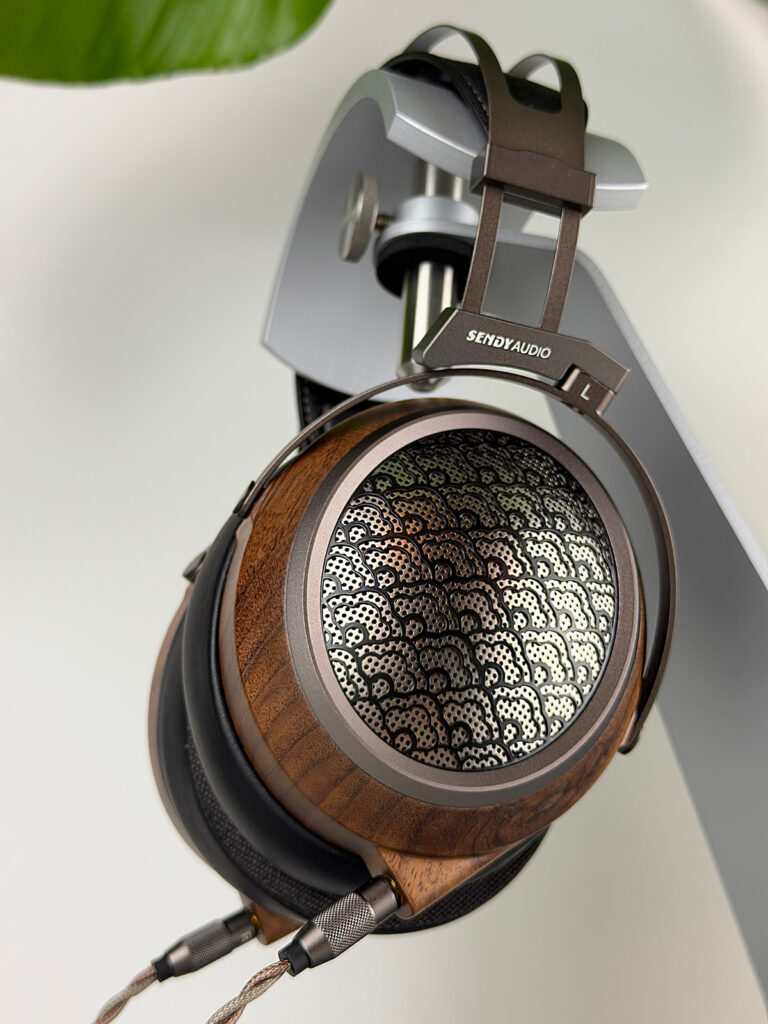
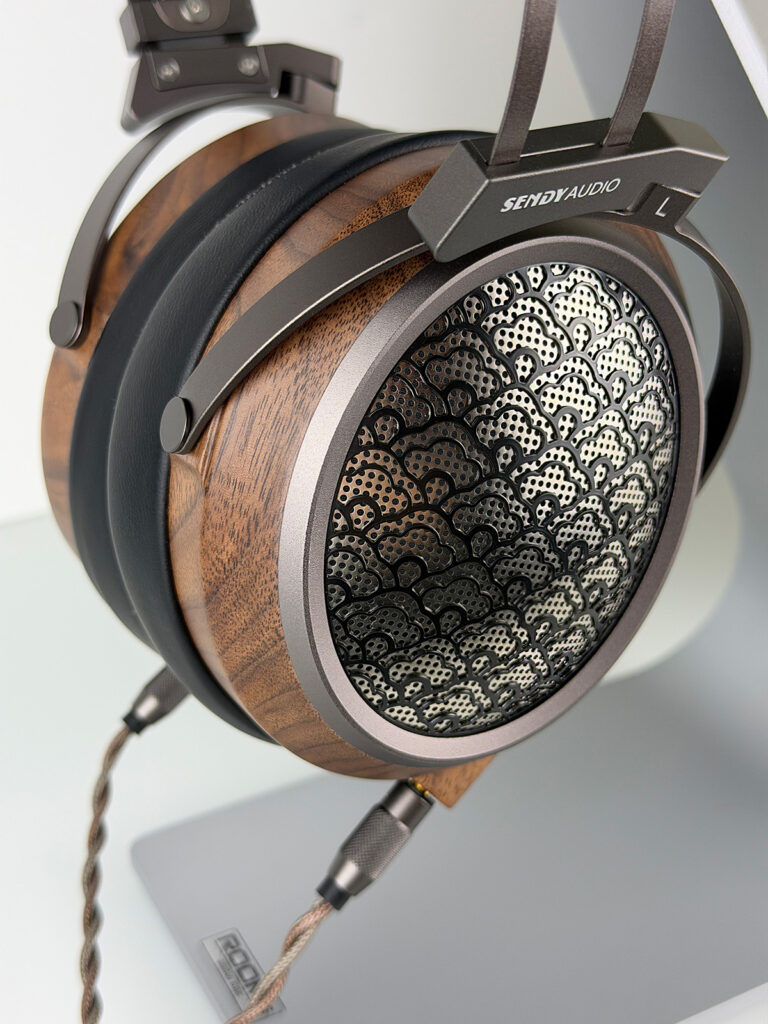
The black walnut earcups combined with the CNC-machined metal frame look and feel genuinely luxurious. This construction clearly distinguishes the Sendy Audio Egret from the lightweight, cost-driven designs often seen in this segment. The wood grain is beautiful, giving off that premium, handcrafted vibe that makes you want to display them as much as listen.
Weighing in at around 420 grams, they are not the lightest planar headphones on the market, but the weight distribution has been carefully engineered. The headband uses a combination of metal and padded leather for adjustability and comfort.
The large, plush earpads offer excellent cushioning and breathability. Clamping force is moderate and firm enough for a good seal. It is never fatiguing over long sessions.
Egret’s driver
Beneath the refined exterior, the Egret is built around a substantial 98 × 84 mm planar magnetic driver featuring an ultra-thin composite diaphragm measuring less than 800 nanometers in thickness. This extremely low-mass membrane allows for rapid acceleration and controlled movement, which directly contributes in clean transient responses and low distortion characteristics.
Sendy Audio applied its electron beam evaporation deposition process to lay down the conductive traces at an exceptionally fine level. This improves uniformity across the diaphragm surface, enhancing stability and consistency throughout the frequency range. So rather than relying on tuning tricks, the Egret’s performance is rooted in controlled driver behavior and structural precision.
Leather travel case
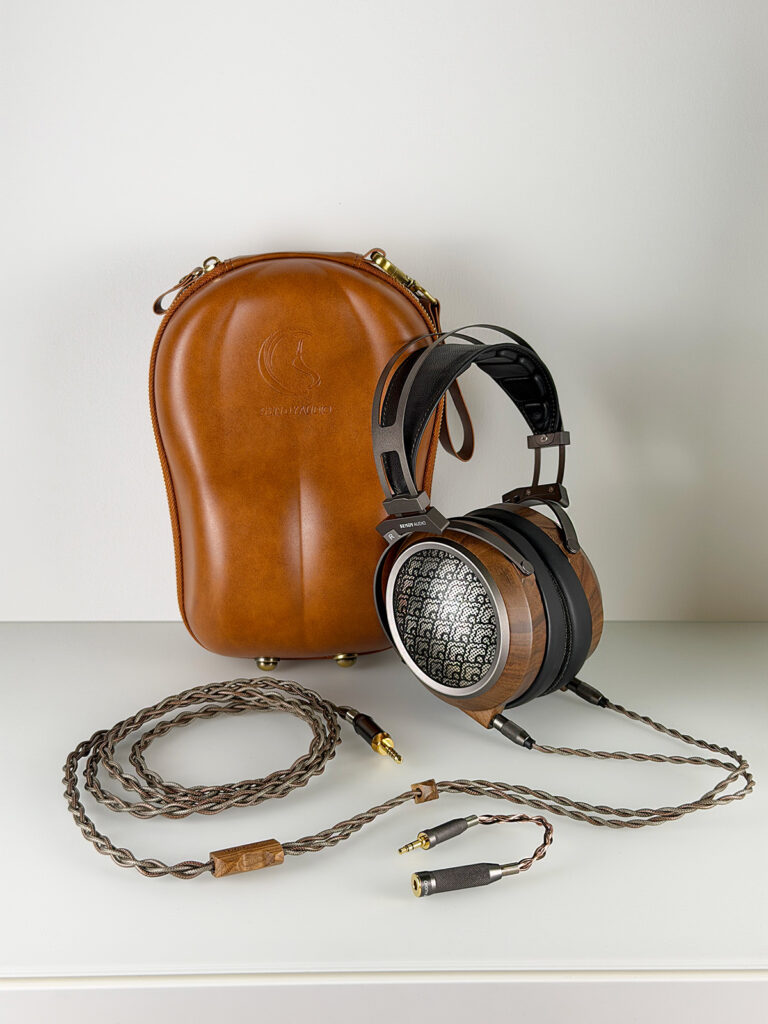
The Egret ships with Sendy’s signature leather travel case, a design that has become recognizable. The build quality is difficult to fault. That said, a bit more visual distinction between models, especially as prices climb would make the packaging feel more exclusive and easier to identify. But no real complaints here, Sendy Audio’s use of materials are high-class.
Included cable
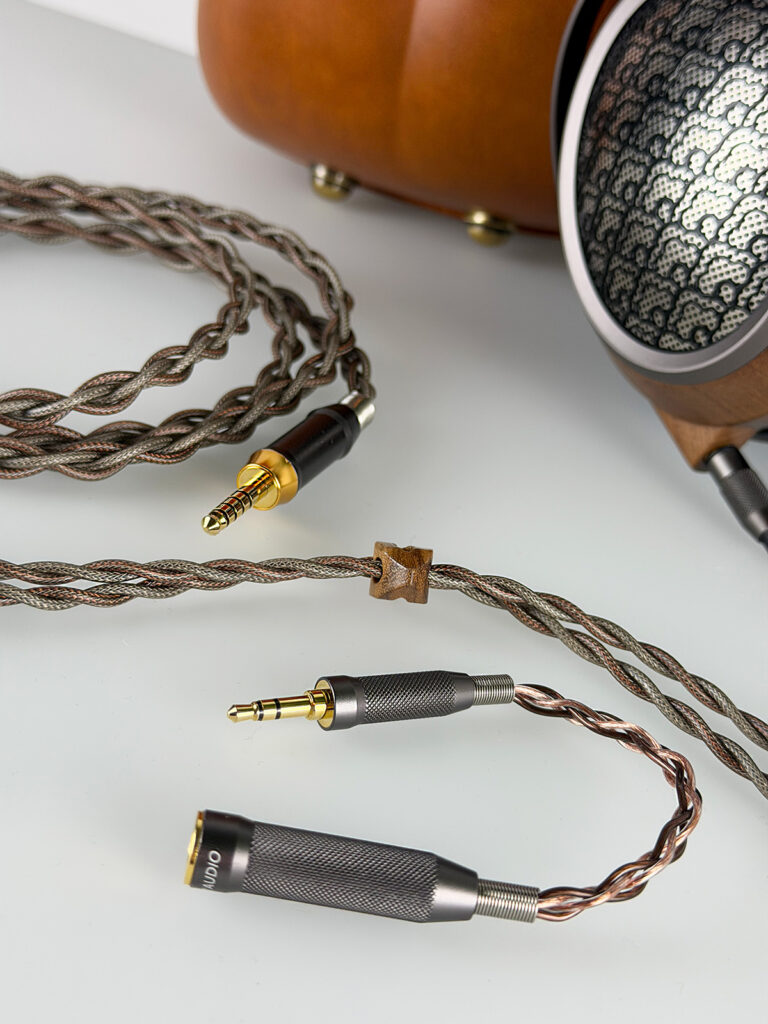
In the leather case, we find the headphones, a small pouch that holds the cable and two adapters: a 4.4 mm to 3.5 mm converter and a 3.5 mm to 6.35mm. The included cable is where Sendy Audio exceeds expectations. Unlike many competitors in this price tier, Sendy Audio includes a high-quality cable that is premium in both design and construction.
The cable features a multi-strand construction:
- 30 strands of 0.05mm Furukawa oxygen-free copper
- 10 strands of 0.05mm silver-plated OFC
- 10 strands of 0.05mm gold-enameled OFC
- The inner layer uses a graphene-reinforced PVC structure
- The conductors are wrapped in copper and silver-plated mesh, finished with a PVC outer sleeve
Specs:
- Type: Open-back planar magnetic headphone
- Driver: 98 x 84 mm planar magnetic with nanoscale composite diaphragm
- Impedance: 24 Ω
- Sensitivity: 95 dB ± 3 dB
- Frequency response: 20 Hz – 40 kHz (some sources note extension down to 8 Hz)
- Weight: ~420 g (including cable)
- Cable: Detachable silver-plated copper, 4.4 mm balanced + adapters
- Earpads: Memory foam with velour/leather hybrid
- Housing: Solid black walnut earcups, CNC-machined metal frame
- Accessories: Hard-shell carrying case, adapters, pouch
Test equipment:
Sound Quality
The Egret leans into a warm but balanced signature with a mild U-shape tilt. Bass is controlled and textured, with planar speed that provides enough midbass punch and sub extension to add weight. The Egret sounds matured and refined, like well aged wine. There’s a smoothness that makes everything feel cohesive and inviting, perfect for acoustic, jazz, blues and vocals-heavy or anything where timbre matters.
Treble is open, airy and detailed without any harshness or sibilance. There is a clean extension that resolves fine nuances but stays relaxed. This keeps fatigue low and lets the presentation breathe, creating that intimate yet expansive ‘live-room’ feeling. Staging and separation are impressive for its price point. Wide and precise enough to place instruments convincingly, with good layering.
Detail retrieval is very competitive. Dynamics feel lively and the overall tuning has a nice balance between engagement and composure, no wild peaks or dips to throw things off.
Treble
The highs are open, airy and impressively detailed. Extension is strong, revealing the fine nuances in cymbals & strings without harshness or sibilance. There’s no artificial brightness, the treble stays smooth and relaxed. The treble brings liveliness to the presentation without crossing into sharpness, making it ideal for extended listening. The Egret does an excellent job of keeping the upper treble in check, without over-smoothing it.
Midrange
We believe this is where the Egret excels the most. The midrange carries real presence and weight without sounding thick or congested. Vocals are placed clearly at the center of the mix, with convincing body and clean articulation. Male voices sound grounded, while female vocals retain smoothness without sharp edges. The overall tuning leans warm, but in a controlled way. Guitars, pianos and strings have natural body and texture without sounding thin or overly analytical. The warmth adds density and emotional weight. Nothing feels masked or artificially sweetened.
Bass
Bass is well-defined and textured, with excellent speed and control. Sub-bass reaches deep enough to add weight and impact. Midbass provides punch and body without ever bloating or smearing into the mids. It is not tuned for exaggerated slam, but for accuracy and control. This gives the bass a more mature and disciplined character. The bass serves the music rather than dominating it.
Soundstage & Imaging
For an open-back design, the Egret offers a surprisingly intimate but still expansive stage. Width is good, with precise left-to-right placement. There is solid layering that lets you follow complex arrangements effortlessly. The stage depth feels properly scaled. It delivers a realistic sense of space without resorting to exaggerated holographic effects. The Egret remains composed and engaging. Imaging is focused and consistent, with instruments positioned clearly and without artificial widening.
Pairing
The Sendy Audio Egret’s low 24-ohm impedance and 95 dB sensitivity make it easy to drive overall. That said, most headphones clearly benefit from a higher-quality source, where improvements in control, layering and refinement become more apparent. The Egret is no exception in this regard.
On the Burson Soloist Voyager, the Egret was very controlled and authoritative. The amplifier’s massive Class-A power reserve delivered a firm, effortless grip on the planar drivers. This translated into an articulate, well-defined bass with excellent texture and depth. The midrange had refinement and body. Vocals sounding expressive and full of nuance. Treble remained open detailed and polished.
On the Luxsin X9, the Egret displayed impressive composure and scale. The amp’s smooth, confident delivery provided excellent driver control, resulting in tight, nuanced bass that carried real weight. The midrange had a natural warmth and rich texture. Treble was lively, clean and airy. The overall presentation was open, wide and expansive.
Paired with the Shanling M8T on high gain, the Egret took on a more organic and fluid character due to its tube stage influence. The M8T’s smooth, yet dynamic output offered solid control, keeping the bass tight and textured. The midrange picked up a gentle layer of warmth and depth, bringing vocals forward with natural intimacy and emotional weight. Treble came across as airy, detailed and extended yet remains relaxed and smooth.
Connected to the Sparkos Labs Gemini, the Egret delivered a clean, precise and highly engaging performance. The amp’s excellent transient speed kept the bass agile and punchy with just the right amount of impact and definition. The midrange was smooth and balanced, allowing vocals to sound natural and present without any artificial edge. Treble was crisp and smooth.
The Egret consistently demonstrated its strengths: effortless drivability paired with meaningful scaling, where cleaner power brought out more control, body and openness without changing its warm natural character. While the Egret scales with higher-end amplification, it never felt demanding or overly dependent on it.
Listening impressions
Please allow me to walk you through a few music tracks to highlight Egret’s strenghts and capabilities.

Haevn – Promise – (Symphonic Tales II)
The combination of orchestral strings, cinematic percussion, piano and layered male vocals showcases the Egret’s ability to maintain composure and tonal density. The string sections sounded full and textured without any sharpness. The low percussion carried weight without becoming dominant. The Egret kept everything cohesive, allowing the arrangement to breathe naturally.
Joe Bonamassa – Burning Hell (Blues deluxe)
The Egret presented Bonamassa’s guitar with convincing body and texture. The bite of the strings were present, but never overly sharp or fatiguing. There was enough upper-mid clarity to capture the expressive bends and vibrato. The snare strikes had snap and the bass line stayed controlled. The Egret preserved the blues character of this recording. The slight grit in the vocals, the resonance of the guitar amp and the rhythmic drive of the band all came through.
Hugh Masekela – Stimela, The Coal Train (Hope)
This live recording is driven by trumpet, percussion, bass and audience interaction, it demands strong dynamic control and realistic spatial layering. Through the Egret, the gradual build-up of the track felt controlled and natural. The trumpet sounded smooth and full, with air and extension. It was clearly present but without any harsh edge. The bass came across tight and articulate, providing a solid foundation without overpowering the mix. The overall presentation gave a convincing sense of immediacy, making it feel as if I was seated within the recording space.
Emilie-Claire Barlow – D’la bière au ciel (La Plus Belle Saison)
This french jazz arrangement with upright bass, piano, trumpet and Emilie-Claire’s female vocals showcased the Egret’s refinement. The upright bass was rounded and textured. Everything remained smooth and the vocal presentation was fluid and natural. The headphone favored tonal richness over analytical sharpness, which worked beautifully here.
Conclusion
The Sendy Audio Egret brings the brand’s signature wood craftsmanship to a mid-tier planar magnetic headphone, featuring an open-back design. The Egret looks and sound stunning, proving that you don’t need flagship pricing to enjoy high-end quality with genuine character.
Sendy Audio does not cut corners. It’s clear they avoid the easy route, even with the included stock cable. It’s not a basic accessory, but a thoughtfully crafted, high-quality cable that matches the overall premium presentation. Sendy Audio consistently maintains a high standard.
Sonically, the Egret leans warm and balanced, offering an organic presentation with lush mids and controlled treble extension. The bass is well-defined and textured, prioritizing clarity and structure over exaggerated impact. Vocals and acoustic instruments have an organic timbre.
Technical aspects like detail retrieval, staging and control rivals pricier competitors with ease. The Egret isn’t chasing analytical extremes or bass-heavy thrills; it’s designed to immerse you in the music.
For anyone seeking an open-back planar that combines serious craftsmanship, engaging warmth and fatigue-free listening, the Egret is worth a serious audition. It delivers a high-end performance with exceptional attention to detail.
Pros
- Exceptional build quality
- Comfortable and balanced weight
- High quality (stock) balanced cable
- Warm, lush and balanced tuning
- Smooth and detailed treble without harshness
- Natural midrange with excellent timbre and body
- Controlled and textured bass with good extension
- Impressive staging and separation
- Easy to drive (but scale well)
Cons
- Refined but not the most powerful bass.
- Stage is more intimate than ultra-wide
- Not the most lightweight