iFi Audio operates under the umbrella of Abbingdon Music Research (AMR), a UK-based high-end audio manufacturer founded in 2000. Building on AMR’s expertise in reference-level systems, iFi was introduced in 2012 and focuses on developing complete playback components, such as Zen series streamers, signature DACs and headphone amps that deliver end-to-end devices.
In 2023, SilentPower by iFi was introduced as a seperate brand, with a dedicated focus on the ‘silent’ side of hi-fi: power-line noise, EMI/RFI interference and ground loops that can infiltrate into even the most refined systems. Its lineup includes power, networking and video solutions, as well as accessories and cables. Designed to integrate seamlessly into any setup, SilentPower products deliver cumulative improvements when adding a higher-quality power supply or an additional conditioner. The results a lower noise floor, smoothing treble, tightening bass control and creating a more effortless, analog-like presentation.
iFi Audio builds the instruments that play your music, while SilentPower provides the ultra-quiet stage and pristine power grid allowing those instruments to perform without any backstage hum or electrical buzz stealing the spotlights.
In this review we will explore the OMNI LAN and experience how well it performs in cleaning up the signal path of the network.

The OMNI LAN
Adding the SilentPower OMNI LAN to your hi-fi chain is comparable to removing the last trace of static from a line. Once inserted between the router and streamer or DAC or server, the system takes a clear step forward in refinement and ease.
This is not about ones and zeros or packet integrity. Ethernet is a packet-based protocol with error correction. The data either arrives intact or it is retransmitted. In that sense, the musical information remains unchanged.
Common-Mode Noise and Its Influence on the Audio Chain
What does change is the electrical environment in which that data is processed. Network switches, routers and switching-mode power supplies generate high-frequency noise. This noise can travel along the ethernet ground reference and shielding, often in the form of common-mode noise.
Although galvanic isolation is built into the Ethernet standard, it is not absolute at higher frequencies. Residual noise can still couple through transformers and parasitic capacitances, finding its way into your audio chain.
Once inside, this noise can raise the overall noise floor, interfering with clock stability and increase phase noise or jitter within sensitive DAC circuitry. The result is not altered data, but subtle degradation in timing precision and analogue output stages. Lowering that electrical contamination often translates into improved microdetail, more stable imaging and a more relaxed, natural presentation.
Design & Build Quality
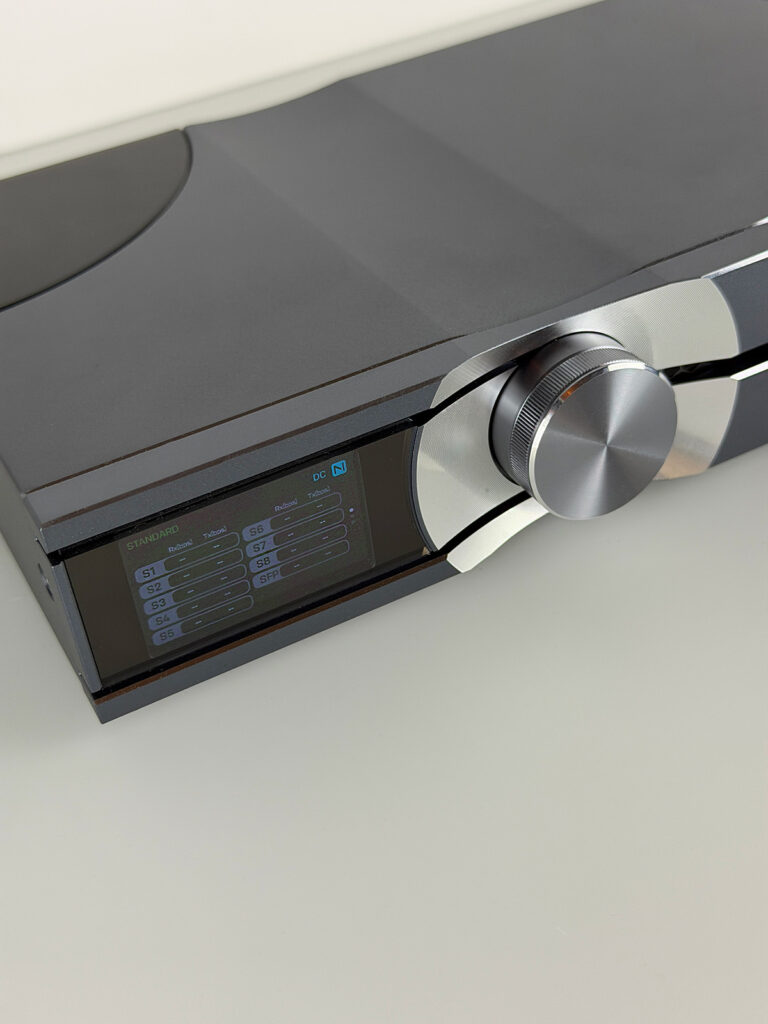
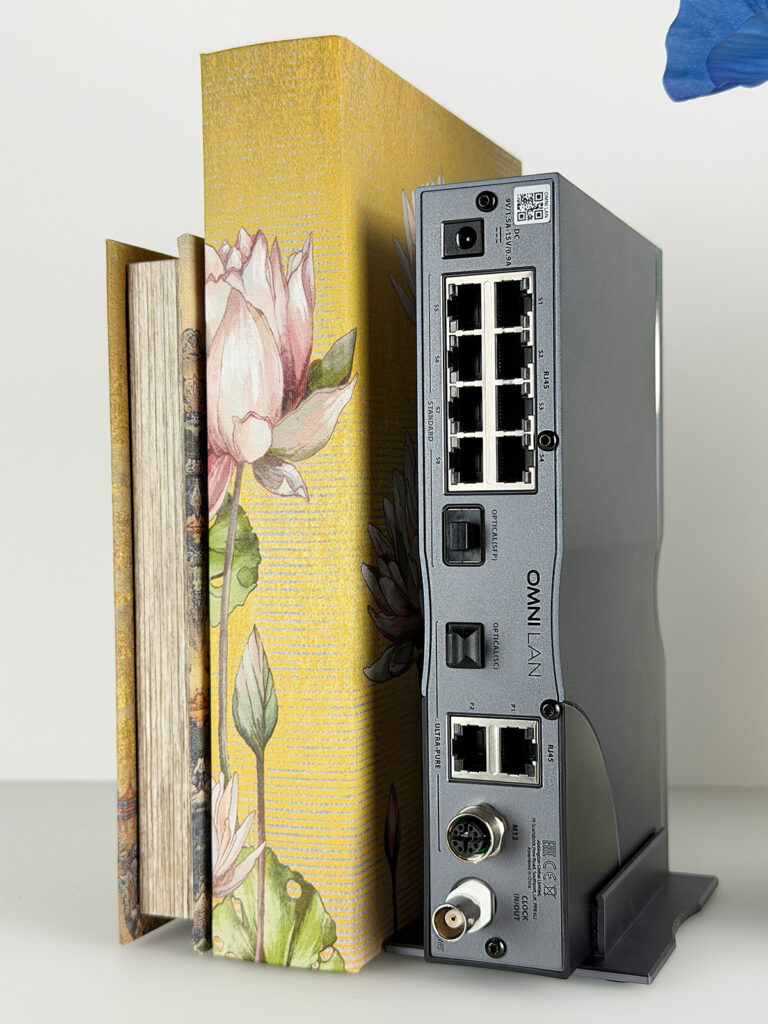
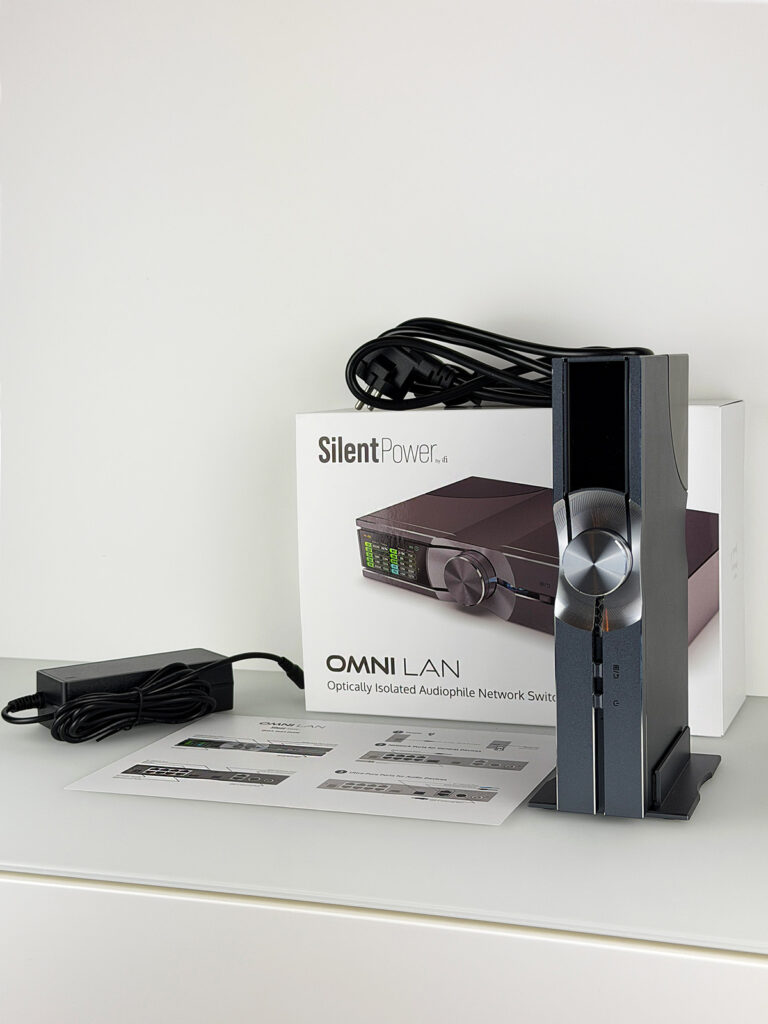
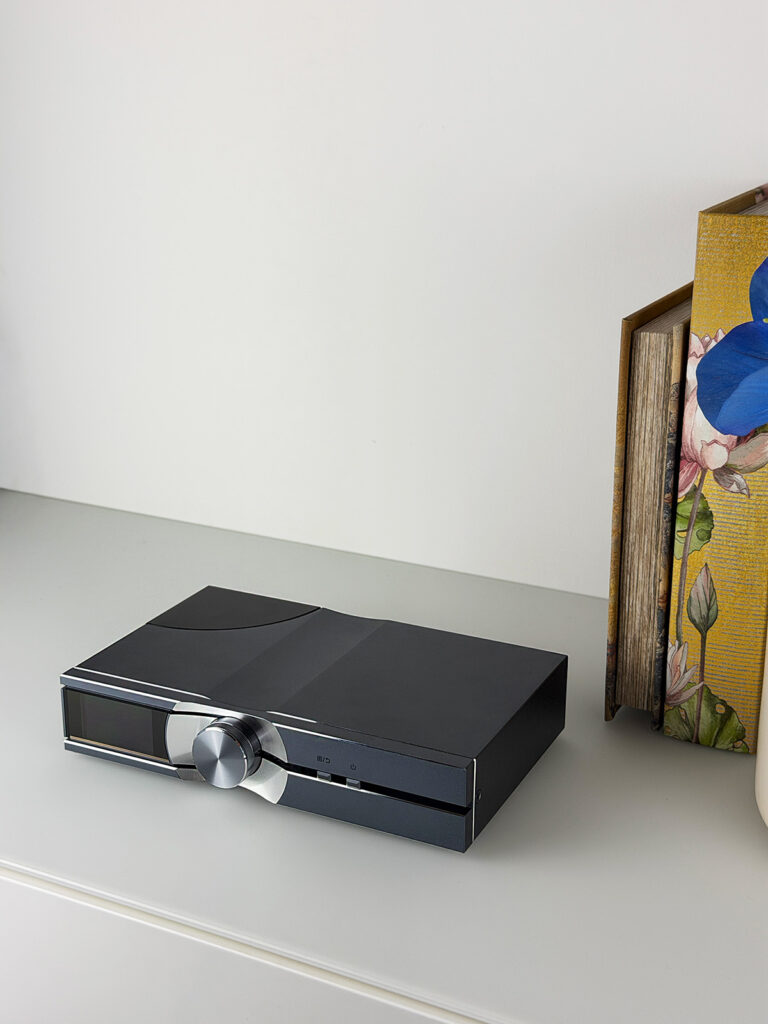
From a design perspective, the OMNI LAN has to be one of the coolest looking switches around. Its compact aluminum chassis immediately conveys a premium feel, complemented by a flawless finish. It can sit flat or stand vertically with the included stand. There’s even an optional rack-mount kit available for larger systems.
The enclosure has a decent weight to it and the case has a nice finish. The front panel features a crisp 2-inch color display that provides real-time network bandwidth information, making it easy to monitor traffic and identify potential bottlenecks. It also allows quick access to certain settings directly from the unit. Beyond its practical function, it adds a touch of appeal for those who simply enjoy seeing what is happening inside their network.
A decent power supply is included, which will be perfectly fine for most users. For those interested in experimenting with aftermarket upgrades later, such as the iPower X or iPower Elite, that option is available. Even so, the default PSU never feels lacking or out of place.
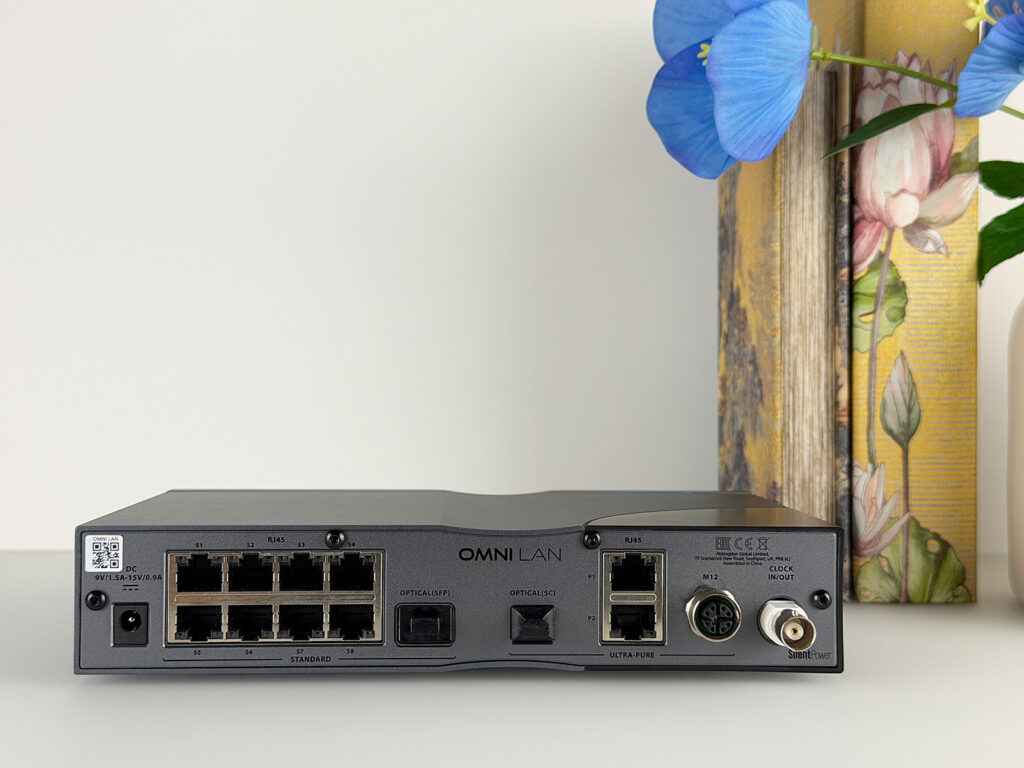
The rear contains 13 ports in total.
- Eight standard RJ45 ports
- SFP port (optical)
- Two dedicated ‘ultra-pure’ RJ45 ports
- SC optical port
- M12 port (Industrial standard)
- 10MHz Clock Sync in/out port
What’s in the box
- The OMNI LAN
- 15 V power supply
- Short network cable
- Anti-slip feet
- Vertical stand
- The basics for getting started.
Specs
- Device type: Optically isolated network switch
- Ports: 8× standard RJ45 (1 Gbps) + 1× SFP optical; 2× ultra-pure RJ45 + 1× SC optical + 1× M12
- Isolation: Triple-stage (optical signal conversion + galvanic barriers)
- Clocking: Internal femto-precision GMT with 10 MHz BNC in/out (75 Ω)
- Bandwidth: 1000 Mbps
- Jitter: < 0.05 ms
- Packet loss: < 0.09 %
- Display & control: 2-inch TFT + front buttons
- Full remote access via iFi Nexis app (iOS/Android)
- Power: 15 V DC input
- Dimensions / weight: 214 × 157 × 41 mm / 1.06 kg
- Configurable grounding (DC-RF / RF / ISO)*
Test Equipment

Interface and screen
The iFi OMNI LAN features a informative front display that gives immediate insight into the unit’s operational status. It shows network activity, port configuration and selected operating modes in a clear and legible way. It makes it easy to verify that everything is functioning as intended. For example, brightness can be adjusted or turned off entirely, which will appeal to listeners who prefer a distraction-free setup. The display also features an auto-rotate function.
Control through the iFi Nexis app adds another layer of usability. You can configure port modes, monitor connection status and fine-tune certain operational settings. The app connects via both network and bluetooth.
Apple IOS app: iFi Enexis
Google Android app: iFi Enexis
Settings (Physical on the unit or Nexis app)
- Clock Sync (External clock yes/no)
- Brightness
- GND* (DC-RF / RF / ISO)
- Auto Power restore
- Port speed settings
- Lan Signal leds (on/off)
- Factory reset
*The switch can be grounded three ways
DC-RF: Connects both the DC ground and the RF ground together
In this mode, both the DC ground and RF ground are connected to earth. This gives the device a fixed reference point and allows high-frequency noise to be drained away. It can improve stability in properly grounded systems and reduce floating voltages. In more complex setups it may introduce ground loops if other components are also grounded through different paths.
RF: Grounds RF only, with no DC ground
Only high-frequency noise is connected to earth, while the DC ground remains floating. This maintains DC isolation but still provides a path for RF noise to escape. It often lowers the risk of ground loops and can result in a quieter background in sensitive audio systems. Results are system dependent, but this setting is frequently the most interesting one in high-end network chains.
ISO: No DC or RF connection to ground
The device is completely floating, with no connection to earth for either DC or RF. This provides maximum galvanic isolation and eliminates the possibility of ground loops through the switch. In some systems this can bring a sense of stability, especially where multiple earth connections already exist. The downside is that RF noise has no direct path to ground.
Which setting suits best is system and situation dependant.
Sound quality
The moment the OMNI LAN was introduced into the chain, the most immediate and consistent change was a significantly noticable lower noise floor. That subtle electrical haze or low-level digital grain you might not have consciously noticed dissapears, creating true silence between notes. Micro-details emerged more effortlessly, for example: the faint reverb tail on a vocal phrase when listening to Melody Gardot’s track.
At first, the change is not immediately dramatic. There is no instant ‘wow’ effect. Instead, the difference reveals itself over longer listening sessions. The presentation feels calmer, less strained and more composed. It is only when the OMNI LAN is removed from the chain that the shift becomes unmistakable clear. The system sounds slightly more tense and less settled.
The improvement presents itself as greater sense of ease throughout the system. Clarity improves naturally, the overall presentation feels calmer and more composed. Instruments settle more convincingly into space and the image gained stability. Tonal balance just became slightly more organic. Voices carry a touch more body, decay sounded more natural and there is less of that subtle digital tension.
Each time we removed the OMNI LAN from the chain, we found ourselves wanting it back. Its influence is subtle, yet it brings a sense of calmness and composure that you you notice immediately when it’s gone.
In essence, the OMNI LAN doesn’t impose a new ‘house sound’. It simply removes barriers, allowing your existing components to perform closer to their full potential. For anyone with a resolving digital chain who has ever sensed a slight veil or restlessness in streamed playback, the OMNI LAN is well worth considering. It can make everything click into place.
Switching to an iFi iPower X
Switching from the stock power adapter to the iFi iPower X brought a noticeable step forward in refinement. The overall presentation became slightly calmer and more composed, with a lower perceived noise floor and improved focus across the soundstage.
The differences were not dramatic, but they were consistent. Transients felt a touch cleaner, spatial cues were more precisely defined and complex passages carried a bit more separation and ease. There was also a subtle improvement in timing and flow, giving the music a more relaxed and coherent character.
In a resolving setup, the iPower X allows the OMNI LAN to operate with greater composure and clarity. It remains a refinement rather than a transformation, but in high-end systems that refinement can be worthwhile.
Listening Impressions
To maintain a consistent comparison, I ran a short playlist of four familiar tracks covering jazz, orchestral pieces, a live recording and close-miked vocals. I first listened without the switch, then placed the iFi Audio OMNI LAN in-line and repeated, track by track. We repeated this process several times to ensure reliable impressions. All testing was done with the stock power supply.

Hugh Masekela – Stimela (The Coal Train)
Without the switch, Stimela already carried weight and atmosphere. The audience presence was clear, the trumpet sharp and expressive and the bass line solid. Nothing to really complain about.
With the OMNI LAN Switch in place, the performance opened up. The background became noticeably darker, more than we expected. Micro-details such as subtle audience reactions and low-level percussion textures were easier to follow. Masekela’s trumpet projected with more body and a little less glare.
Fawkes the Phoenix – Los Angeles Philharmonic, Gustavo Dudamel
This orchestral piece was a test for layering and scale. Without the OMNI LAN, the orchestra sounded wide and powerful, but during climactic sections the string mass had just a tad treble glare.
Adding the OMNI LAN Switch in place improved separation between instrumental groups. Violins had more air around them, while brass retained their golden bite without becoming strident. With the lower noise floor, soundstage expanded in depth somewhat too.

Melody Gardot – Lover Undercover
This track thrives on intimacy. Without the OMNI LAN, Gardot’s voice was smooth and warm, the double bass rounded and pleasant.
Once the OMNI LAN Switch was introduced, her voice gained a finer edged definition. Breath textures became clearer. Brushes had a softer touch. The piano notes carried longer with a more natural decay. The overall presentation felt calmer and more stable, as if the noise floor had dropped, allowing subtle cues to surface.
The system used for this evaluation was high-end. While it already delivered an excellent quality on its own, adding the OMNI LAN made everything simply sound more refined.
Alexis Cole – Do You Ever Think of Me
This recording already has a delicate, late-night character. However, there was a mild softness in the leading edges of piano notes.
With the OMNI LAN Switch, transients became more precise. The piano gained clarity in the upper registers. The space between instruments became more defined, giving the arrangement an even more three-dimensional presentation.
Conclusion
We were initially unsure how much impact a device like the OMNI LAN could have, but the results proved more convincing than expected. While a standard network switch may transmit data correctly, it can also introduce electrical noise into the chain. Reducing that noise floor revealed that a network stage is not as neutral as often assumed.
The iFi SilentPower OMNI LAN demonstrates that network infrastructure can play a meaningful role in high-end audio. The improvements observed were tangible and repeatable, without drifting into audiophile myths or exaggeration. It is a well-built device, underpinned by carefully considered engineering choices.
Solutions like this are most effective when the rest of your system is already performing at a high level. Think of it as a finishing touch that refines an already capable setup. It will not compensate for weaknesses elsewhere in the chain.
In a resolving system, the OMNI LAN clearly lowers the noise floor. The overall presentation becomes smoother, more controlled and more open. Separation and layering emerge naturally and most noticeably, everything sounds calmer and more coherent. Dynamics feel less constrained and timing improves in a way that allows the music to flow effortlessly.
The SilentPower OMNI LAN elevates a well-balanced system to its fullest potential. It is for serious listeners who want to extract every last drop of performance from their setup.
Pros
- Premium build
- Triple optical/galvanic isolation removing network noise effectively
- Dedicated ‘ultra-pure’ RJ45 ports
- Femto GMT clock + 10 MHz sync capability
- Live status display and Nexis app for easy monitoring
- Several grounding modes
- Versatile placement (flat/vertical/(optional)rack)
Cons
- No iFi iPower X is included in the box
- Optical is SC only