Founded in Shenzhen in 2017, Fosi Audio has grown into a familiar name in affordable hi-fi. What started with the V1.0 amplifier has since expanded into a broader range of products, including DACs, headphone amplifiers, headphones and even loudspeakers.
The BT20A MAX combines Bluetooth 6.0, RCA inputs and the latest PFFB technology. Compared to earlier BT20 models, Fosi Audio has made several thoughtful refinements that improve both the amplifier’s versatility and overall user experience.
With the introduction out of the way, let’s explore the BT20A MAX in more detail.
Design and build quality
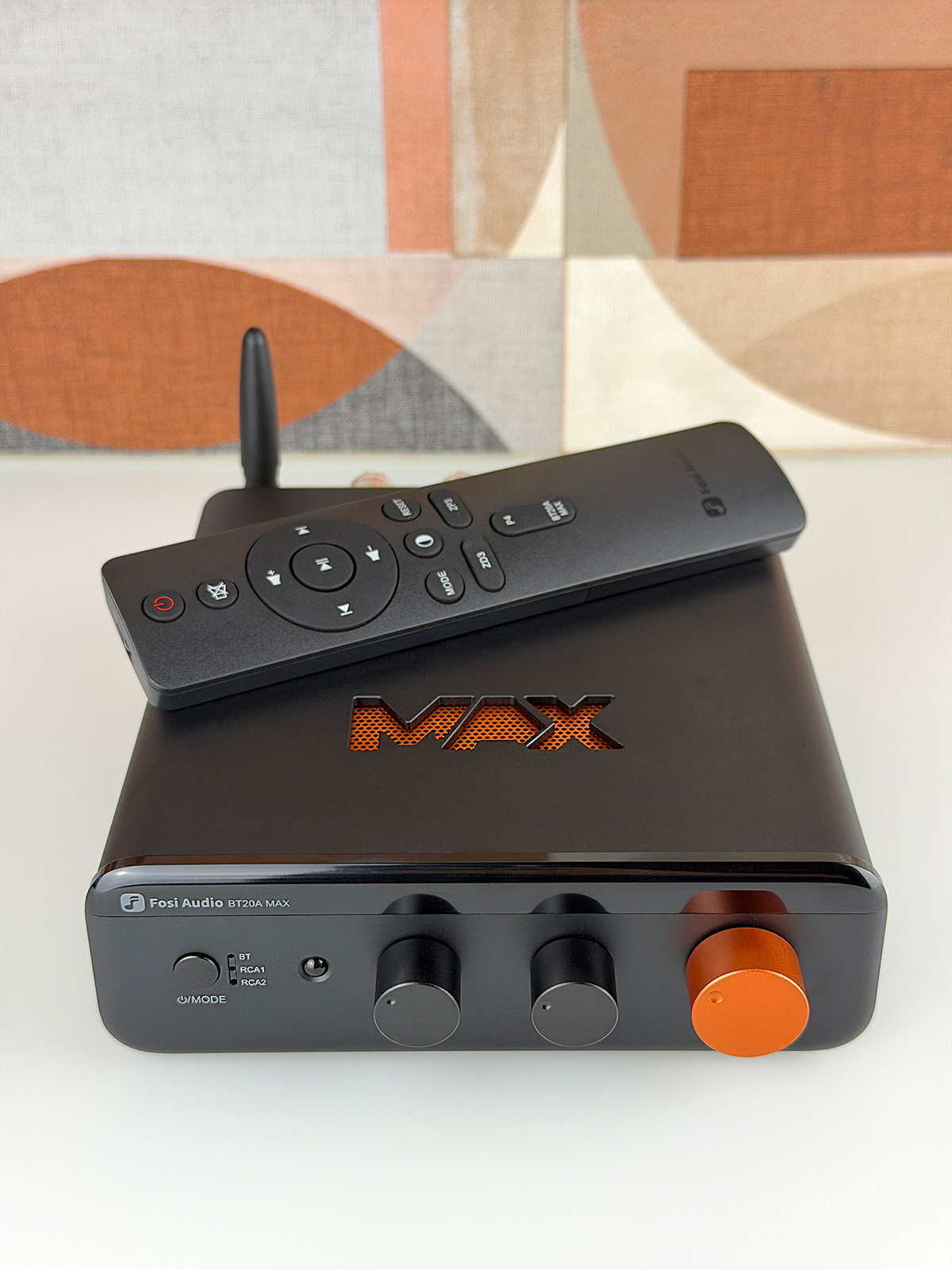
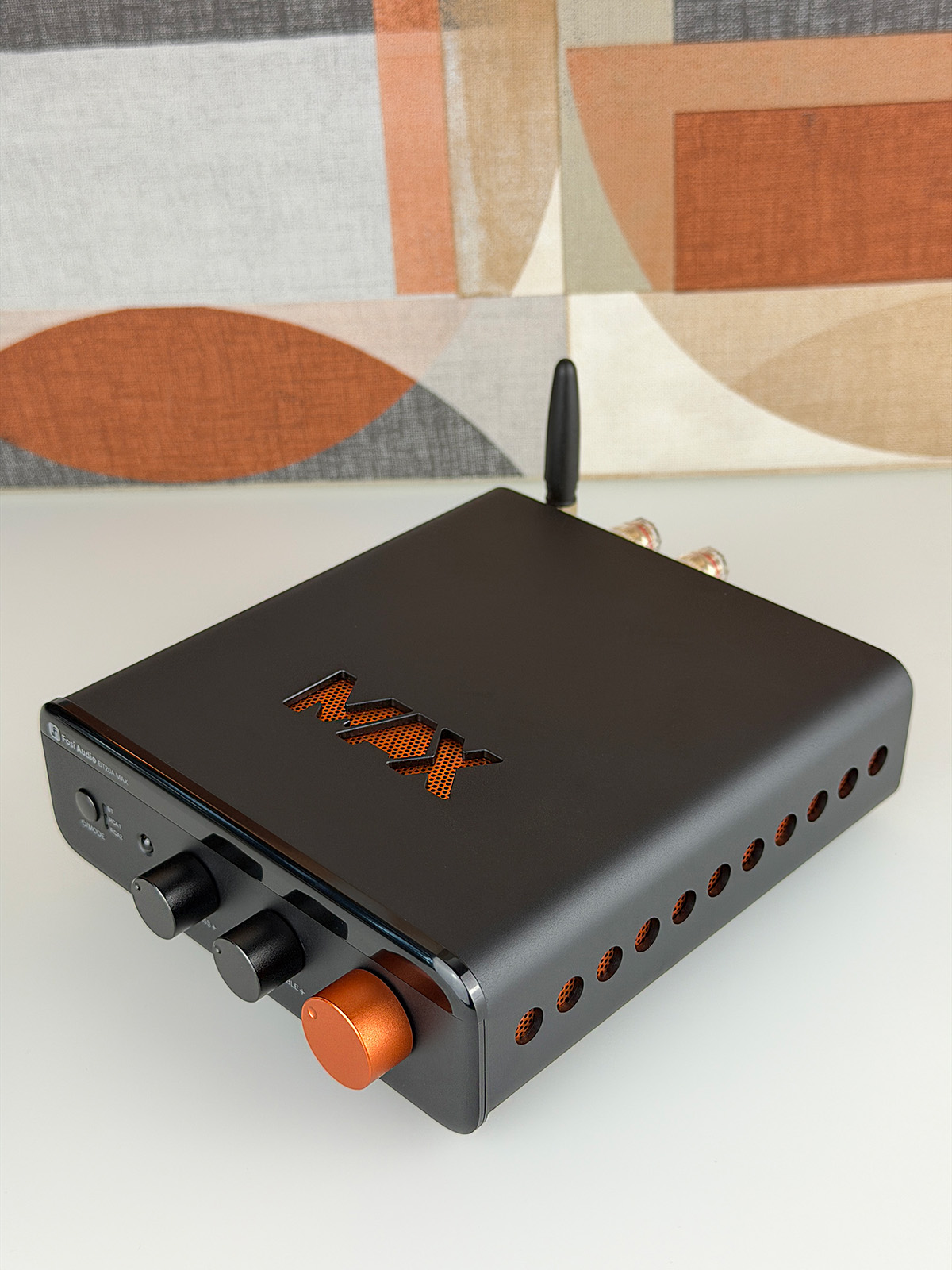
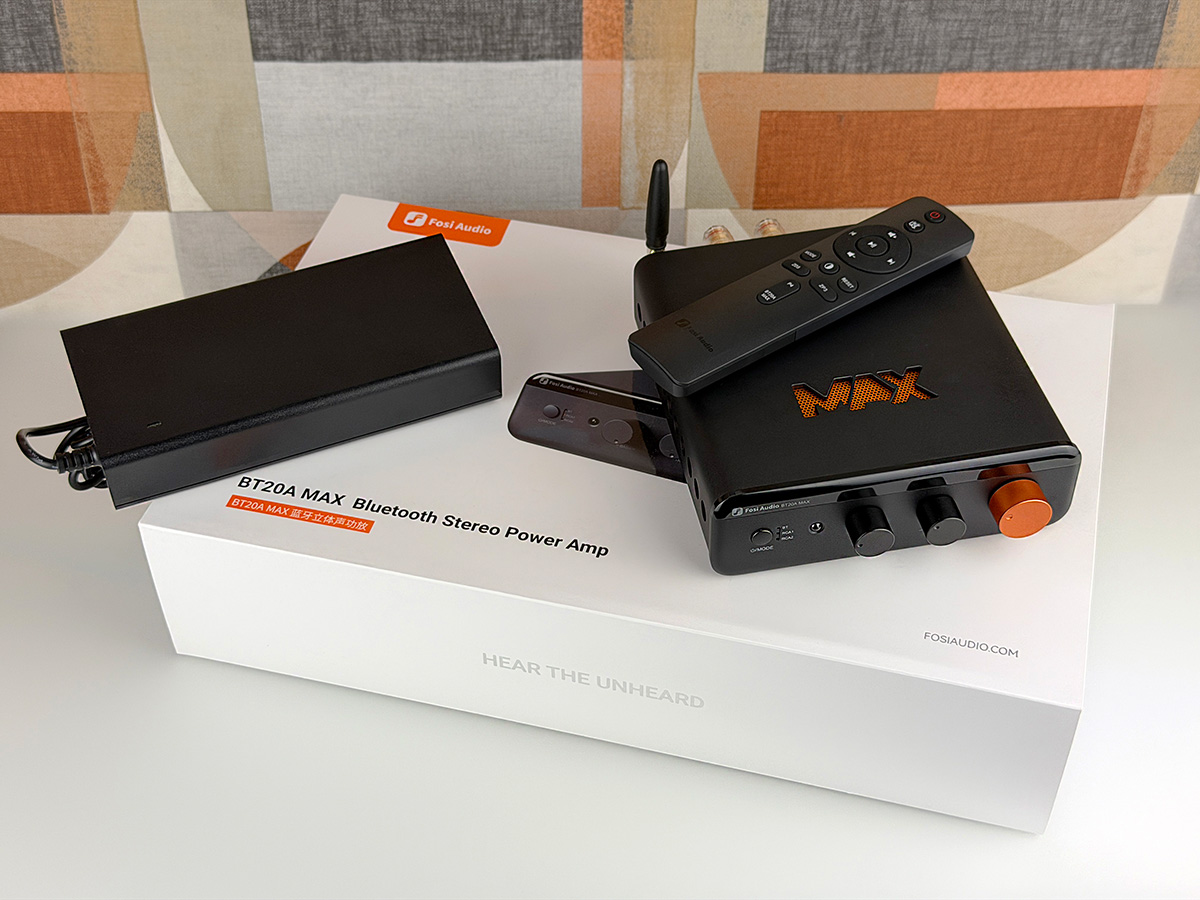
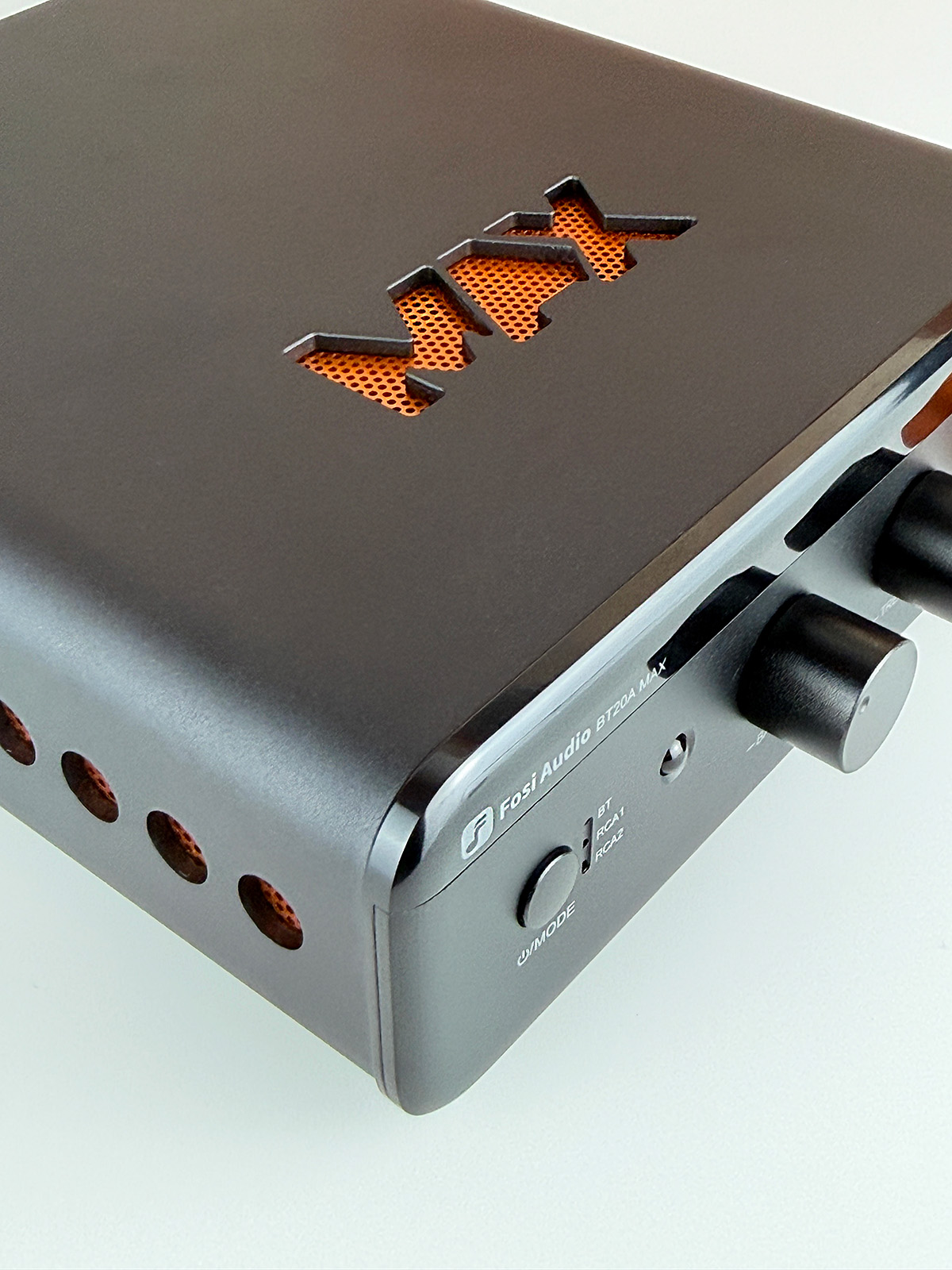
The BT20A MAX features a compact aluminium chassis with softly rounded edges, giving it a refined and modern appearance. The signature Fosi orange accents provide a subtle contrast, adding a touch of character.
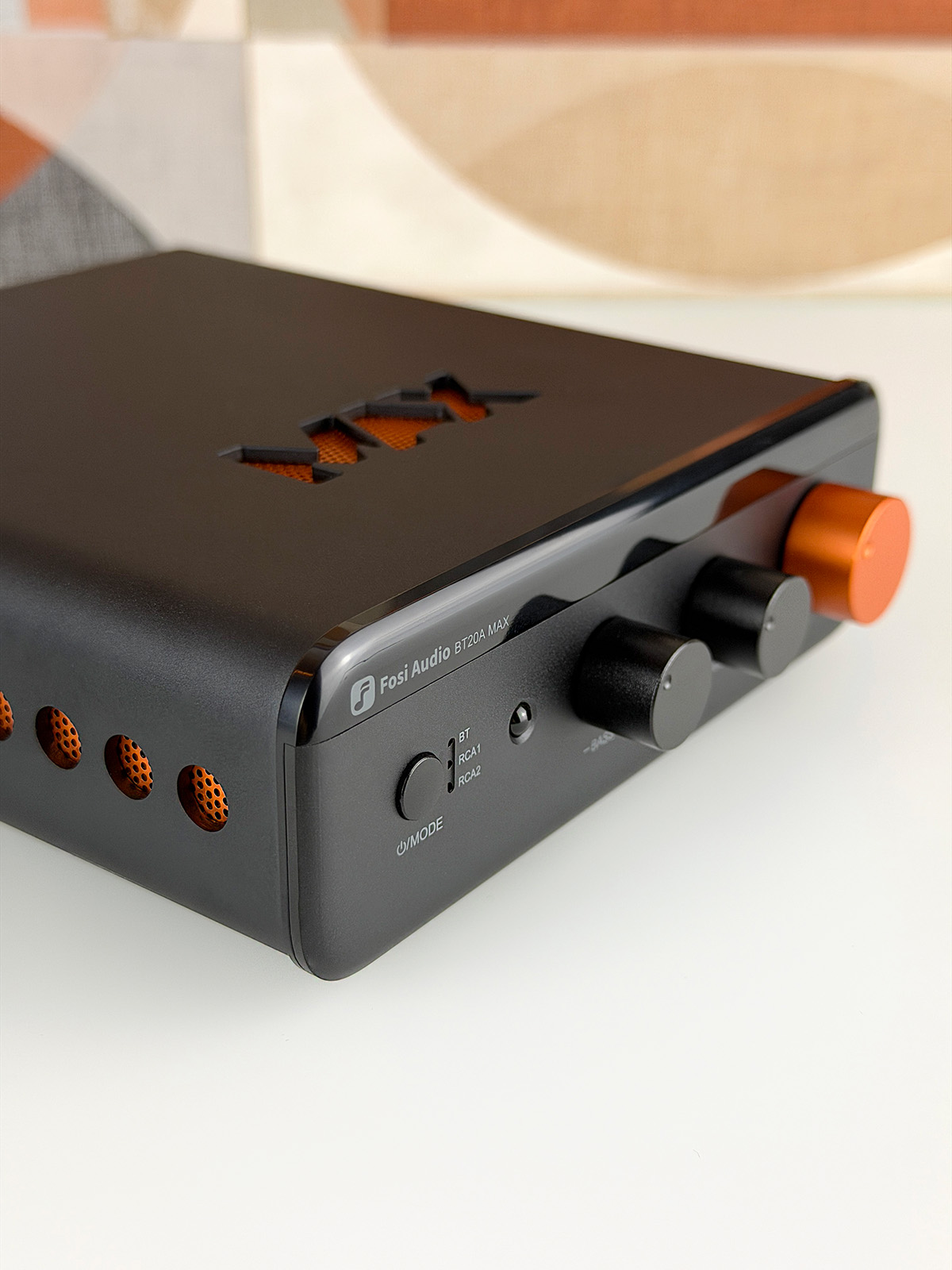
The front panel features three controls for bass, treble and (motorized) volume. To the left are the infrared receiver for the supplied remote control, three status LEDs indicating the active input and a combined power and input selection button.
Ventilation openings are integrated into both side panels, backed by an orange mesh, while a larger vent on the top panel allows heat to escape from the internal cooling fan. The BT20A MAX does become warm during use, but never to a concerning degree. Even so, it is best to avoid placing it in a confined space and allow sufficient airflow around the chassis. The fan-cooling has received mixed reactions online, its audibility largely depends on the listening environment. In our experience, the fan noise was minimal and inaudible from a normal listening distance.
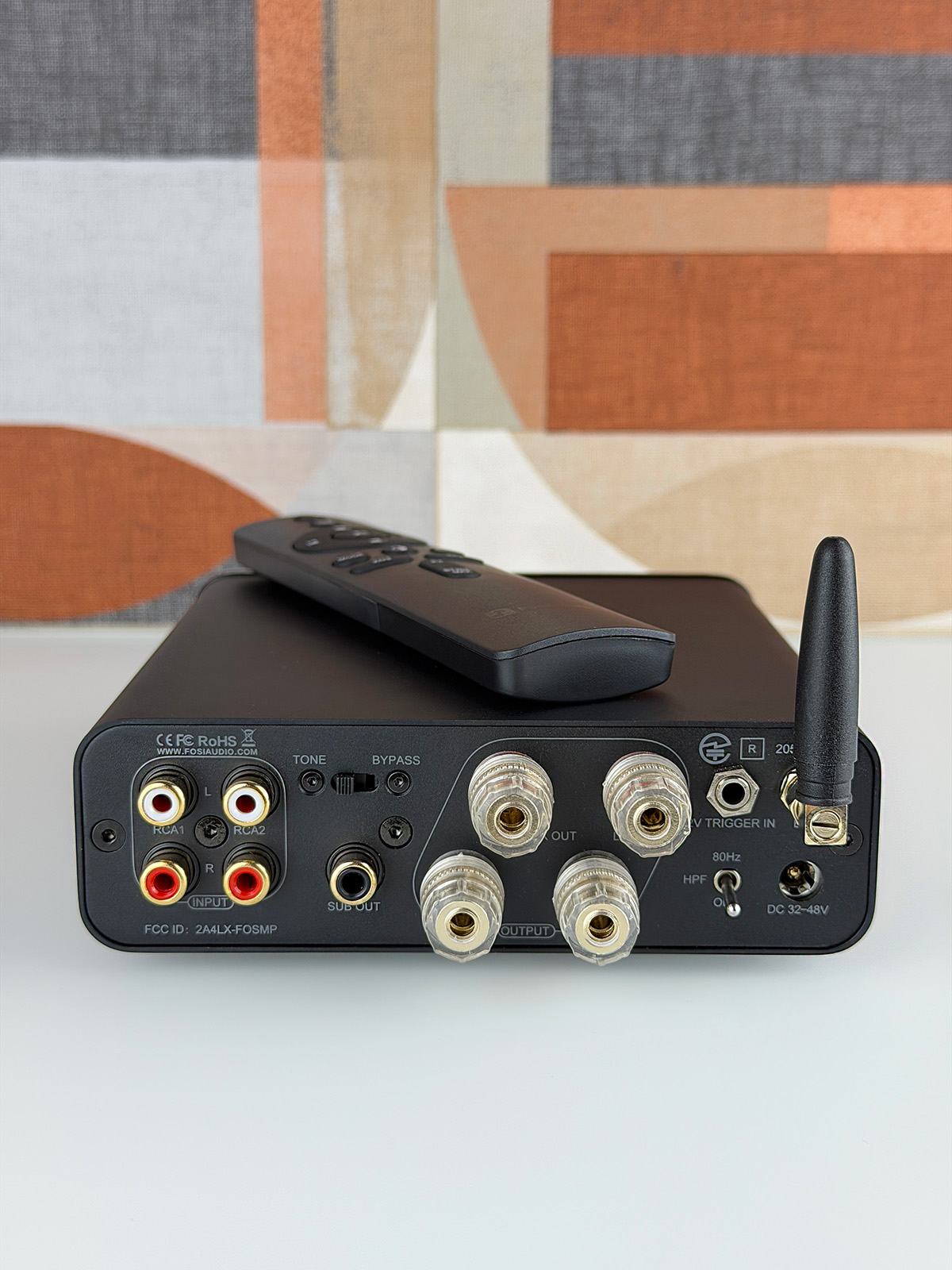
The rear panel houses dual RCA inputs, the tone bypass switch and a subwoofer output. The centrally positioned speaker binding posts accept both bare wire and banana plugs. The rear panel also houses the Bluetooth antenna, 12V trigger and DC power inputs. There is also a switchable 80Hz high-pass filter for use with a connected subwoofer. When enabled, frequencies below 80Hz are redirected to the subwoofer.
The supplied infrared remote provides access to all essential functions, volume adjustment, mute, input selection and playback controls for compatible Bluetooth devices.
Technical Overview
The BT20A MAX is built around the well-proven Texas Instruments TPA3255 Class-D amplifier, paired with NE5532 operational op-amps. One of its key additions is the implementation of PFFB (Post-Filter Feedback), which continuously monitors the amplifier’s output and corrects small deviations in real time. This helps reduce distortion, keeps the frequency response more consistent and makes the amplifier less sensitive to differences in loudspeaker impedance. In practice, PFFB helps the amplifier deliver a more consistent and accurate output.
Fosi specifies a THD below 0.003% and a signal-to-noise ratio exceeding 112 dB.
The internal analogue and digital power supplies are isolated from one another to minimise interference. Fosi also offers the BT20A MAX with a choice of 32V, 36V, 48V or 48V GaN power supplies, allowing buyers to select the version that best matches their power requirements. Depending on the power supply used, the BT20A MAX can deliver up to 300W per channel in to 4Ω.
Wireless connectivity is handled by Qualcomm’s QCC3095 Bluetooth 6.0 chipset, with support for SBC, AAC, aptX, aptX HD, aptX Adaptive, aptX Lossless and LDAC.
The only feature we found ourselves missing is a digital input. With the Cirrus Logic CS4398 DAC already handling Bluetooth playback, the addition of an optical, coaxial or USB input would have been a logical step. It would have allowed digital sources such as streamers to be connected directly, without the need for an external DAC.
Specs
- Channel: 2.1
- Chipset: TI TPA3255, NE5532
- Max Output Power: 300W × 2 @ 4Ω
- RMS Output Power: 180W × 2 @ 4Ω
- Input: RCA1 / RCA2 / Bluetooth
- Output: Speaker Out / Sub Out
- SNR: ≥ 112 dB
- THD+N: ≤ 0.003%
- Terminal Impedance: 2–8Ω
- Bluetooth SoC: Qualcomm QCC3095
- Bluetooth Device Name: Fosi Audio BT20A MAX
- Bluetooth Version: 6.0
- Bluetooth Connection Range: ≤ 15 m (50 ft)
- Bluetooth Audio Codecs: SBC / AAC / aptX / aptX HD / aptX Adaptive / aptX Lossless / LDAC
- Frequency Response: 20 Hz–20 kHz (±0.5 dB)
- Voltage Range: DC 32 V–48 V
Inside the Box
The BT20A MAX arrives in a compact (sleeved) but well-organised package, with the amplifier, external power supply and accessories each housed in custom-cut foam inserts. In the box you’ll find the external power supply, Bluetooth antenna, infrared remote control and a multilingual user manual. The external power supply is considerably large compared to the BT20A MAX itself, something that immediately stands out when unpacking the amplifier.
Test equipment:
- Eversolo T8
- Chord Electronics Qutest
- Sonus Faber Lumina II
- Sonus Faber Olympica Nova III
- Samsung 22 Ultra (Bluetooth/LDAC)
Sound Quality
For our listening tests, the BT20A MAX was paired with the Chord Electronics Qutest and Sonus Faber Lumina II.
The BT20A MAX delivered a balanced and musical performance with an impressive level of refinement. Bass is well controlled, offering good weight and impact while remaining composed even at higher listening levels. Treble is smooth and refined, avoiding excessive brightness while retaining enough energy to sound open and airy. The integrated tone controls provide useful flexibility for those who prefer to fine-tune the tonal balance, while the bypass function offers a cleaner signal path when no tonal adjustment is required.
Stereo imaging has convincing width and accurate instrument placement, with respectable depth and slightly more emphasis on width than depth.
We also connected the BT20A MAX to the considerably more demanding Sonus Faber Olympica Nova III. This was never intended as part of the formal evaluation, but simply to see how far the amplifier could be pushed. While the Olympica Nova III clearly reaches a higher level with powerful high-end amplification, the BT20A MAX remained composed, delivering a surprisingly full and musical presentation. Although the Olympica Nova III was clearly capable of more, the combination remained musical and enjoyable to listen to.
We also compared the BT20A MAX’s Bluetooth input against the Chord Qutest connected to its RCA input. The Bluetooth implementation performed well, although the Qutest connected via RCA retained a clear advantage in overall refinement. Through Bluetooth, the upper frequencies sounded slightly more forward, carrying a firmer edge. Via the Qutest, the same recordings sounded smoother and more refined. Part of this difference is likely attributable to the Bluetooth transmission itself. Even with high-quality codecs such as LDAC, Bluetooth remains a compressed audio format, whereas the analogue input from the Qutest avoids this limitation.
Listening impressions
During our listening sessions, the BT20A MAX consistently impressed us with its balanced and controlled presentation. Vocals on Stacey Kent’s “Over the Rainbow” and Melody Gardot’s “La Chanson des Vieux Amants” were reproduced with excellent clarity and a natural tonal balance, while Haydn’s “Paris Symphonies” demonstrated that the amplifier is capable of handling complex classical recordings with convincing separation and control. HAEVN’s “Trade It for the Night” revealed a wide soundstage, controlled bass and convincing dynamics.
Only when compared with considerably more expensive high-end amplifiers did subtle differences begin to emerge. That is hardly surprising and certainly not a criticism. Considering its asking price, the BT20A MAX delivers an outstanding level of performance. Compared to those high-end amplifiers, the finest micro-details are reproduced with slightly less refinement, depth and natural decay.
None of these observations detract from the overall listening experience. The BT20A MAX remains an engaging and musical amplifier, delivering a level of refinement that is remarkable for its price.