Fosi Audio, founded in 2017 by Ryan Huang in Shenzhen’s Longgang District, has always focused on making high-quality Hi-Fi accessible to a wider audience. The company introduced its new slogan in 2025, ‘HEAR THE UNHEARD’, reflecting its commitment to innovation driven by user feedback.
‘Our vision is to become a global leader in audio innovation. Fosi Audio will continue to push the boundaries of audio technology based on user feedback, making HiFi not a luxury for the few, but an art of sound that can be enjoyed by audiophiles and music lovers around the world’.
– Founder Ryan Huang
Fosi Audio products are available in more than 100 countries. Backed by a modern Shenzhen facility with a 2,300 m² R&D centre, dedicated production lines and a growing portfolio of international patents, the company continues to develop innovative and affordable Hi-Fi products for a global audience.
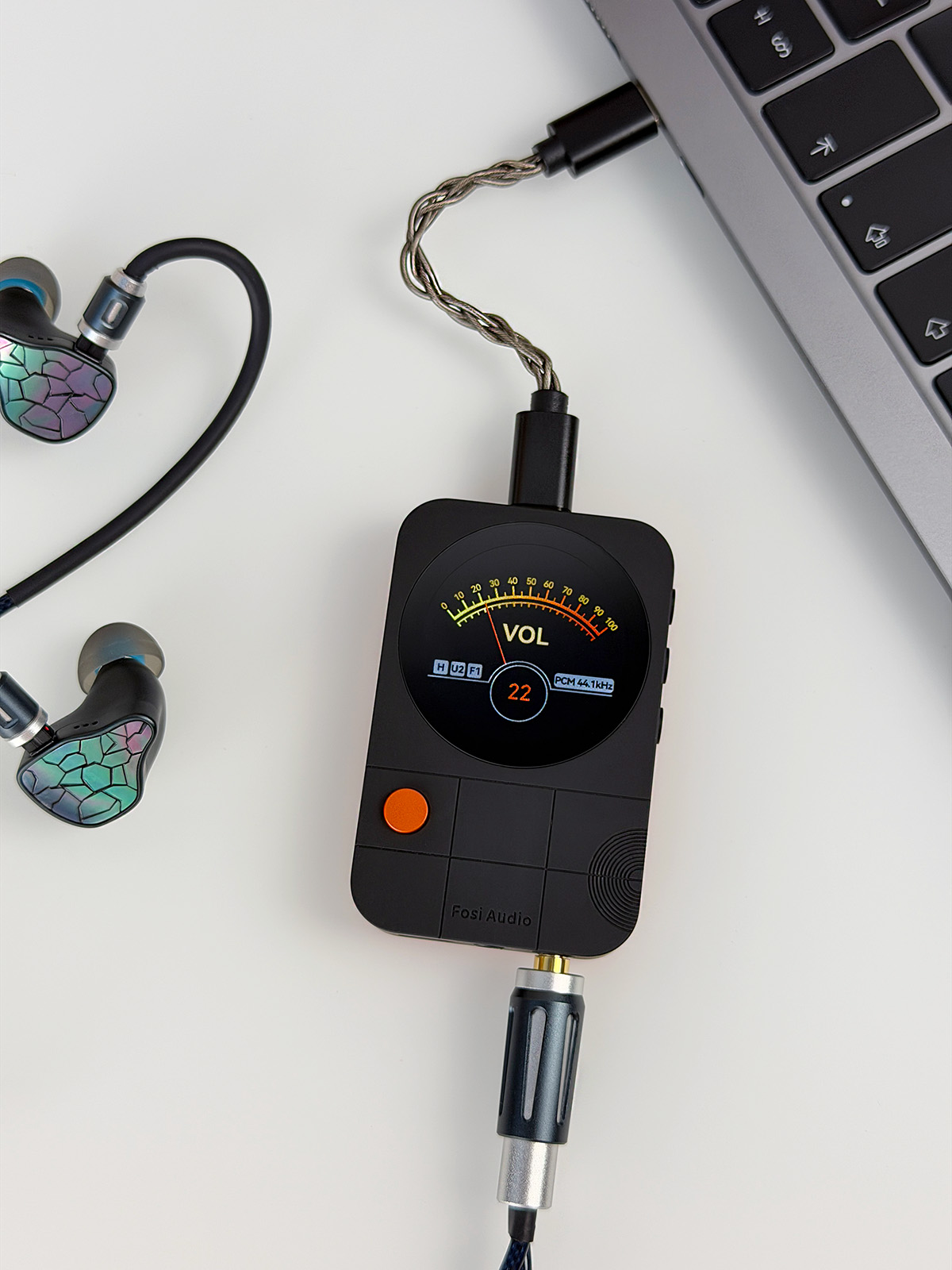
The MD3 portable DAC reflects that approach. It combines a compact design with clever MagSafe mounting and pass-through charging. It allows your phone to be charged while listening, a feature that many portable DACs still lack. How does it perform? Let’s find out.

Design and build quality
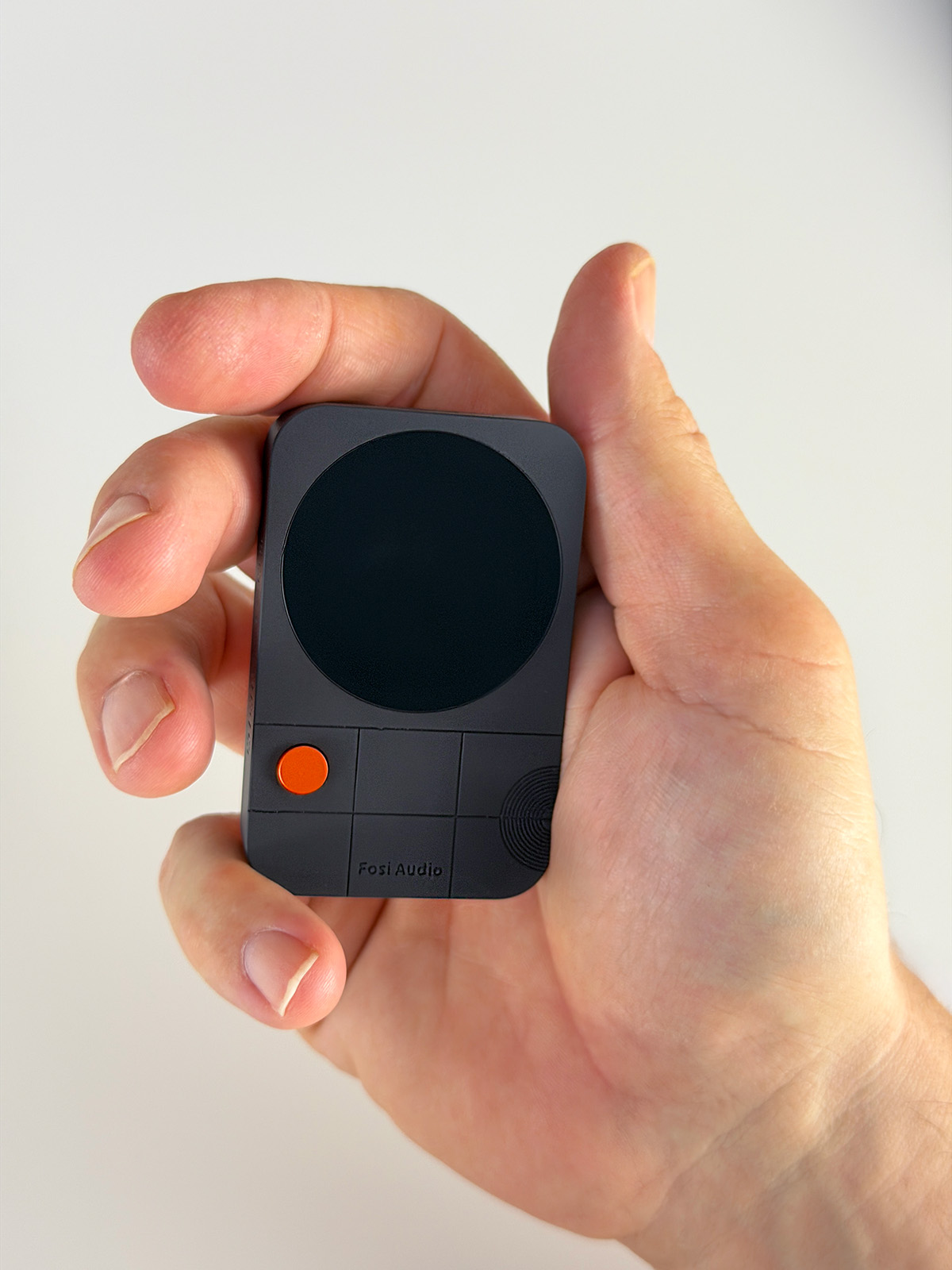
The Fosi Audio MD3 is remarkably compact. Measuring just 70 × 45 × 12 mm and weighing around 50 grams, it occupies very little space whether attached to your phone or carried in a pocket.
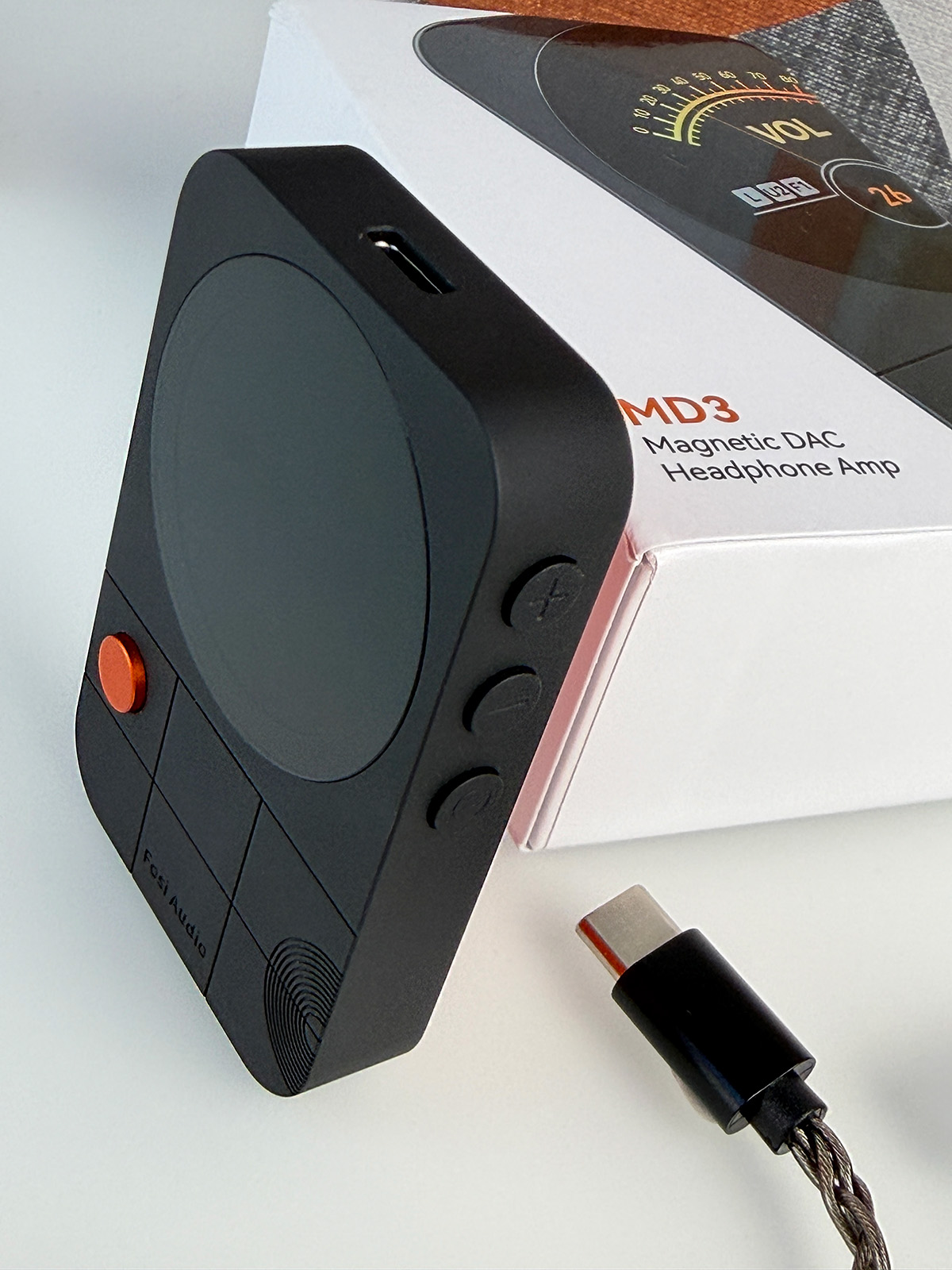
The chassis is CNC-machined from aluminium and finished with a fine matte texture. It gives the MD3 a robust and refined appearance. Rounded edges complement the design, while the precise machining adds to the overall sense of quality. The perforated aluminium front panel, featuring the Fosi Audio logo, adds a subtle finishing touch.
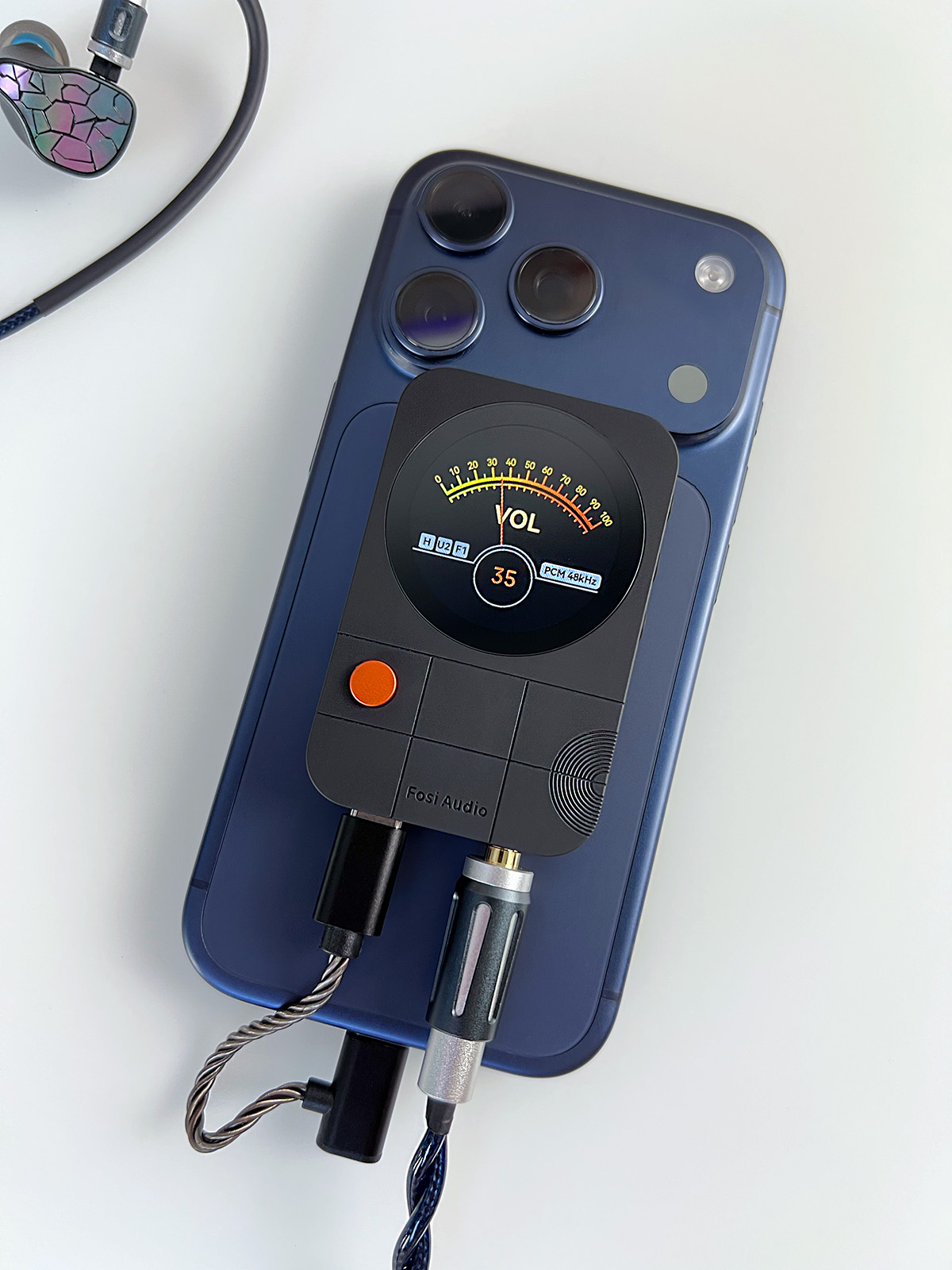
Turn the MD3 around and you’ll find a soft orange leather rear panel with integrated MagSafe magnets hidden beneath it. Besides protecting the back of your smartphone from scratches, the leather finish also provides additional grip. During testing, the magnetic connection remained secure, keeping the MD3 firmly attached to the back of your iPhone.
The 1.28-inch circular display is sharp, easy to read and presents all essential information. Custom images and animations can be uploaded, adding a personal touch to the MD3. Fosi Audio has even included a number of built-in mini-games.
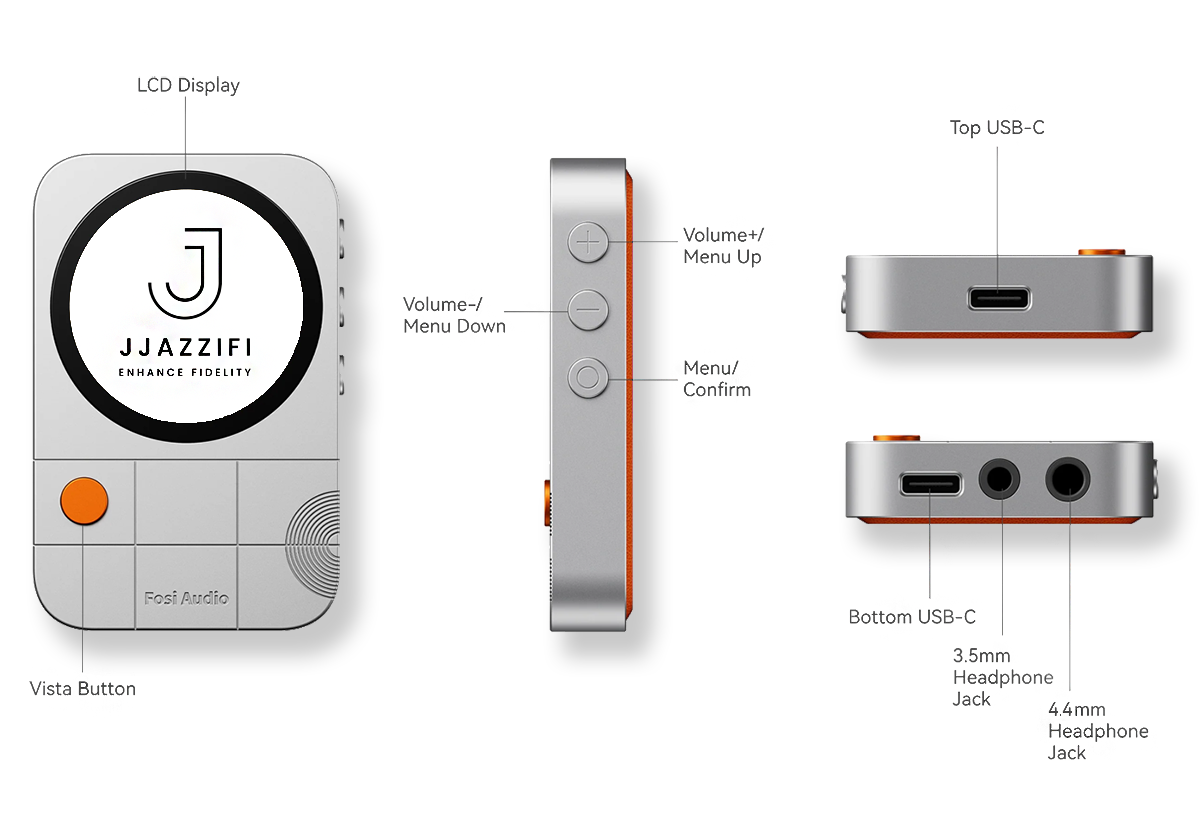
The side houses two buttons that serve a dual purpose, acting as volume controls during playback and as up/down navigation keys when moving through the menu. A separate multifunction button is used to confirm selections. Beside the display you find an orange Vista button, used to enter the photo album, switch between uploaded images and return to the previous menu. Double clicking the Vista button rotates the screen.
Taken as a whole, the MD3 leaves a positive impression with its combination of compact dimensions, practical features and high-quality finish.
DAC and amplifier stage
The MD3 is built around the ESS Sabre ES9039Q2M, a 32-bit DAC based on ESS Technology’s HyperStream IV architecture. It supports PCM up to 32-bit/384 kHz and native DSD256. Its low power consumption makes it well suited to USB-powered DACs.
The amplifier stage is built around four ESS ES9603Q amplifier chips. Two are dedicated to the 3.5 mm output, while the remaining two drive the balanced 4.4 mm output. The MD3 delivers up to 180 mW at 32 Ω from its balanced output. The same DAC and amplifier configuration is also used in Fosi Audio’s DS3 desktop DAC.
Fosi specifies THD+N figures of 0.00075% for the single-ended output, a noise floor below 1.7 µV, and a frequency response extending from 20 Hz to 48 kHz. These are more than respectable specifications for a compact USB-powered DAC.
Connectivity
We used several sources without any compatibility issues. The MD3 also supports UAC 1.0, extending compatibility to older USB devices that do not support UAC 2.0.
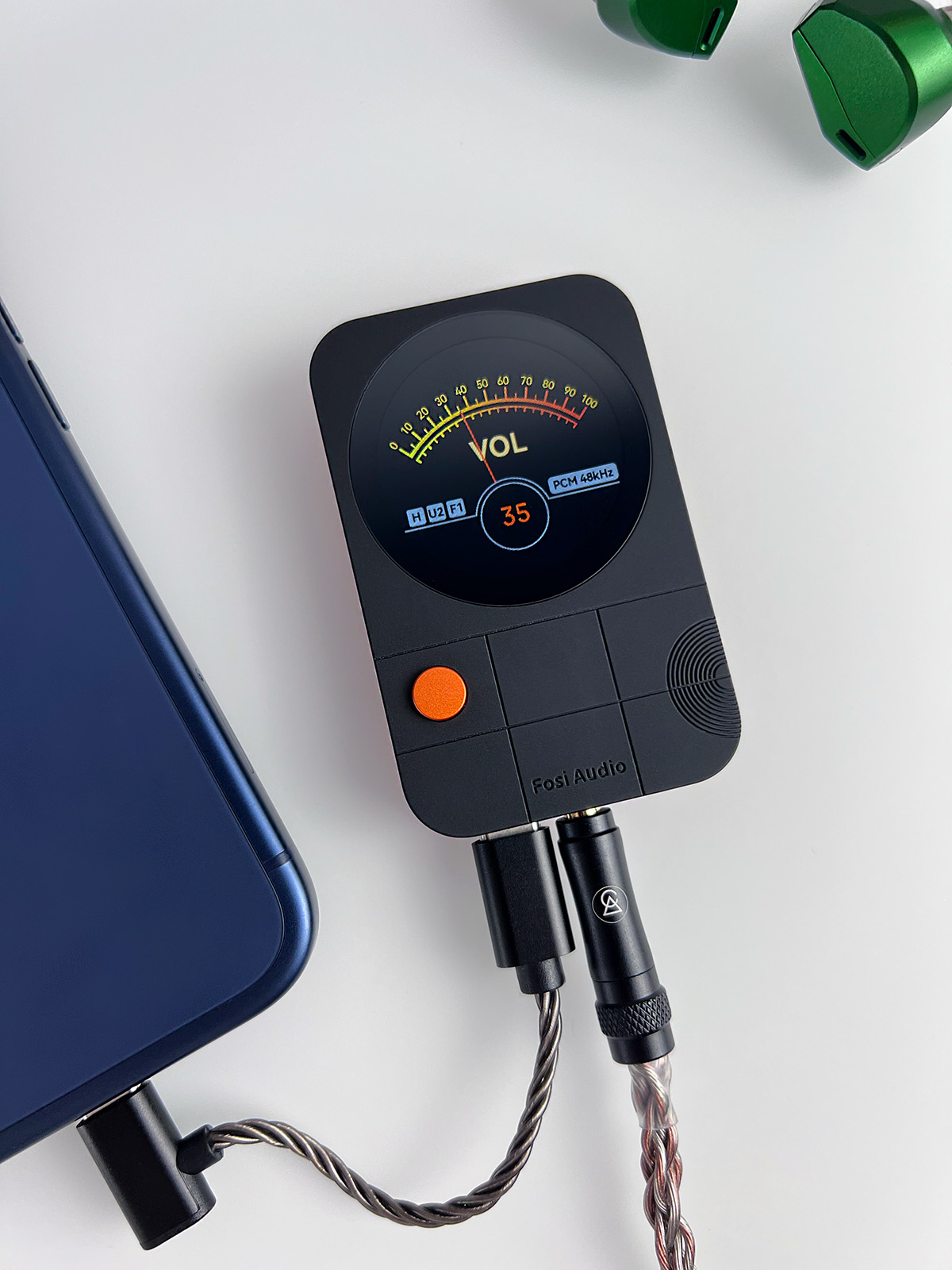
Although the MD3 works well with laptops, tablets and other devices, its design is clearly tailored to phone users. The integrated MagSafe magnets hold it securely to the back of a phone, creating a compact setup.
The dual USB-C design is one of the MD3’s practical features. The lower USB-C port handles the audio connection, while the upper port can be used for pass-through charging. This allows you to charge your phone without interrupting music playback.

Inside the Box
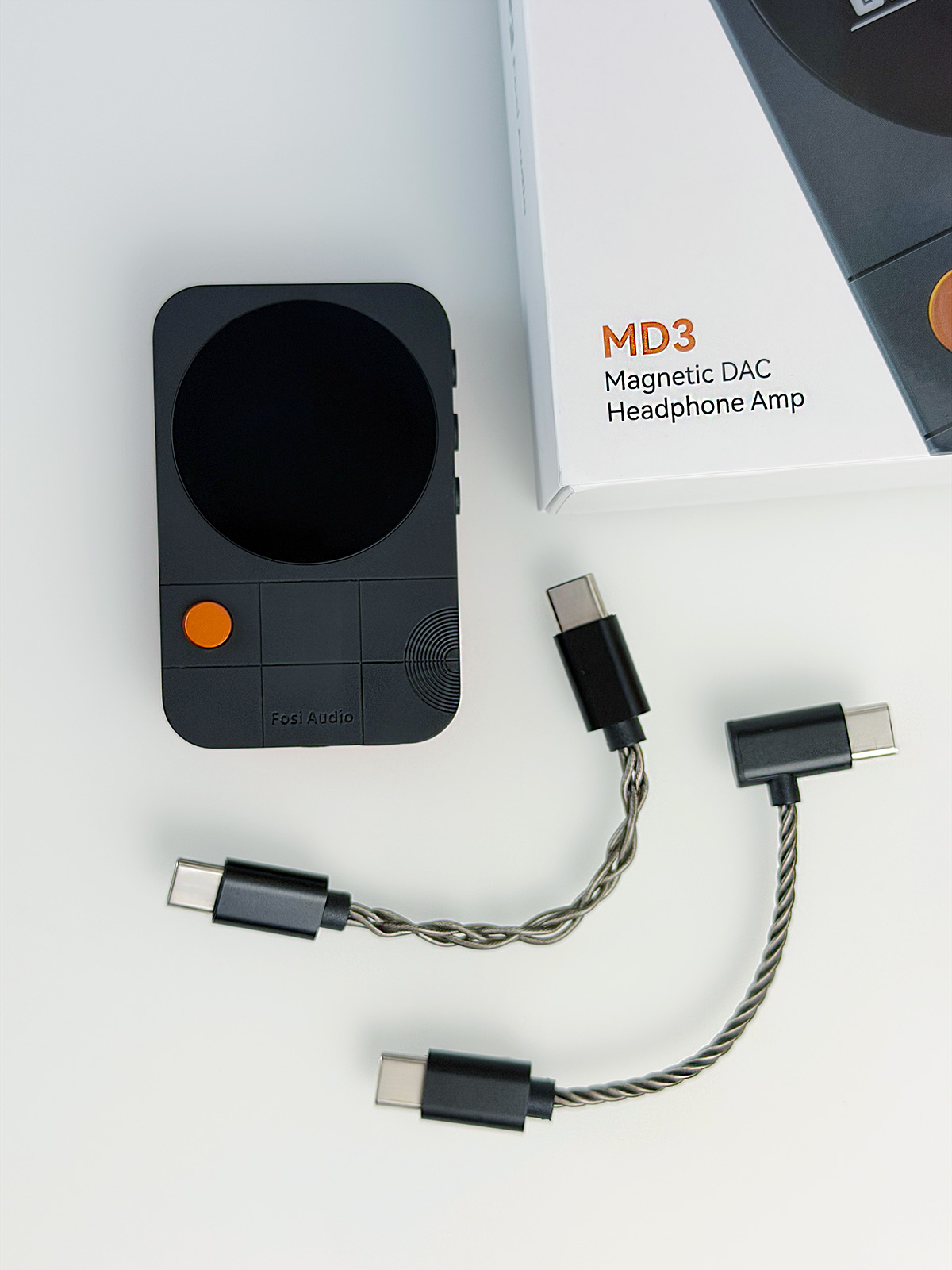
The MD3 arrives in a small compact box. Inside you’ll find:
- Fosi Audio MD3
- Braided USB-C to USB-C cable
- (extra) USB-C to USB-C cable with a right-angle connector
- USB-A to USB-C adapter
- Magnetic mounting ring for devices without MagSafe
- A quick start guide and user manual
Specs
- DAC Chip: ESS Sabre ES9039Q2M
- Amplifier Chips: 4 × ESS ES9603Q
- USB Audio Class: UAC 2.0 / UAC 1.0
- Inputs: USB-C (Top): Pass-through charging • USB-C (Bottom): Audio, Image Transfer, Firmware Updates
- Outputs: 3.5 mm Single-Ended, 4.4 mm Balanced
- Audio Format Support: UAC 2.0: PCM up to 32-bit / 384 kHz, Native DSD256 • UAC 1.0: PCM up to 16-bit / 48 kHz
- Output Power (1 kHz, THD+N <1%): 3.5 mm: ≥80 mW ×2 @ 32 Ω • 4.4 mm: ≥180 mW ×2 @ 32 Ω
- Frequency Response: 20 Hz – 48 kHz (±0.2 dB)
- Signal-to-Noise Ratio: 3.5 mm: ≥115 dB • 4.4 mm: ≥116 dB
- Dynamic Range: 3.5 mm: ≥115 dB • 4.4 mm: ≥116 dB
- THD+N: 3.5 mm: ≤0.00075% • 4.4 mm: ≤0.00084%
- Supported Headphone Impedance: 16–300 Ω
- Display: 1.28-inch circular colour LCD
- Weight: 50 g (±2 g)
- Dimensions: 70 × 45 × 12 mm
Test equipment:
Sound Quality
The MD3 has a clean and neutral presentation. It does not add warmth to soften recordings, nor does it introduce extra brightness to create the impression of more detail. It delivers a transparent presentation while maintaining a smooth and natural character.
The noise floor is exceptionally low. Even with highly sensitive IEMs such as the Campfire Audio Andromeda 10, the background remains completely silent, with no audible hiss. This not only benefits quieter passages, but also allows subtle details to emerge more clearly.
The frequency response is well balanced throughout. Bass is controlled, extends deep when required and delivers a satisfying sense of punch and dynamics without dominating the presentation. The midrange follows a more neutral approach. Vocals sound natural, instruments retain their own tonal balance and there is no obvious emphasis that pushes midrange further forward than intended. Treble extends well and remains composed, providing sparkle without becoming sharp. The soundstage has a good sense of width and depth, giving an appropriate sense of scale.
The MD3 also provides a selection of filters. The differences are relatively small. The slower filters produce a slightly softer presentation, while the sharper filters add a little more definition to transients. The differences are subtle, leaving the choice largely down to personal preference.
Overall, the MD3 offers a neutral tonal balance and an exceptionally low noise floor. Together, these qualities make it an easy match for a wide range of headphones and IEMs.
Listening impressions
The following tracks were selected to assess the MD3’s overall performance. Listening was carried out using a variety of IEMs and headphones to build a broader impression.

After listening to several tracks of the selected albums, the MD3 impressed with its clean and neutral presentation, but never analytical. At no point did it sound like a typical portable DAC. Whether playing orchestral music, jazz or vocal recordings, it remained consistently balanced, with a hint of smoothness.
Instruments and vocals sounded natural, with convincing timbre and a pleasing sense of realism. While the Sendy Audio Apollo Pro planar is capable of scaling with more powerful desktop amplifiers, it nevertheless proved to be a nice match for the MD3. Bass was tight and controlled with good impact, while the midrange and treble remained well balanced. The overall presentation felt natural and composed.
Hans Zimmer’s Interstellar is a demanding soundtrack, moving from quiet, atmospheric passages to powerful orchestral crescendos. The MD3 remained in control, keeping individual instruments well separated while delivering convincing dynamics and a solid, well-defined low end.
Sophie Milman’s ‘Make someone happy’ and Melody Gardot’s ‘My one and only Thrill’ both rely on beautifully recorded vocals and acoustic jazz instrumentation. Through the MD3, voices sounded natural and lifelike, while subtle details remained clearly audible without affecting the warmth and intimacy present in the recording.
Josh Groban’s ‘Gems’ is built around his powerful vocals, backed by a full orchestra. Even during more demanding passages, such as ‘All I Ask of You’, the MD3 kept both voices clearly separated from the accompanying orchestra. On Buika’s ‘En Mi Piel’, the emotion in her voice came across convincingly, capturing both the intimacy and expressive dynamics of her performance.
From large-scale orchestral works to intimate vocal performances, the MD3 consistently maintained the same sense of balance and control. That remained true regardless of which IEM or headphone we paired it with. The term “musical” has become something of a cliché, but it suits the MD3 well. Not because it adds warmth or smooths over imperfections, but because its neutral and balanced presentation allows each recording to retain its own character.
Conclusion
The Fosi Audio MD3 is a compact portable DAC that feels solid and well made, while delivering impressive sound quality. It delivers a neutral sound signature with an exceptionally low noise floor and plenty of power on tap. The MD3 is best suited to IEMs and most headphones. Efficient planars also paired very well, with no indication that the amplifier was reaching its limits.
The MagSafe design makes the MD3 particularly convenient when you’re on the move and the dual USB-C ports allow you to charge your phone while listening, a feature that many portable DACs still lack.
Taken as a whole, the MD3 leaves a very positive impression through its refined and neutral presentation, practical design and remarkable value for money. The Fosi Audio MD3 is an easy recommendation.
Pros:
- Neutral and detailed
- Low noise floor
- MagSafe attachment
- USB-C pass-through charging
- Clear display and intuitive controls
- High build quality
- 3.5 mm and 4.4 mm outputs
- Compact and lightweight
Cons:
- No Bluetooth support
- Draws power from the connected device
- Thicker than most dongle DACs